
There is a quiet moment that happens for many parents of medically complex children. It doesn’t come with an announcement or a clear turning point. It’s not when the diagnosis is given or when the monitors start alarming. It’s more subtle than that.
It’s the moment you realize that waiting—waiting for answers, waiting for direction, waiting for someone else to take the lead—might not be enough for your child.
For me, that moment came early in Luka’s journey. The most important thing I learned from that moment is this: you are allowed to ask for more—more support, more opinions, more clarity—even when no one offers it.
My 22-month-old son Luka, was born with prune belly syndrome, which caused kidney failure, respiratory failure, urological abnormalities, and cardiac issues. When he was born he was taken straight to the NICU, where everything felt urgent and overwhelming. Specialists rotated in and out. Plans shifted quickly. Conversations were filled with medical language I was still trying to understand. I remember sitting there, trying to absorb it all, trying to be “a good parent” in a system that felt bigger than me. But underneath all of it, there was a faint, persistent feeling: something was missing.
There was an evolving medical care plan for our son; but, emotionally, relationally, and holistically my husband and I were struggling. We were getting through each day, but we weren’t grounded in anything that could help us process what was happening or prepare us to make decisions with clarity. So I asked for help. This is when we were introduced to the palliative care team.
I will never forget the first time we met the palliative team’s nurse practitioner and physician at our Florida hospital. With a calm, gentle presence, they offered the support that I had sensed we so desperately needed. They quickly became one of the most important supporters in Luka’s journey. They were the bridge between everything we were feeling and everything the medical team was trying to do. They helped translate—not just medical language, but priorities.
They asked questions no one else had asked us:
What matters most to you right now?
What are you most afraid of?
What does a good day look like for Luka?
 In a system focused on interventions, they brought us back to values, and that changed everything. Instead of reacting to every new recommendation, we started making decisions through a clearer lens: does this align with what we want for our child? That shift didn’t just help emotionally—it improved how we engaged with Luka’s care team and how we understood the path forward.
But advocacy doesn’t stop at asking for support. Sometimes, it means confronting something much harder: what to do when trust starts to feel uncertain.
There was a point in Luka’s NICU stay where we lost trust in our medical team—not because of one clear mistake, but from a gradual unraveling. The confidence we once felt shifted into uncertainty as conversations became filled with “we think” and “let’s try,” instead of clear, decisive plans. Care decisions seemed inconsistent, providers offered differing opinions, and we often found ourselves piecing together Luka’s plan rather than being guided through it. I kept questioning whether this was just the nature of complex medicine; but deep down, it didn’t feel right. The hardest part was the internal conflict—these were the people keeping our son alive, and questioning them felt both uncomfortable and risky. But that instinct kept growing: we needed more clarity, more alignment, and more confidence in the care he was receiving.
Deciding to seek a second opinion grew out of the moment we realized that we couldn’t keep moving forward with so much inconsistency. Asking for that second opinion felt like crossing a line, and our son’s life hung in the balance. But connecting with a new care team also brought an immediate sense of relief—we were finally taking back some control. The process required persistence and advocacy in ways that stretched us, but ultimately led us to transfer Luka’s care to a different state entirely. It was a difficult decision, especially in the middle of a crisis; but it was an important turning point. Looking back, it wasn’t just about losing trust—it was also about learning to trust ourselves. In complex medical situations, parents don’t need to have all the answers, but they do need to listen when something doesn’t feel right and have the courage to act on it.
“Trust your gut” sounds simple; but in practice, it’s complicated. Your gut doesn’t always feel like clarity. Sometimes it feels like anxiety. Sometimes it feels like you’re the only one in the room questioning something, while everyone else seems sure. What I’ve learned is that your gut isn’t about having answers—it’s about recognizing when something doesn’t sit right and giving yourself permission to explore that further. For my husband and I, that meant asking hard questions. It meant slowing down decisions when we could. And eventually, it meant making one of the hardest choices we faced: changing hospitals.
A second opinion brought new insight. A new team brought a different approach. And slowly, something shifted—we felt aligned. Not because everything was perfect, but because we felt heard, included, and grounded in a shared understanding of what mattered for Luka. Twelve hours after the medical transfer, a new palliative team was there to greet us. They were new but familiar. Their open arms and hearts were there to hug us and hold us and listen while we cried, reliving all we had been through. They were ready to plan care conferences and help get us acquainted with our new team.
This is the part of advocacy people don’t talk about enough. It’s not always confident or clear. It doesn’t feel strong. Most of the time, it feels like fear mixed with responsibility. Because you don’t actually know if you’re right. You just know that you can’t ignore a feeling.
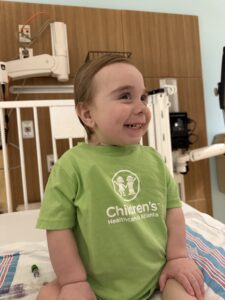 Today, Luka is six weeks post kidney transplant. He has survived four fetal surgeries, and 11 months worth of NICU and PICU stays. Right now he is sitting on the living room rug and flipping through Horton Hears a Who, bending each page as he grips them with determination. It’s such a small, ordinary moment—but for us, it represents everything we fought for. We made it out alive. And while that is something I will never take for granted, survival is only part of the story. There are still memories that stay with me—moments that don’t fade as easily as I thought they would. But when I look back, I don’t regret asking for more.
The experiences that shaped this understanding were not easy: recognizing when trust in our care environment was compromised, choosing to pursue a second opinion, and making the decision to change teams despite the uncertainty. Each of those moments required stepping outside of what felt comfortable; but, each one moved us closer to the care Luka needed.
If you are a parent in the middle of caring for a sick kid right now:
You are not asking for too much.
You are not overthinking.
You are responding to a situation that asks everything of you.
And if you are a clinician, please know this:
When a parent asks more questions, seeks another opinion, or requests additional support, it is an expression of how deeply they are trying to get this right for their child. Honor their tenacity.
I used to think good care meant finding the right team and following their lead; but now I understand it differently. Good care is collaborative. It’s built on communication, trust, and the willingness to pause and ask: Are we still aligned with what matters most? Because sometimes, the most important shift in a child’s care doesn’t come from a new treatment. It comes from the moment a parent realizes they are allowed to speak—and chooses to.
“I sense that it’s been a tough year,” the palliative care clinician stated at the start of our visit. He had clearly reviewed Sasha’s medical chart; or he could tell by just looking at her positioning and demeanor. It had been a tough year.
Sasha usually meets with palliative medicine once or twice a year, per their recommendation. In 2025 we cut back to an annual cycle because Sasha was doing so well. But just over a month ago I looked at Sasha, struggling to hold her head upright and sleeping more often, and I realized we needed to schedule a visit.
Palliative care supports the management of chronic or life-limiting conditions with significant disease burden. The specialty specializes in symptom management and the social-emotional impact of the condition on both the patient and the family.
I was grateful that Sasha was relatively robust and engaged on the day of our palliative care appointment. Just the day before she slept until nearly 1:00PM, but this day she was awake for most of the car ride and leaned forward from her wheelchair in the exam room to look directly at Dr. Wilson, listening to our conversation. I updated him on the past year and told him why I suddenly picked up the phone to schedule a visit. I shared that Sasha was now fully g-tube dependent, that she required three bowel medications daily, and that she was not experiencing her usual springtime rebound. This sunny time of year is normally a celebratory season for us all. Sasha is typically gaining energy and stamina with each lengthening day. But this year, she was still sleeping often. It felt worrisome. Things were progressing.
At my initiation, Dr. Wilson and I discussed what body systems I should expect to be managing later in Sasha’s disease progression. What additional medical equipment may enter our lives? Suction to mitigate secretions was something I anticipated, as well as possible oxygen machines like CPAP or BiPAP should apnea present. What else may be coming our way? Pain management tends to be the harrowing chapter, Dr. Wilson shared; and his team would support us if and when physical discomfort starts to arise. Then we turned our conversation to the social-emotional effects of Sasha’s disease progression.
I worry about my younger daughter. I worry about the impact that losing a child places on a family unit. I’ve started pondering Sasha’s legacy. I shared stories that day about how some of my fellow rare disease mom friends navigated their child’s later years. Each approached this stage very differently, in accordance with their individual personalities. Our provider shared names of colleagues who might be able to engage Child Life Specialist resources for Nika. He said he would get me a list of books that I might find helpful. And then he shared his insights into how to navigate legacy and memory making. Some families create bucket lists. We often talk about doing the big things you always wanted to do together with your loved one, like going to Disney. Other times, and more realistically, it may be simple time spent reminiscing and sharing joy, sitting on the couch together and going through photographs.
I thought about what he was saying. Quality and quantity of time are both unknown, for all of us really. I felt divided by the number of ways our family could and should spend time with Sasha. Do we want to keep chipping away at all of the big Bucket List items, or should we pivot? I looked over at Sasha, her leftward leaning posture fixed and pronounced. Does she just want to enjoy the flowers in our yard and sit in the sunshine together? Or should we be jetsetting? Perhaps I need to shift my thinking to include listening to the birds as time brilliantly spent.
We then turned the conversation to end-of-life planning, and this is when Dr. Wilson’s wisdom really shone. He suggested I start thinking about the involvement I wanted Nika to have when her sister’s end of life nears. Is Nika comfortable talking about death? Does she know what death means? Does she use that word? What were our personal philosophies? I told him I wasn’t sure. I didn’t know what type of funeral I want for Sasha. I didn’t really know my husband’s preferences either.
The only concrete idea I had was about a burial place. I shared with Dr. Wilson my recent discovery of a newly developed green burial space in our state, the first of its kind, and how that resonated with me the most. It is near the mountains that Sasha and I frequented years ago and very close to our former home in the north. I knew certain, upon reflection, that location for her final resting place felt like home. But then I found I was struggling with what our family might think. This would be a non-traditional choice, and it was over an hour’s drive away. Dr. Wilson then revealed an idea that I know will support me through many of my decisions and days ahead. “Whenever I find myself thinking I should do something,” he said, “I ask myself if I want to do that something. Who am I making this decision for? Is it authentic for me or is it because I should do it to conform to societal expectations?”
Together we reflected on some of the decisions some of my friends have made as rare disease moms, and how much I respected them because they were authentic choices. Some parents chose not to have a funeral and kept things very private. Some parents employed a prolonged pause, waiting before letting the world know of their child’s passing altogether. Some held services where loved ones flew in from all over the world to enormous places of worship. To me all of it felt so very right—specifically because the actions were so authentic and deeply personal. It seems these moms did not let concerns about outward appearances or pleasing others impact these important choices. As long as the decisions I make moving forward are the ones I want to make, not ones I’m making because I should make, then that internal guiding wisdom will not fail me.
I do not know how Sasha felt sitting in that conversation beside me, though I wish I did. At one point I noticed Dr. Wilson paused as a look of both concern and curiosity washed over him. He gazed at Sasha and appeared to want to say something. It is both beautiful and challenging that palliative appointments are not scripted. While a loose checklist of topics to cover is helpful, letting the conversation evolve organically can be even more beneficial. But I don’t think we missed our opportunity to ask Sasha how she felt hearing us discuss end-of-life topics. I know in my heart that we opened the door for future discussions for me to have with her privately while sitting beside her at home.
After visits like the one we just experienced this spring, I have a deeper appreciation that palliative care is as much a resource for the caregiver as it is for the patient. We have met with multiple palliative care providers over the years, knowing intuitively that a good match in communication style is paramount in this specialty. To feel fully seen and aligned as a team member with palliative medicine are of the greatest gifts in helping navigate what can feel like an infinite abyss of uncertainty and unknowns. The world of medically complex parenting is never straightforward, but a provider who takes the time to impart wisdom and guide choices is a form of solace I wish for everyone. It is a gift that stays with a family long after the appointment ends.
 Joanne Huff comes to Courageous Parents Network as a long time follower and parent enthusiast of the organization. As the Mother of two girls, the oldest of whom has the rare disease MPS IIIA/Sanfilippo Syndrome, Joanne has benefited tremendously from the intimate parent interviews and candid, vulnerable story sharing throughout numerous thought provoking blog posts. As her daughter’s activities and lifestyle started to slow down with disease progression, CPN became a larger anchor in times of uncertainty and unrest. It is through this lens that Joanne hopes to share experiences and insights via the CPN blog.
Joanne completed nursing school after her daughter’s diagnosis, receiving her Bachelors of Science in Nursing from Plymouth State University, Plymouth NH. She enjoyed community liaison work with home care providers of adults with special needs up until her own daughter’s care became increasingly more involved. In addition to serving on the Boards of New England Regional Genetics Group (NERGG) and Adaptive Sports Partners through 2024, she has found great purpose in volunteer work advocating for policy improvements and change in Washington DC with the National MPS Society. In her free time, Joanne seeks balance and refuge with yoga, hiking and performing as an ensemble Soprano vocalist with the Pemigewasset Choral Society. When not blogging for CPN, Joanne enjoys sharing offerings on her personal Blog Folding Origami for God. She resides in Bow New Hampshire with her two daughters, Sasha and Nika, her husband Mike and her yellow lab Suki.
Four Practices for the Parent Who Cannot Stop Searching
Caregiver parents know a desperate kind of searching. It begins with a midnight symptom search and quickly devolves into a need for relief from the discomfort of not knowing. Psychologists call this Deprivation Curiosity: the kind of curiosity driven less by genuine interest and more by compulsive anxiety, where unanswered questions begin to feel unbearable, like an unreachable itch.
This itch has ramifications. It loosens our critical filters. We treat anecdotes like data and find patterns everywhere, even when they are not really there, a phenomenon called apophenia. Eventually, the need for answers hardens into a mask of certainty. We grip a diagnosis or prognosis not because the evidence holds, but because uncertainty itself feels impossible to hold. We cannot bear to let our conviction go. Our anxiety learns to wear a false face of conviction.
Underneath all of it runs the more insidious belief: that not knowing means we are failing our children. That a good parent must be relentless in their search. That to leave a question open is tantamount to denying the presence of a wound we would be obligated to close.
At some point, if you search long enough and honestly enough, the searching breaks down into what is called aporia, which translated literally, means roadlessness. It’s a sense of directionlessness that comes from the realization that effort, even when applied correctly, does not always produce certainty. The standard response to aporia is despair, or a redoubling of your search efforts. But a particular philosophy known as Pyrrhonianism offers another possibility. Instead of forcing certainty where none exists, it suggests that a deliberate suspension of judgment, learning to stay open to uncertainty, was not only a more rational reaction but one that would lead to peace. They encourage fostering a willingness to examine reality openly without demanding that it close around our judgments of that reality. And what followed, the ancient philosophers reported, was ataraxia, a state of being unperturbed, a tranquility that arrives not as a reward for finding the answer but as a consequence of releasing the grip on needing one.
This is the shift from Deprivation Curiosity to Interest Curiosity. You seek because the inquiry is inherently interesting, not because the ignorance is intolerable. Someone who can do this successfully is known as a zetetic, from the Greek zetein, to seek. For the zetetic, the inquiry is the point.
None of this is easy to practice. Knowing the difference between Deprivation Curiosity and Interest Curiosity doesn’t automatically move you from anxious searching to open inquiry any more than knowing what hunger is stops you from reaching for the nearest snack. This reorientation is slow and messy, often bogged down by our expectations of what we believe we owe our children and ourselves. It isn’t easy, but it is possible to practice.
One framework is NEWS:
Notice what we are thinking and what we are doing
Examine the judgements you are making
Wonder about the reality of the child in front of you, rather than the story your anxiety is telling you
Surrender to the unknowing
Notice
I have started more Google searches than I would ever reasonably be able to finish. Not only due to the limitations of time and space, but because what I’m seeking may not exist. What has helped me the most with these doom spirals is to pause, right in the middle of the search. Not at the end, not when you’ve finished the thread, in the middle, the moment you start to feel your eyes strain, while the tabs are still open and the itch is still active. Ask yourself: Am I seeking an attainable truth, or am I looking for relief from this anxiety?
You don’t have to answer it immediately. You don’t have to stop searching. The question alone introduces a small gap between you and the momentum of the scroll, a half-second of observation that didn’t exist before. Sometimes you will find that you are genuinely investigating, following a thread because it is interesting and the answer might actually help. Sometimes you will find that it is two in the morning and you have been reading the same forum for an hour and you are not looking for the truth anymore; you are looking for someone to tell you it will be okay. Both answers are honest. Only one of them is the itch.
Examine
Sometimes I wonder whose side my mind is on. I will take some small inconvenience and build it up into a great, sprawling, impossible nightmare of an obstacle. The Pyrrhonists observed that much of our suffering comes not from circumstances themselves, but from the labels we attach to them. We do not just encounter an outcome; we encounter an outcome we have already decided is bad, bad in itself, bad by nature. And once something is bad by nature, it must be fixed, avoided, or solved. The search becomes urgent because the alternative is intolerable.
I’m not talking about unfounded optimism. I’m not saying you need to reframe all your pains as pleasant. And I’m definitely not saying that the diagnosis doesn’t matter, or that everything happens for a reason. What I am saying is to question whether the outcome you are fleeing is actually, inherently, necessarily as catastrophic as the itch is insisting it is. Feeling bad about your reality is not the same as your reality being bad. Not every unanswered question is a crisis. Not every unnamed thing is a threat. Some of them are just…unknown. And unknown, on its own, is not the same as bad.
When the urgency loosens even slightly, the search changes character. You are no longer fleeing something. You are, perhaps, just looking.
Wonder
I have caught myself mid-scroll realizing I could not tell you what she did that morning—what made her settle, what her hands were doing. I had been looking, but not at her.
I now make an effort once a day, as often as I can manage it, to look for something about my child that has nothing to do with her diagnosis.
Not her symptoms. Not her therapies. Not what she can’t do yet or what we are still waiting to understand. I train my attention on something else entirely—the way she tracks a sound, what she does with her hands when she is content, the specific quality of her attention when something catches it. This is the texture of who she is becoming that has nothing to do with any of the search terms I have ever typed.
In encouraging you to do the same, I am by no means suggesting that you bypass the hard work of acknowledging their medical complexities. This is not denial. It is refusing to let the medical framework be the only framework, refusing to let the problem-solver’s narrow field of view be the only view available. Our children are not diagnoses with humans attached. They are unrepeatable, exceeding any label, perpetually more than what we know about them.
Surrender
Journaling has been a part of my life almost since I learned to write, and recently I’ve started writing down all the things that I don’t know. I like a good old-fashioned notebook with a pen. There’s an intentionality that comes with the ink and a reminder that comes with my smudged left hand, but a note on my phone works too. And yet I tell myself it requires time and space that I just don’t have. Deep down I know that’s a deflection of the real struggle.
The real struggle is in what to write. Creating a list of the things you are comfortable not knowing sounds easier than it is. Not the things you have given up on. Not the things you are pretending not to care about or wish you didn’t have to think about. Write the things you can actually hold open, with some degree of equanimity, as questions that don’t yet need to close.
It will probably be a short list at first. That’s fine. The point is not the length of the list. The point is the act of naming the open questions as open questions. Celebrate these as open doors for future inquiry rather than gaps that need to be filled immediately. The Pyrrhonist in you knows that the unanswered question is not the end of the road. Perhaps we should replace the question mark (?) with an ellipsis (…), to transform the nature of the query, and leave your curiosity open.
And some of what you write there, you may find, has been waiting a long time to be set down somewhere that isn’t a search bar.
The itch of Deprivation Curiosity will return. The tabs will multiply. The doom spiral has a way of finding you in your weakest moments. But in between those moments there is a child in front of you, becoming someone, right now, in ways that no search engine will ever be able to index. These practices of Interest Curiosity are just small ways of making sure you don’t miss it.
 Stephen Hager goes by his second middle name (he has three), Bud, because it’s easier to remember and baristas never misspell it. Along with his wife he is a caregiver for their 8-year-old daughter, Emma, who has pachygyria, a rare neurological disorder. He believes in taking an active approach to advocating for his child and others like her. To this end, he sits on various advisory councils at Children Hospital of Orange County (CHOC), volunteers on consulting and directing boards for various non-profit centers and lends his writing skills where he can. Experiencing a lack of support for parents of medically complex children, Bud founded a support group through CHOC focusing on parent-to-parent interaction. He is also a professor of psychology and has a small private psychotherapy practice.
“Dear Nymeria,
I see you in everything, everywhere I go, everything I do – your face is there, little reminders everywhere.
I don’t think a minute goes by that you’re not on my mind. I don’t know how to accept that the most perfect little girl, the happiest girl I have ever known, is just gone. I want you here so badly, but I’m trying. Nymeria, I just miss you so incredibly much.
Until I see you again, I will continue to live my life in hopes that you are looking down, smiling. And until then, I will write to you.
One day closer,
Love, your mom”
The emptiness in our house and in my calendar is a reminder that my daughter is gone; yet I can still feel her presence here. Since her passing, I have been writing letters to her to fill the ache in my heart and the void in our house.
“Sweet Nymeria, I am writing you into our life. I’m writing letters to heaven.”
During the day and sometimes in the middle of the night, I write to Nymeria in various ways – using the notes app on my phone, a pen and my journal, or typing up and printing out my thoughts. The most cathartic aspect is being able to express my feelings without fear of judgment. My letters to Nymeria are raw and honest, detailing my emotions and experiences. Leading up to her burial, I put pen to paper and wrote.
“I picked out your first outfit; I shouldn’t pick out your last. Today I delivered your dress, shoes, hair pin and nail polish to the funeral home. You’re going to look so beautiful. You always do. I know you’re going to love what I picked out for you. You get to wear heels – your very first pair. I wish you could have danced here on earth. I hope you are dancing with the angels.”
Only in the privacy of writing to her could I find my way through the difficulty of saying goodbye. The whole family is finding ways to say goodbye. It’s challenging grieving while also parenting Nymeria’s surviving siblings. I have found writing helpful in this way too. I have penned letters from the perspective of others – Nymeria’s father, brother, and sister – honoring their reactions and emotions. Sometimes I share these letters with them, other times I do not.
Writing letters has allowed me to feel connected with Nymeria, sometimes more connected than I felt in the final weeks of her life. In the days leading up to her death, I struggled to be mentally present due to my overwhelming anticipatory grief. As her oxygen levels fluctuated dangerously low, I was caught up in worries – Is this the end? How will I let her go? Eventually, I found the strength to tell her that I would be okay (although it did not feel possible I would ever be okay again). It was then that I made a promise to Nymeria – I will meet you in heaven.
I have come to realize that in heaven time must function differently, not chronologically. Nymeria is in heaven now; but she is not alone, searching for me. Instead, when she looks for me, she will find me, because someday I will join her. I end each of my letters the same way – “One day closer, my love.” Please do not misinterpret this. While I am heartbroken, I am still committed to living my life and loving her siblings here on this earthly plane. So for now, the best I can do to stay connected to Nymeria is write letters to heaven, because that is her new address.
There is the motherhood we expected; and then there is the one we actually get and live. This Mother’s Day, three Courageous Parents Network team members—each currently parenting a child with medical complexity—share what it means to mother in a reality shaped by intensive caregiving and uncertainty. Their reflections hold the stretch, the weight, and the quiet, enduring devotion of this parental journey. To all of the beautiful powerful (seemingly) tireless mothers in the Network, we wish you a Happy Courageous Mother’s Day. Enjoy these honest reflections.
______
“I’m a mother, but too often I have to remind myself to feel like one. Instead, out of necessity and without formal training, I have to be my son’s care coordinator, social worker, administrative assistant, advocate, personal care assistant, and unskilled nurse. I’ve learned so much and gained these skills because I became a mother of a child who needed me to fulfill those roles. But in the daily struggle to meet his needs, I’ve lost the simple, grounding feeling of just being ‘mom.’ My goal, for this mother’s day, is to lean into doing the activities with my child that quench and quiet the yearning in my core to feel like a mother, nothing else. I want to enjoy motherhood, not endure it.”
Naomi Williams CPN Associate, Social Media
______
“For most of my life, Mother’s Day was something I showed up for on behalf of others. I celebrated with my mom, who I’m incredibly lucky to have and who remains one of my closest friends. Meanwhile, I quietly carried my own grief alongside the joy. I had always dreamed of being a mom, and for a long time I wasn’t sure that would be part of my story. On my first Mother’s Day, I was pregnant with Owen, still unaware of his prenatal diagnosis. That day felt full of possibility—daydreams, hope, even a few happy tears. I remember a deep sense of peace, holding onto what might be, without yet knowing how profoundly motherhood would reshape me.
Now, as Owen’s mom, Mother’s Day is both everything and not quite what the world imagines it to be. He is the best. Being his mom is the greatest gift of my life. And yet, the day doesn’t look like the days I shared with my mom when I was a kid. There’s no breakfast in bed or handmade cards, no getting dressed up and heading out for brunch. Instead, I hope for a good day—for Owen to feel well, and for the caregiving load to be a little lighter for both me and my husband.
A mentor once shared something that has stayed with me: our medically complex children look to us with the same depth of need and connection as a newborn looks to their mother—not to diminish who they are, but to honor the intensity and beauty of that bond. It’s deeper, more constant, and profoundly meaningful. So, with that framing, while Mother’s Day may still sometimes feel like a day for others, I know I get to celebrate being Owen’s mom every single day. Every bit of it—the love, the exhaustion, the literal blood, sweat, tears, and yes, even poop—is worth it for the privilege of being his mother.”
Lindsey Topping-Schuetz, CPN Associate, Parent Champion
______
“This Mother’s Day, I’m starting the day with a nice, long stretch. My son’s body depends on my care; and he has recently gone through a growth spurt. I’m achy from caregiving. I need to stretch more.
But this version of motherhood has stretched me in more important ways. I’ve had to stretch my perspective to see small gains in his coordination and communication as monumental to his development. I’ve expanded my understanding of what a joyful life looks like. I’ve enhanced my creativity to make play possible in therapy gyms and hospital beds. I’ve broadened my thinking from focusing on afterschool activities to weighing decisions about surgeries, quality of life, and how our whole family copes best.
So yes, I need to stretch physically. But more than that, motherhood has stretched me well beyond my original, expectant capacity. I am still a mother, stretched and still stretching.”
Laura Will, CPN Associate, Story Curation
I’ve always used social media as a mental getaway. Until recently, I wasn’t someone who felt drawn to share my life publicly or curate it like the accounts I followed. I scrolled through posts for entertainment primarily. It all felt distant from who I was, so I never had a desire—or a reason—to participate in that way.
When I found out I was pregnant, I started following other mothers—watching their journeys through pregnancy and early motherhood. But not long into my own pregnancy, I realized my path wouldn’t look like theirs. Following an abnormal fetal ultrasound at 19 weeks, I knew this wouldn’t be a typical motherhood experience.
All of a sudden, I didn’t see my life reflected anywhere online. And for a long time, I thought that meant this atypical journey wasn’t meant to be shared.
I deeply craved connection, especially with other mothers navigating medical complexity; but I was afraid. Fearing judgment, misunderstanding, or unsolicited opinions about deeply personal medical decisions, I worried about how my daughter would be perceived. Privacy felt like protection. It felt like the safest way to shield something that was still so tender.
But over time, that same privacy became isolating.
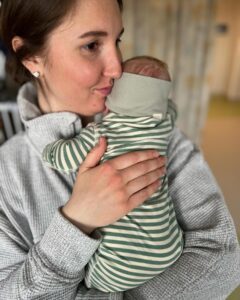 I feared how others might see my daughter. I feared assumptions about her differences, and about me as her mother. My heart was tender. I was quietly grieving the version of motherhood I had once imagined, while also longing to connect with others who understood this unexpected path.
For a long time, I held both of those truths privately.
It took me over a year to feel ready to let even a small part of our story be seen publicly.
I didn’t start sharing because I felt confident. I started sharing because I felt alone. Eventually, my desire for connection outweighed my fear.
I began small. During a family weekend away, I documented what tube feeding looked like outside of our home. I shared during Tube Feeding Awareness Week—something personal and vulnerable, but not our whole story.
The response surprised me.
Some messages came from mothers walking a similar path, finally seeing themselves reflected. Others came from people who wanted to learn and better understand. And some were simply quiet expressions of support from people I hadn’t heard from in years.
Through that, I began to find a sense of connection.
The most meaningful connections haven’t come from likes or comments. They’ve come from private messages that say, “This feels like my life too.”
The community I have found isn’t loud—it was deep, real, and often private. It looks like DMs, text messages, and shared understanding. It looks like celebrating inchstones instead of milestones. It looks like connecting with other mothers and even medical professionals who understand both the clinical and lived experience of this kind of motherhood.
It looks like not feeling so alone.
But social media hasn’t been entirely easy.
As I began sharing more, I also felt a new kind of pressure—the internal question of “Should I film this?” or “Should I share this?” It started to pull me out of the moment and into documentation. My screen time increased. My mental load grew.
There are still days when it feels overwhelming—when I want to step back, delete the apps, and just be present without the noise or comparison. Sharing your story doesn’t mean it becomes natural or easy. I didn’t start sharing to build a platform or turn this into something bigger—I started sharing to build connection. And I’m still learning how to protect that intention.
Over time, I’ve found more of a middle ground. I no longer share to keep up—I share when it feels meaningful. I’ve shifted from obligation to intention: connection over performance, meaning over metrics.
I don’t share everything, and I don’t only share the good—but I share with purpose, because I want to help others feel less alone, create space for stories that don’t fit neatly into categories, and gently challenge assumptions while reducing stigma around children and families living different kinds of lives. I share to build the kind of community I once searched for. And maybe, by sharing a little more of our real lives, we can make that in-between space feel just a little less lonely.
I was certainly late to the party. It wasn’t the first time, but this particular soiree had consequences. Some doors don’t stay open forever. Too late, and you don’t just miss the moment, you lose the chance entirely. And that finality, that reality, could really sting.
For me, the “party” would be having another child. I experienced a decades-long internal debate of whether or not to expand our family after Sasha. During the years that it was more or less expected of me by society to be growing our family, many well intended individuals asked, “Do you plan on having another one?” My answer never needed much prompting. No, I did not intend on having more children.
Sasha has a rare genetic condition known as Sanfilippo Syndrome. From logistical to emotional, there were a wide range of reasons why Sasha should remain an only child. Primarily, as someone who tends to be mentally scattered in many different directions, it felt like an insurmountable task to add an additional individual who would be dependent on me for their survival and wellbeing. I felt capable and competent in caring for Sasha, because it was solely Sasha. There was a balance in the scheduling, transporting, caring for and worrying about one child. Any hiccups or new medical events weren’t as overwhelming because I did not have another individual to schedule, transport, care for or worry about.
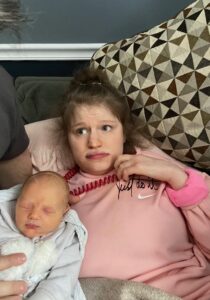 There were other reasons too. Namely the realization that bringing another individual into the world meant that a child, however young and tender, would ultimately endure the death of their sibling. Despite having no idea who this imaginary child might be, it absolutely broke my heart just thinking about that scenario. If I could minimize the rippling effect of that loss – let it end with me and Sasha’s dad – perhaps that would be one small victory in an avalanche of sadness.
When Sasha was three years old, her dad and I split up. Two years later, when I met my now husband, I told him that I did not intend on having more children. That declaration of decisiveness gave me a sense of control. This also meant I could dodge the guilt-ridden feelings I knew awaited me if I was not completely dedicated to solely Sasha. He understood my position, though I’m not sure he held it himself; and so we moved through life for a few years without concerns about family planning.
Sasha’s diagnosis was discovered during this time, which had me doubling down on my position. Sanfilippo Syndrome is autosomal recessive, only resulting from two copies of a faulty gene, each inherited from a parent. The fact that my second husband did not have this faulty gene erased the concern of having another child with the same condition. Any child with my second husband would only have the possibility of being a carrier of the condition, as I am. Regardless, I had chosen to avoid all potential outcomes, and simply care for Sasha.
But something happened when I turned forty. We had just bought a home and were settling into a rhythm, when my husband suggested we start a family. I was stunned. Yet for some unknown reason I thought, “Why not?” I was forty after all, and I knew the chances of getting pregnant were low. When I got pregnant, I was stunned once again, and then even more so by the rollercoaster of an early miscarriage mere weeks later. How sad the whole ordeal actually made me was what shocked me most of all. What if I had been wrong all along? I was being practical all those years, adamantly insisting that one child was manageable. What if, in my pragmatic attempt to control the outcome of loss for another sibling, I had lost sight of the fact that none of us can really control any outcome? I realized I might miss the party, while maintaining my calmer, cleaner, simpler calendar.
In that brief conversation initiated by my husband, we changed course and fully committed ourselves to expanding our family. After struggling to get pregnant a second time naturally, the harrowing and complicated journey known as in vitro fertilization (IVF) began. We had been given low teen percentile success rates with each IVF cycle. By age forty-two I’d had two failed rounds of reproductive endocrinology interventions and was encouraged by my provider to consider other options. We were at the end of the road – a road I wasn’t so sure I should be on in the first place; but one I so desperately wanted to return to only to learn that all the on-ramps had closed. After two years of evaluating the myriad of emotions that come with closing a door to what could have been open if I’d been punctual, I finally shut that door for good. I was back to my original plan. Sasha would not have a sibling to change her life’s balance. We would not feel the burden of juggling too much, and a sibling would never know the pain of losing Sasha. It all finally made sense. A full circle closed, and I felt a sense of restored peace.
I wish I could adequately convey my shock then when I found out I was pregnant the day after my 45th birthday. My birthday itself started out pleasant enough – sunshine blazing, vibrant summer greens around our front porch and clear, electric blue skies. Yet I did not know why I felt so incredibly off. I forced myself to go for my usual run, despite my feet feeling like cinder blocks. I made myself finish my morning coffee, even though it brought little joy. I ate voraciously, yet had no interest in a celebratory birthday margarita that night. It was all so atypical. The next morning, when my morning coffee was still incredibly unappealing, it gave me reason to pause. There was no way… was there? I was far too old at this juncture, but what else could it be? The mere idea of a pregnancy test felt slightly embarrassing, but I still had some (very expired) test sticks from the IVF chapter a few years before. The strip immediately came back positive. What an ugly joke. I recalled the spreadsheet of success rates given to me in an educational IVF brochure a few years back. At forty-five, I now had a paltry 3-5% chance of a “live birth” resulting from a natural conception. There was no way this would be successful.
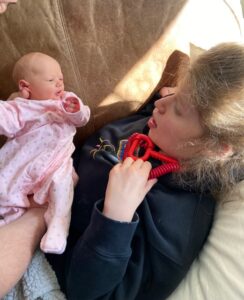 Despite the nine-month saga of a high risk geriatric pregnancy during a pandemic, lo and behold a 6 lb. 14 oz. baby girl was born via cesarean section on February 27th 2021. It is difficult to encapsulate that day, or those weeks or months that followed. The adjustments, the worries, being a novice all over again. Not knowing what milestones to expect with a healthy, typically developing baby. Was she in fact a healthy, typically developing baby? What I did know was that having the choice taken out of my hands was perhaps the only way for this newly expanded family to ever launch.
We are five years in, and I can now say what an extraordinary thing it has been to get to hear one of my children call me “Mommy.” Nika’s health has offered some healing. And yet, I now experience anticipatory grief for Nika. I am fearful about the day when she learns her sister has a terminal diagnosis. I wonder how she will learn that news. I feel in my heart that she should learn that revelation from me. While I am forthcoming answering Nika’s questions, such as why Sasha no longer does something she sees her once doing in an old photograph, I am not sure if Nika senses what that foreshadows. I have not yet broached the issue of Sasha’s impending mortality.
Fellow rare disease moms I have spoken with have, understandably, varying viewpoints on how and when to bring this topic up with a sibling. Some chose to let it develop organically, others opted to be proactive and initiate the discussions. Genetic counselors and palliative care providers are a tremendous resource as we approach these discussions. No choice is wrong. As long as we can be honest with ourselves, then I think we’re doing right by our children.
In this burgeoning era with Nika, I live in an entirely new world, as does Sasha. I see how much of a priority Nika has become, and I witness daily how Sasha is often second in line in my attention. I am hyperaware that these past five years would have looked so different for Sasha had we remained on the original path. But I am also aware of the energy and joy Nika has brought into Sasha’s world – this tiny powerhouse who performs dance routines, gymnastics shows, and belts out “let it GOOOO” for her every single day. I am in awe of how much Nika loves the beauty of trees, just like Sasha always has. I can still envision Sasha, at the onset of each spring, gazing up at the branches high above her. In my memories, she is beaming, smiling so broadly. Today, Nika asked me to pull the car over to the side of a tree-lined road so she could actually hug one. They have shared love, facial expressions and a shared language, even without words. Yes, it is hard, every day – the scheduling, transporting, caring for and worrying about two dependent children instead of just one. One child is medically complex and deserves more from me than I can always give her. The other I so deeply wish could play with her sibling the way the neighborhood kids play with theirs. I hope that none of us will ever have to endure the loss of Sasha. But every day leading up to that inevitable day, and all the days before it and after it, I will feel lucky that there was more love than I knew how to plan for, that our family grew beyond what I thought I could hold.
Joanne Huff comes to Courageous Parents Network as a long time follower and parent enthusiast of the organization. As the Mother of two girls, the oldest of whom has the rare disease MPS IIIA/Sanfilippo Syndrome, Joanne has benefited tremendously from the intimate parent interviews and candid, vulnerable story sharing throughout numerous thought provoking blog posts. As her daughter’s activities and lifestyle started to slow down with disease progression, CPN became a larger anchor in times of uncertainty and unrest. It is through this lens that Joanne hopes to share experiences and insights via the CPN blog.
Joanne completed nursing school after her daughter’s diagnosis, receiving her Bachelors of Science in Nursing from Plymouth State University, Plymouth NH. She enjoyed community liaison work with home care providers of adults with special needs up until her own daughter’s care became increasingly more involved. In addition to serving on the Boards of New England Regional Genetics Group (NERGG) and Adaptive Sports Partners through 2024, she has found great purpose in volunteer work advocating for policy improvements and change in Washington DC with the National MPS Society. In her free time, Joanne seeks balance and refuge with yoga, hiking and performing as an ensemble Soprano vocalist with the Pemigewasset Choral Society. When not blogging for CPN, Joanne enjoys sharing offerings on her personal Blog Folding Origami for God. She resides in Bow New Hampshire with her two daughters, Sasha and Nika, her husband Mike and her yellow lab Suki.
On Practical Wisdom as the Art of Excellence
“For the man who is truly good and wise bears all the chances life becomingly and always makes the best of circumstances, as a good shoemaker makes the best shoes out of the leather that is given him.” — Aristotle, Nicomachean Ethics I.10
The alarm goes off at 2:47 AM. Not the clock but the pulse oximeter, which is a different animal entirely. My wife and I are moving before we are awake, a choreography so practiced that our bodies have memorized it faster than our minds have. Check the probe. Check her color. Check the rise and fall of her chest against the ventilator’s steady rhythm. My child is fine. It was a positional issue and the probe shifted on her toe. We resettle her. We resettle ourselves. The monitors quiet. The house resumes its mechanical breathing.
We lie back down. Neither of us sleeps.
In the dark, I find myself doing what I often do after the adrenaline has no more work to do: I begin to think through the night’s decisions. Did we make the right call? Should I have checked her temperature as well? What if it wasn’t just the probe? Was I too slow, or was I, in fact, exactly the right speed? This is not anxiety, or not only anxiety, but something more deliberate. It is a practice I did not choose so much as grow into, the same way a callous forms by repeated contact with rough material.
The ancient Greeks had a word for this practice. They called it phronesis. We translate it, a little flatly, as “practical wisdom” or “prudence,” though the philosopher Aristotle meant something far richer. For him it is the cultivated ability to perceive what a situation actually requires, and to act accordingly; not from rule, not from habit alone, but from a deep, seasoned attentiveness to the specific gravity of this moment, with this child, in this particular kind of dark.
If you are a parent of a medically complex child, you are already practicing phronesis. You may not have a name for it; but you know it.
Practical wisdom is not expertise in the clinical sense, though it can include clinical knowledge. You may have learned about the half-life of the rescue medication, the therapeutic index for various seizure meds, or the subtle differences between voltage-gated sodium or voltage-dependent potassium channelopathies. That knowledge is often necessary and always hard-won. But it is knowledge of universal facts that hold steady regardless of circumstance. Phronesis is different. It operates in the territory that textbooks cannot reach, the territory of particulars. Particulars like the specific quality of the cry that precedes a tonic-clonic, or the three-second window before a coughing fit becomes a desaturation.
Emma does not seize the way much of literature describes. She does not pale before; she flushes first and pales after. She does not stiffen first; she goes quiet. The monitors may say she is stable when, if you know her, you can see—by the particular set of her jaw and the way her hands are clenched—she is not okay. Something is building. This is not instinct, though it can look like instinct from the outside. It is the accumulated, deliberate act of paying attention over time. It is the eye of experience. And it is, in the fullest sense, a form of practical wisdom.
The practically wise parent recognizes that no protocol covers every situation because luck, that indifferent variable, regularly produces situations for which there is no protocol. Phronesis is what you exercise in the gap between the protocol and the moment. It is the ability to deliberate well under pressure, to hold two or three possible courses of action, weigh them against the specific texture of right now, and move. Not perfectly; but well enough. And then, afterward, in the dark, to review your actions—not to punish yourself, but to refine.
This is how practical wisdom grows. It is not given. It is made, in the repetition of hard nights.
There is a version of parenting advice that implies good parents are simply people with good intentions and warm hearts. This is not wrong, exactly, but I think it is insufficient. As they say, a sharp tool in untrained hands is a liability. Likewise, intention without discernment can cause harm in the most sensitive places such as the exam room, the IEP meeting, in the 2:47 AM alarm.
Our situation and things in it are akin to tools. Wealth, strength, access, opportunity. All of these are not good in themselves. They are instruments. A hammer in the hands of someone who does not know what they are building is just a thing that damages whatever it touches. But in the hands of a craftsperson, it builds something that lasts.
The same is true of everything that comes to us by luck; including the good luck of having a strong advocate for a partner, a generous specialist, a good insurance plan, a smooth stretch of weeks. These things are genuinely good. But they do not automatically make you a good parent. Practical wisdom is what converts good fortune into good action. It is the skill that looks at a stable week and asks, ‘What do I do with this?’ Do we push for the therapy evaluation we have been delaying? Do we rest, because rest itself is preparation? Do we make the phone call we have been dreading?
The prudent parent is not simply reactive, they are responsive. Reactivity is your nervous system’s answer to a crisis. Responsiveness is your character’s answer to each of life’s challenges. One is automatic. The other is cultivated.
There is an analogy, again borrowed from Aristotle, that helps illustrate what this kind of wise response to life looks like. A good shoemaker makes the best shoe possible from the leather available. Not the shoe they wished they had leather for. Not the shoe they could make if the leather were different. The best shoe from this leather, right now. A good parent makes the best of the circumstances they have. Perhaps that includes working to improve those circumstances, but it is not a life spent fantasizing about what they wish they had.
This is the practical wisdom available to us. Not the wisdom of better circumstances, but the wisdom fitted to these ones. The ‘leather’ of our situations—the diagnosis, the prognosis, the limitations of a body that requires extraordinary maintenance—are often poor by any conventional measure. And what’s more, our children’s lives are housed in systems that regularly treat them as line items instead of human beings. There is a relentless, compounding fatigue that makes every decision feel weightier than it should. And yet, something is still being made from this. I see it when my wife navigates a prior authorization call with a patience that has iron in it. A patience deliberately chosen because she has learned that fury spent carelessly accomplishes nothing for Emma, while fury channeled into clear, firm, documented language sometimes opens a door. That is phronesis. That is a shoe being made from difficult leather.
I see our good parenting in the 2:47 AM deliberation. It is instinct that is not quite instinct, the fast, practiced assessment that looks effortless only because it has been done hundreds of times and each time, slightly refined. I see it in the ability to hold open the question: what does she need right now? Not what does the monitor say? Not what does the protocol dictate? Instead we ask, what does she need, now, from us? We answer it well, or well enough.
There is one more thing worth naming, because it surprised me when I came to understand it. Practical wisdom does not eliminate bad luck. It does not, in the final accounting, protect Emma from the facts of her condition. What it does is reduce the surface area where bad luck can do additional damage. The practically wise parent is harder to catch off guard. This is not because they are unfeeling, but because they have learned from the work of attending to their child, to their own responses, to the difference between what they can control and what they cannot. They carry what they are choosing to carry; but, they carry it with technique.
You are already doing this. You do it in ways you probably do not credit yourself for, in the middle of the night, in the fluorescent offices, and in the ordinary hour when you look at your child and know—just know—what they need before they can ask.
That knowledge is not nothing. It is, in fact, everything. It is the good shoemaker’s art. The art of the excellent parent. The Good Parent.
And it belongs to you.
Phronesis is not a skill you acquire and then possess; you cannot develop it by reading about it. It is a practice which means it requires a repeatable form. Over time, I have come to rely on three questions I return to when the situation is unclear, the stakes are high, or I have just acted and am lying in the dark wondering if I acted well.
The first is: What does this moment actually require?
Not what do I fear? Not what does the protocol say? Not what did I do last time? The question I specifically ask is: What does this child, this hour, this specific circumstance actually require of me right now? This question slows the reactive nervous system just long enough for the responsive character to engage. It is the perceptual move that phronesis begins with: seeing clearly before acting.
The second is: What is the best I can do with what I have?
This is the shoemaker’s question. It releases you from the fantasy of better leather, the better diagnosis, the better system, the better version of yourself who got more sleep. It returns you to the only territory where excellence is actually possible which is here, now, with these resources, these constraints, this child. It is a question of radical presence. And it is, in my experience, the one that most reliably converts frustration into action.
The third is: What will I do differently next time?
Not what did I do wrong? That framing would lead to punishment, not refinement. Instead let’s ask, What will I do differently next time? This is the 2:47 AM question, the one I ask in the dark after the adrenaline has no more work to do. It is how the callous forms. It is how the instinct that isn’t quite instinct gets built, slowly, out of repetition and honest attention.
You don’t need to ask all three in sequence. Some moments only call for one but they are portable enough to carry each at all times. They fit in the exam room, the insurance call, the ordinary hour when you look at your child and feel the full gravity of what is being asked of you.
This is not a fix. These questions won’t lift you out of crises; but they will help you carry your burden with technique. A technique which, over time, becomes something very close to wisdom.
Stephen Hager goes by his second middle name (he has three), Bud, because it’s easier to remember and baristas never misspell it. Along with his wife he is a caregiver for their 8-year-old daughter, Emma, who has pachygyria, a rare neurological disorder. He believes in taking an active approach to advocating for his child and others like her. To this end, he sits on various advisory councils at Children Hospital of Orange County (CHOC), volunteers on consulting and directing boards for various non-profit centers and lends his writing skills where he can. Experiencing a lack of support for parents of medically complex children, Bud founded a support group through CHOC focusing on parent-to-parent interaction. He is also a professor of psychology and has a small private psychotherapy practice.
There doesn’t seem to be a word to describe what it feels like for a parent to first hear the name of their child’s diagnosis. I tried to name the feeling – catastrophic, devastating, scary.
None of these terms fully encapsulates the experience; the way the name of the disorder stuns and disorients. What word describes what it feels like to live inside a snow globe that is suddenly and violently lifted and shaken relentlessly?
My blonde-haired, round-faced, full-smiled, running-never-walking, 3-year-old Anni couldn’t possibly be the bearer of such a complicated term like “mucopolysaccharidosis.” She could easily navigate a playground, a dinner plate, and a preschool classroom. How was she going to navigate a disease that would relentlessly steal her skills, leaving seizures and a feeding tube as a consolation prize?
I didn’t know on that diagnosis day – the day I sat on my living room floor hearing the words, “Don’t Google it” – how much would be asked of our family. I only knew enough to be terrified and heartbroken, stuck on a repeating loop: How? How? How? How would I ever be okay again? How would I make a life for her that wasn’t a downward spiral of hopelessness? That day, it felt like someone pressed the diagnosis into my hand, and I knew that I would never put it down.
When I learned about my daughter’s diagnosis, I also discovered how much I had quietly and automatically assumed on the day I found out I was pregnant about what her life would be like. I expected sleepovers. I expected school plays. I expected late nights introducing her to movies that I grew up with. I expected teenage years of eye rolling and slammed doors. I expected broken curfews and negotiations about borrowing the car. I expected a normal amount of heartbreak. I expected to live longer than her. I didn’t expect to hear “mom” a limited number of times. I didn’t expect to have to thicken water in her sippy cup, so it wouldn’t leak into her lungs. I didn’t expect to have to carry her when she was a teenager. I didn’t expect I would change her diaper beyond 3 years old.
What do I wish I had known in those early days after her diagnosis? What did I need that I couldn’t find on Google? I already Googled what the disease meant for her. What I didn’t know – what I wanted to look up – was whether I would be able to handle it all. If I were sitting on the other side of that question, answering my 28-year-old self, staring at a brand-new diagnosis, here’s the most honest answer I could give to this question:
Am I going to be okay?
Answer: No. Then yes. Then no, no, no. Then yes again.
A huge part of grieving Anni’s diagnosis and the life I thought we would have together was acknowledging that this type of thing happens, and happens often. Terminal diagnoses are not rare. Even rare diseases are not rare in the grand scheme of human suffering. A mother losing a child is not actually that unusual. I had to grieve that an uninterrupted cosmic “yes” is not something any of us are promised.
I remember sitting with Anni after she had lost most of her speech. We snuggled and stared into each other’s eyes, without words, for what felt like forever. And in that moment, nothing needed to be different – not her diagnosis, not what was coming. The grief was there, and the love was there, and they were the same thing. We were just two people looking at each other.
I didn’t expect this life to be so full of love. I didn’t expect that caring for her body would be more than changing diapers. I didn’t expect the people I would meet who would work very hard to make her life full of good experiences and meaningful inclusion. I didn’t expect to become part of a community that intentionally turns their heartbreak into positive action. I didn’t expect such an expansion of joy.
My perspective on joy isn’t about putting a positive spin on things or hunting down a silver lining. It’s not “just focus on the positive” messaging because doctor appointments, IEPs, and a DNR can be relentless, exhausting, and sorrowful – they are always there. If we focus only on the positive, it would be like looking at our life through a pinhole. I don’t want a pinhole, I want a wide-eyed, courageous panoramic view of it all.
In the 14 years since her diagnosis, I’ve learned that moments of joy are not few and far between. They’re not moments that are meant to sustain you until the next heartbreak. They’re not moments of reprieve in a long line of disappointments and frustrations. What I slowly learned is that living a full life means viewing all moments with equanimity. The dark and luminous alike are necessary for the full human experience. None of us gets through life unscathed, but the gift of living goes to those who learn to invite in both the prickly and effervescent – to sit with them, to listen, to let them stay for a while.
Remember the word I was looking for to describe receiving a diagnosis? Maybe it’s tricky to find that word because the experience itself is so complex. Maybe it’s a word that can only be written with hindsight.
So I invented one:
Excruliance
excruliance (ek-skroo-lee-əns) noun, excruciating + radiance
The simultaneous experience of devastation and illumination; the overwhelming, clarifying, heartbreaking, and ecstatic feeling that arrives when a moment is too vast for any single emotion to contain. Often felt when love and loss become indistinguishable from one another.
“The diagnosis did not destroy her — it arrived with an excruliance she would spend years learning to name.”
The CPN team and I have just released CPN’s 2025 Impact Report. Certainly we’re proud of it because we’re proud of the work, and it is filled with numbers indicating CPN’s growing reach and engagement with parents and clinicians. Numbers matter in impact reports because they measure progress and scale.
Numbers also matter when you’re measuring the passage of time, ticking off birthdays and anniversaries. Next month – May 9 – marks 25 years since my daughter Cameron died. This is a big number that hurts my head and my heart.
Numbers matter for what they measure, but they don’t hold any deep meaning on their own. The significance comes in the individual stories behind the numbers. Stories contain lots of meaning. And stories are a vehicle for understanding and healing.
So here is a CPN story that is more meaningful to me than all the data in our impact report.
In the fall of 2015, in Burlington Vermont, Sarah Casey and Steve Shaw received the fatal diagnosis of Gaucher Type 2 for their beautiful 8-month-old daughter Emerson Mary Shaw. Emerson’s primary care pediatrician was Dr. Meredith Monahan, who had actually been the chief resident at University of Vermont’s College of Medicine when Sarah’s sister-in-law, Dr. Alicia Casey, had been a younger resident at UVM (a detail that is relevant to this story, so hold on to it).
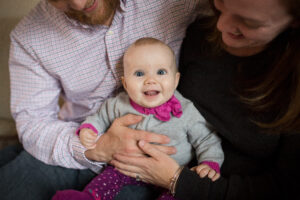 There was little to be done to meaningfully extend Emerson’s life, but Sarah and Steve could keep Emerson more comfortable through Enzyme Replacement Therapy, for which she would need a port. They traveled to Boston Children’s Hospital – where Dr. Alicia Casey was now an attending pulmonologist – for her niece’s port procedure. While there, Sarah and Steve met with the pediatric palliative care team and expressed how isolated and utterly alone they felt. The palliative care team referred them to Courageous Parents Network, which was only in its second year.
Reluctant at first to engage with CPN, Sarah quickly came to appreciate the multiple parent perspectives shown in CPN’s videos and blog posts, and how these parents gave language to what she and Steve were feeling. Sarah also participated in CPN’s pilot psycho-education series that psychologist Nancy Frumer-Styron was leading.
Back in Vermont, Sarah asked Emerson’s PCP Dr. Meredith Monahan for a referral to UVM’s palliative care pediatrician, Dr. Bob Macauley. Dr. Macauley had taught both Meredith and Alicia during their residencies. In conversations about decisions for medical interventions, Dr. Macauley helped Sarah and Steve understand that they could still be good parents if they focused entirely on Emerson’s quality of life rather than quantity of months.
Emerson died in June 2016 at age 16 months. While Sarah and Steve grieved deeply, they had no regrets.
 Up to this point, I (Blyth, founder of CPN) had no idea of Emerson, Sarah or Steve. CPN does not ask parents to identify themselves to use its resources and engage with its programming. But shortly after Emerson’s death, Sarah sent me an email personally thanking CPN for the help we provided and including photos of Emerson. Reading Sarah’s words and seeing these photos of Emerson with her parents, I burst into tears. CPN was only two years old, and this was among the first direct feedback we had received – putting a face, and unmistakable imprint of parental love, on the impact we were having.
Several years later, I interviewed Sarah and Steve and Sarah’s mother Melissa for Courageous Parents Network, so that their story could help other families just as they had been helped. And shortly after that, I interviewed Dr. Macauley so that his wisdom as a palliative care provider would be available on the platform. We also did a book talk with him for his recent memoir, Because I Knew You.
Meanwhile, also unbeknownst to CPN, Dr. Alicia Casey – now director of the Interstitial Lung Disease Program and Pulmonary Fellowship Training Program at Boston Children’s Hospital – was referring families in her practice to Courageous Parents Network. One such family was Frank and Jeanette, whose son Frankie Jr. was one of her patients. I learned about this when dad Frank reached out by phone to thank CPN for helping him see that he was not alone. Naturally, I had to interview them for CPN, to meet Frankie and to share their courageous parenting with other parents. I came away changed – moved by Frankie’s gentle energy, Frank’s humility and Jeanette’s feisty advocacy.
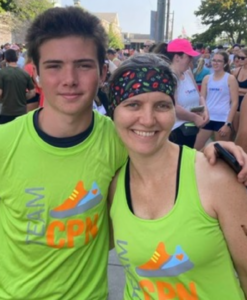 By this time, at her own initiation, Sarah was organizing and directing CPN’s running and fundraising team for the famous Falmouth Road Race, one of the oldest races for non-profits, held each August. Sarah and Steve and Alicia run on Team CPN in memory of Emerson and to raise money in support of other families. And for the past two years, Alicia’s son Jeremiah – Emerson’s cousin – has run too. (Sarah is actively recruiting runners for our team this year.)
Last month, Dr. Alicia Casey celebrated a milestone birthday. As a surprise, her family asked that gifts be made to CPN in honor of Alicia’s work and Emerson’s memory. The combination of this spontaneous gesture and the significant amount of money raised again brought me to tears. Of the amount gifted and her sister-in-law, Sarah said, “this is a testament to how much Alicia is loved and to how much her community values her dedication to her patients and families.”
It is also a testament to Dr. Alicia Casey’s appreciation of the work of Courageous Parents Network to promote palliative care, to help parents see that they are not alone, and to orient and equip them as their child’s advocate. When I spoke with Alicia about how her friends and family gave in her honor, she reminded me that she had trained under Drs. Bob Macauley and Meredith Monahan. We noted what a small world it had become –in the best possible sense. Alicia said, “I trusted that Meredith and Bob and all the people who trained me would take good care of Emerson, Sarah and Steve. And that I could be Emerson’s aunt and Sarah and Steve’s sister-in-law.”
At least for now, this is where the story ends. Dr. Macauley instilled in Drs. Monahan and Casey the primary principles and values of palliative care. Dr. Monahan became a primary care pediatrician and Emerson became one of her patients. Dr. Casey, Emerson’s aunt, became a pediatric pulmonologist and refers patient families like Frank and Jeanette to Courageous Parents Network. And people in their orbit, their network, give to CPN as an act of respect and appreciation; and to keep the goodness flowing.
The numbers in CPN’s impact report capture an expanding reach and dedicated engagement. But, this specific story captures what the numbers cannot. The authentic, soft, heart-forward connections between individuals who share a love for child and family and a dedication to compassionate care, the impact of which ripples outward for decades.