Theme: Partnership and Marriage
The mom of a baby born extremely premature discusses some of the things they heard in the NICU and thinking about how she and her husband thought about ‘quality of life’ differently. The father was more focused on the far future, and she was very very present-moment. The involvement of ethics was somewhat helpful.
Theme: Partnership and Marriage
We have been told that to be resilient is to stand apart. To weather the storm unmoved, to endure without breaking, to carry the weight without complaint. Fathers especially are given this story. The good father is the oak: tall, steady, admired precisely because he does not need to lean. He shelters others but never asks to be sheltered. His strength is measured by how little he requires.
This myth has a certain beauty to it. We do not carve statues in the shape of vines; we carve them to look like pillars. All that is soft is gone, what remains is that which is hard or has been hardened. And yet, when you live long enough inside the weight of grief and care, the myth begins to feel brittle. A father who cannot bend, who cannot admit need, eventually snaps. The oak rots from the inside. The story I inherited about resilience has left me lonelier than I know how to name.
I did not really begin to question this until I found myself sitting at my daughter’s bedside, watching her chest falter in the dark. One breath would come, ragged and shallow, then a pause too long. Then another gasp, as if her small body was unsure whether to continue. In those moments, she did not fight. She yielded. She let the air and the mask, and our trembling hands do the work. She trusted that she could rely on what held her.
Her resilience was not in resistance but in reliance. And it startled me. Because if resilience for her is reliance, if her survival is the sum of many hands, many ties, many threads, why have we been taught to imagine resilience as the opposite? Why have we been told that to lean is failure, that to rely is weakness?
Endure in silence, carry your grief like a private stone, prove yourself by not needing anyone. This script makes us solitary. It distorts fatherhood into isolation, as though to love well is to disappear into a fuzzy invisibility. But a single knot, no matter how tight, cannot hold anything on its own. Only when the knots are tied together do they form a net. A father’s resilience, I am beginning to believe, is not found in how firmly he can stand alone but in how deeply he can rely and be relied upon. Resilience is reliance. Strength is not in separation but in connection.
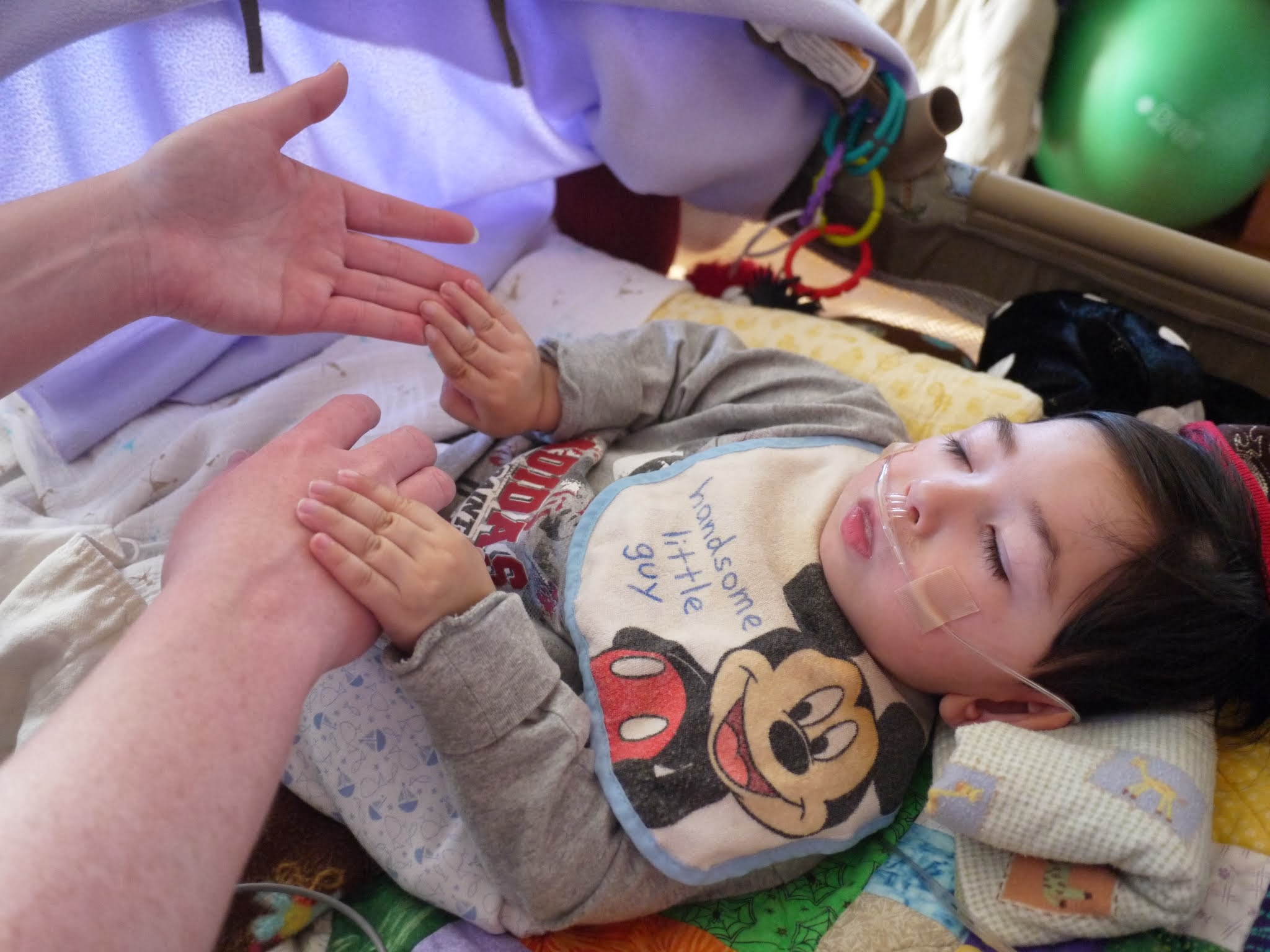
There have been other moments, lower ones. Sitting on the floor holding my daughter when she is too weak to play, to sit, to do much but be held. I trace her small fingers as she drifts in and out of awareness. I often cry then, not from crisis but from the sheer fact that I cannot change her body, cannot take away the fragility she carries every day. Her eyes sometimes meet mine here for a moment before they close. She does not flinch from my weakness. She doesn’t need me to be unshakable; she needs me to be here. A father willing to remain, even if that means relying on her gaze to steady him.
This is the reversal our culture resists: fragility is not the opposite of resilience, but its ground. My daughter’s life has taught me that. The ventilator, the feeding tube, the medications, the meal trains, the help around the house, the thoughts and prayers and good vibes whispered over her—all of it is reliance. And yet it is precisely in this web of dependence that her life continues. Resilience emerges not in being untouched by need but in being held within it.
A spider’s web offers a better image of resilience to me now than an oak. The web trembles. It breaks. But it is also repaired, rethreaded, renewed. Its strength lies not in rigidity but in flexibility, not in singular hardness but in the pattern of connection. Each thread relies on the others; each knot tied to something beyond itself. Fragility is not erased; it becomes part of what holds it all together.
Fathers are rarely given permission to see themselves this way. We have inherited a silence, a script that says we must carry the weight without asking to be carried. And so, we rarely speak to each other about care, about grief, about the unbearable tenderness of watching a child suffer. We retreat into the myth of the oak and call it love. But what if fatherhood were something else entirely? What if resilience has always been reliance, and our silence has only deepened the fracture? I imagine naming aloud the weight of nights spent pacing hospital corridors, the helplessness of waiting rooms, the fear of not being enough. Not to prove endurance, but to weave ties. To hold each other as surely as we hold our children. What if fatherhood was not a fortress but a net?
Reliance does not mean passivity. It means fidelity. To keep showing up even when you cannot fix, to remain present when nothing changes, to lean and be leaned upon. This too is strength. When I sit beside my daughter during a seizure, I cannot stop it. All I can do is hold her hand, call her name, wait for her to return. My resilience in that moment is my reliance, on her will to come back on my wife’s presence, on the small circle of love that refuses to let go.
This is why yielding has become, for me, another name for love. To yield is not to surrender the bond but to trust it more deeply. To stay when you cannot control. To let others carry you when you cannot carry yourself. Yielding is not weakness. It is reliance. It is what nets are made of.
And in the end, this is what remains: not solitary strength, not the illusion of the oak standing alone, but the quiet fidelity of ties that hold. My wife’s hand in mine. Friends who ask the second question. Machines that breathe for my daughter until she can breathe again. My daughter herself, teaching me without words that life is carried by yielding. When I get to thinking like this, she looks at me as if to say, “Of course it takes more than one person. You’d last what, maybe 2 minutes on your own? 3 tops if someone left you snacks.” Alas, she is non-verbal, and I don’t read minds.
The myth told me that to be a resilient father was to stand apart. My daughter has shown me that resilience is the opposite, it is to stand together. To be one knot in a net strong enough to hold the weight of the nothingness of grief. To yield to reliance, and to find in that yielding not failure but promise.
Resilience as reliance, not resistance.
These ordinary instants are the ones that change your life.
Stephen Hager goes by his second middle name (he has three), Bud, because it’s easier to remember and baristas never misspell it. Along with his wife he is a caregiver for their 8-year-old daughter, Emma, who has pachygyria, a rare neurological disorder. He believes in taking an active approach to advocating for his child and others like her. To this end, he sits on various advisory councils at Children Hospital of Orange County (CHOC), volunteers on consulting and directing boards for various non-profit centers and lends his writing skills where he can. Experiencing a lack of support for parents of medically complex children, Bud founded a support group through CHOC focusing on parent-to-parent interaction. He is also a professor of psychology and has a small private psychotherapy practice.
Theme: Partnership and Marriage
Parents Jordan and Julia describe how their baby daughter’s diagnosis of Infantile Epileptic Encephalopathy came with a “100% failure to thrive” prognosis and how they each internalized this in their own way and own time.
Theme: Partnership and Marriage
Parents Nate and Katherine talk so tenderly about coming to understand how they differ in their grief response and supported each other. “We were trying to be gracious with each other and let the other grieve the way they needed to. That’s tricky.” They worked with a grief counselor in the prenatal period and continued after. Nate describes how complex it was and how he lacked the skills. “It was a tricky time.”
Theme: Partnership and Marriage
Parents of a 21-year-old son with complex chronic conditions talk about how their marriage has been forged in the face of the challenge. “He is my best friend. He is the one I trust on everything. It’s a lot and it’s a lot of stress. Marriage with a child that is complex, special needs and now terminal is a whole bag of crazy. I think we learned to be friends and respect each other and recognize that we’re in it together.”
Theme: Partnership and Marriage
Before my husband and I were parents, we were entrepreneurs co-leading a start-up. Little did we know then, a key strategy we were using in growing our business would later serve as a lifeboat for us as family caregivers running an in-home ICU to care for our son’s medical complexities.
In vs On
It begins with differentiating between what it means to work in your business and what it means to work on your business. Working in your business refers to all of the jobs, tasks, and meetings required to deliver your product or service. Working on your business is about assessing and improving the systems, routines, mindsets, workflow rhythms and environments that allow you (or your staff) to work in your business.
Helicopter View
As business owners my husband and I engaged in a practice of setting aside time each month to step away from the office to work on our business. We would tackle a specific operational problem hindering the function and/or growth of our business. It felt like taking a helicopter ride, zooming out to look at the larger landscape, to assess how our business was functioning.
Together we identified one problem, what made it a problem and why change was a priority. Then we expressed our wishes for how it could be different, brainstormed possible solutions, and made a decision on how to approach this change. We called these meetings Remodel Time because the result was a remodel of how our business functioned. This improved efficiency and how work happened in our business.
Providing Care without a Systems Plan
When our son Levi was born with severe HIE, we were immediately immersed into a hospital-based NICU-life with all of its protocols and 24/7 rhythms. At two weeks of age we began the steep learning curve of how to care for our son in preparation for going home. It was a thrilling and terrifying moment to bring Levi home at three weeks old. Figuring out how to be a NICU staff of two was overwhelming.
Each day we faced the sustained uncertainty of if Levi would live to see the next day. Learning the what of caring for Levi was more essential than the logistics and systems of how we were doing it. Oxygen tanks landed by the front door because it was easy for the delivery person. Medications and medical supplies haphazardly found their place in the first available spot.
Even as days became weeks and months, the high uncertainty of tomorrow prevented us from comprehending the need for a systems plan. When Levi caught his first pneumonia we added more medical equipment, medications, and supplies. When he began in-home therapies and early intervention education we added adapted toys, chairs, mats and supplies. Layer by layer, we developed medical care plans, therapy plans, and education plans. These plans included detailed definitions of what it meant to work in the business of caring for Levi. None of these plans addressed the operational aspects of caring for Levi. For that we had no plan.
Remodel Time becomes our Lifeboat
Levi was nearly two years old before we recognized we were living without a systems plan. The relentless 24/7 intensity of caring for him absorbed our total focus. It wasn’t until we began to have night nursing staff (long after having daytime PCAs) that we had to more fully teach our system of care to someone who could care for Levi while we were away (aka asleep).
With great kindness our nurses asked questions and gave insights on different ways we could improve our systems.These seemingly small changes radically improved our daily experience as caregivers. We felt we could begin to breathe more deeply.
This sparked the memory of our Remodel Time business meetings and we began to experiment with how to apply it to caring for Levi. As before, we focused on one problem per meeting with a goal of identifying a specific actionable change we could make with the resources we had available to us.
Here are three tangible examples of changes that came from our monthly Remodel Time meetings.
- We addressed the traffic jam of clean and dirty dishes, syringes, and feeding pump bags all hovering around the kitchen sink. We moved the medical items to the nearby bathroom sink. This generated several improvements including reducing the traffic flow into the kitchen, making meal prep and clean up easier.
- We recognized the furniture in our living room (now Levi’s everything room) did not have adequate storage for his medical, therapeutic, and educational items. Caregivers were spending too much time searching for what they needed which left Levi waiting. We developed a wish list and reached out to a local furniture store that had a program for donating their floor samples to local nonprofits. The store connected us with a nonprofit and our wish list was delivered two months later. Both Levi and his caregivers benefited from this change.
- Levi’s deafblindness impacted how he experienced the world and communicated with others. As he grew his need for his caregivers to understand this grew. Picking him up for a hug could be wonderful or anxiety-producing, depending on how this was communicated to him ahead of time. Increased anxiety easily cascaded into other emotional and physical challenges for Levi. We planned a training for all caregivers to learn about deafblindness and specific strategies for communicating with Levi. This radically improved relationships all around and opened the door for caregivers to share their discoveries as Levi grew.
With each remodel change we made, even the seemingly smallest ones, we felt our burnout decrease and our resiliency grow. We witnessed this also happening within the whole care team. We could breathe deeper and think more clearly. This improved our collective quality of care for Levi and our ability to foresee the next opportunity for change.
Surprisingly, in my marriage Remodel Time also served to tend to some of the grief that comes from having your life broken into “before Levi” and “with Levi” experiences. By bringing the Remodel Time practice into our “with Levi” life, we learned our “before” life wasn’t a waste or an alter-reality we would never return to. Rather, it set the stage for us to love and care for Levi to the best of our abilities right now.
In so many ways Remodel Time became an essential lifeboat in our experience as family caregivers. The relentlessness of running an in-home ICU didn’t change but our ability to live and thrive within it did.
Levi’s mom, Dannell Shu, has served as a parent advocate within pediatric palliative and hospice care since 2014. As a writer, speaker, educator, and thought leader she brings forth insights gained from lived-experience and the stories of children in need of palliative care. She serves as a Family Caregiver on the Pediatric Palliative Care National Task Force. To learn more about her advocacy visit MamaShu.org. To learn about the resources she creates for bereaved families visit RedBirdTime.com
Theme: Partnership and Marriage
All relationships face stress, but partners caring for a child with a serious illness are confronted with unique challenges. Each person in the relationship may cope differently. You may feel closer to, or more distance from, your partner over time. Communication with one another about how each responds to stress and grief, and what kind of support each person needs, can help increase understanding. Dr. Talia Zaider, a licensed psychologist and marriage and family therapist, offers insights and considerations for coping together.
Theme: Partnership and Marriage
Sometimes I think about the deterioration of my marriage as just another casualty of Andalyn’s complex medical needs. After its death, this companionship was laid to rest in the basement of my soul, tucked carefully between unrealized hopes for more children and growing old with my best friend. The transition from being a “we” to a “me” was something I was not prepared for even though it was not entirely unexpected. I have somehow found my way through the past nine years, but being just a “me” frequently feels like it’s not enough.
With all of the arrogance and selfishness of an uninvited, unwelcome guest, divorce barged into our home just as the leaves were beginning to fall and the smell of pumpkin spice everything filled the air. Divorce wasted no time taking over the whole house. Because of Andalyn’s medical needs, anxiety, depression, anger, and grief had already moved in with me so having an additional intruder made the house pretty crowded. When divorce showed up I didn’t have room to unpack his many suitcases bulging with hurt feelings, painful memories, and broken dreams, so I shoved all his crap into closets, under beds, and behind storage bins full of Christmas decorations just so I wouldn’t have to see any of it. I did my best to ignore the messes that divorce created all over the house so I could focus on Andalyn.
This sort of “tunnel-vision focus” wasn’t really much different than the way things had been all along. With all of my energy being poured into our chronically ill child, it didn’t leave much left to tend to my marriage. Sleeping in separate beds to share the tremendous burden of 24-hour care seemed like a good idea in the beginning. We figured at least one of us got to sleep every other night. But the separation grew steadily and spread beyond sleeping arrangements to all the other areas of our relationship. As the days stretched into months and the months into years, I barely noticed the distance increasing between us. A thousand little things, and a few that were not so little, steadily piled up until they buried our relationship under a thick blanket of resentment and unmet needs. Ironically the thing that initially deepened our connection–her medical fragility–was now the very thing forcing us apart.
It was very painful for me as Andalyn’s dad and I struggled to figure out the dance of joint custody and co-parenting. Initially, it almost felt like we were still married but living in separate houses because we still spent a lot of time together. As Andalyn’s medical needs became more complicated and life took us in different directions, however, the last threads of decency between us unraveled. It took several years and some significant events to put us back on a path headed in the right direction. Even so, her dad and I struggled for a long time to find our way back to a place that felt like friendship. Finding our way out of conflict was a very difficult process, but eventually things shifted into a place of empathy, kindness, and mutual cooperation. Compassion smoothed over the broken places and created a space for us to stand together on softer ground.
Without careful tending of this new landscape, the softer ground we have managed to cultivate could quickly become inundated with thorns, rocks, and other harmful barriers. It would be easy to get frustrated and be unkind to one another. When things come up unexpectedly, we try to be understanding and consider the circumstances in each other’s lives. Being flexible and keeping Andalyn as the focus really helps us work together to find creative solutions and avoid a multitude of hard feelings.
Navigating any relationship takes work, communication, and a mutual spirit of cooperation. I would dare to say that on occasion I have found myself working harder on this in our relationship now that I am divorced than I was capable of at times in the marriage. I am also far more capable of being objective now that we are living separate lives.
Having a medically fragile child adds a compounded complexity to divorce so finding ways to keep the peace definitely is the best way to go. Reflecting on all the ups and downs it took to learn how to do this, there are a few things that stand out that have been particularly helpful.
The first and most important is that we finally figured out how to establish consistency. Lack of consistency between households for a medically fragile child can literally be a matter of life and death. Differences in parenting styles, routines, and activities between households have to be carefully balanced with medical, emotional, spiritual, and physical needs of everyone involved. This is not an easy task. It is exponentially harder if there are unresolved misunderstandings or a lack of good communication.
Clear and ongoing communication is incredibly important and so this means involving the medical team on occasion. Allowing providers to shoulder the responsibility to ensure that Andalyn’s medical needs get communicated correctly when there is a potential conflict or when something needs to be clarified puts Jonathan and me on the same level. More importantly, it puts everyone on the same team. However, if I am put into the role of being the teacher or the person dictating how something needs to be done, it can easily upset the delicate balance of power by shifting me into a role of being his supervisor in a way, and that only leads to resentment. The benefits of letting clarification regarding when something needs to be done differently, or explaining the importance of doing something in a specific way, takes me out of the middle and means we both receive information and instructions from the source. Working together with the medical team in this way has taken some of the burden off of my shoulders and has helped to rebuild some areas of broken trust. This simple but incredibly powerful approach has prevented many potential conflicts before they could even happen.
The best way for us to maintain good communication and consistency in Andalyn’s medical needs is to utilize a written plan. Having both a written care plan and a schedule means I don’t have to worry about forgetting important details, and her dad doesn’t have to remember a massive amount of information about her constantly shifting needs. He lives in a different city about 80 miles away from us, so co-parenting and visitation arrangements have to include careful cooperation otherwise Andalyn could suffer life-threatening complications. As various things have changed over the past few years, the situation has made it necessary for me to take on nearly all of Andalyn’s care, even when she spends time with her dad. It is not a common scenario for anyone to have to spend long periods of time with an ex-spouse and their new family. Fortunately, what was initially very painful and terribly awkward has slowly softened into mildly uncomfortable and less awkward. Choosing to do whatever it takes so that my daughter can spend time at her dad’s house may not be easy but it is intentional. An unexpected blessing has unfolded with the beginning of a new and cautious friendship.
Finally, organization makes all the other strategies come together. In Andalyn’s case, going anywhere longer than a few hours is a tremendous amount of work and demands careful planning. When the time comes to get things ready for a visit with her dad, even for just a day trip, it can take hours to make a plan to adjust medical care for travel, gather needed and emergency supplies, and then organize it all into a somewhat manageable chaos. Overnight trips with her dad are not always a possibility. So when they do happen, in order to make things go smoothly and for Andalyn to be safe, good organization is critical. It takes advanced coordination with her supply companies to schedule deliveries so that I have everything on hand that she will need before we go.
The way I handle this is by using a checklist I made that has everything she needs on it. This is my attempt to avoid a crisis–at least one related to things I can control–so I don’t forget anything that has to go back and forth between households. She has nearly 70 different items I have to pack related specifically to her medical needs for trips so obviously I can’t just toss a few things into a backpack at the last minute and drop her off for a weekend somewhere. While it’s not a big deal if I forget a personal item, clothing, or a toiletry, if I forget her medications or supplies, her dad can’t just make a Target run to grab a $3500 infusion pump or a $1000 bag of Total Parenteral Nutrition along with a spare toothbrush from the toothpaste aisle. In addition to remembering all her stuff I also need to make sure that I pack everything in a way that is easy for her dad to quickly find the things he needs. He appreciates my efforts to make doing her medical care easier for him and safer for Andalyn.
Advanced planning, careful organization, care plans and checklists, anticipation of potential needs, making intentional effort to work together and prioritizing Andalyn’s needs ahead of my own are all necessary if I can ever hope to master the art of a good divorce. It certainly creates a tremendous amount of extra work for me but her dad is incredibly appreciative. When he acknowledges the sacrifices I make it feels wonderful to be validated. The peace of mind that comes from knowing at least in those visits I am doing everything I can to meet her medical needs AND she gets to be happy–that is what makes all the hard stuff 100% worth it.
________________________________________________________________________________________________________________
About Amanda
I live in Aurora, Colorado, with my feisty daughter and crazy cat. Andalyn has complex medical needs and multiple challenging diagnoses. I have spent her life striving to make things as normal as I can for her because she has already fought a lifetime of battles. Through a combination of faith, grace, my hypervigilance, and her incredibly tenacious spirit somehow she continues to beat the odds and has already lived longer than many suspected she ever would. Because I feel everything deeply, I have learned to cope with the challenges of meeting her needs through my writing, the power of connection, and bits of hope I find scattered along the way. I have been writing essays and short stories since I was a child but recently I accomplished my life long dream to publish a book. My novel, A Tattered Soul, is the true story of my journey coming to terms with Andalyn’s life-threatening illness and its undefined prognosis. When I am not writing or caring for Andalyn I enjoy sleeping, finding ways to help others, baking anything delicious, and watching TV. I survive most days on copious amounts Diet Dr Pepper, sarcasm, and a little bit of dark humor sprinkled in for good measure.
Theme: Partnership and Marriage
When my husband, Charlie, and I heard that our six-month old daughter Cameron had a rare and fatal disease, one of our very first thoughts was Oh God, how are we as a couple going to do this? Will we each survive and will our marriage survive????
Of course, there was no immediate answer to this question, nor was there a guidebook.
Even for questions that are impossible to answer, there are things that can be done to try to answer them with the best outcome possible. Charlie and I knew we needed help and we were very open to therapy. I wasn’t looking for a marriage therapist, but I did think that it would be helpful for us to talk to someone as a couple. Someone told us that there were therapists who helped couples process their grief during periods of illness, so I went in search of such a person.
Let me just say, they are not easy to find. The first person we met with spent the entire hour dead-heading potted geraniums in her office and telling us that her granddaughter had been sick but got all better with an operation. Ummm, this was not relevant to our situation and was certainly not helpful. We left her office incredulous and laughing. As my anxiety about my future increased, I despaired that we would find someone.
But shortly thereafter we did. And she made all the difference. Her specialty is families of children who have serious illness – both the patient, the siblings and the parents. Charlie and I met with her monthly, then bi-weekly, and by the end of Cameron’s life we were meeting every week. I like to joke that we would have moved her into the house if that had been an option.
As a grief therapist, she helped us understand our feelings and our fears and recognize our strengths and vulnerability. She told us that what attracts us initially to our partner is typically how we complement each other— how we differ from each other— but how initially in a crisis, we want our partner’s emotional reactions to mirror our own so that we feel understood and on the same page. We want our partner to be able to RELATE to how we feel. Different isn’t helpful when we’re upset. And yet different is what we typically get. It is typical for parents in a crisis to show different emotional responses, and this difference is often based on gender. This was certainly true for us. During Cameron’s illness journey, my husband and I frequently responded so differently to a significant crisis—seizures, pneumonia, feeding challenges—that I wanted to run screaming from the house, one scary feeling on top of another. This therapist helped us understand what was happening and find common ground instead of anger.
During the 18 months that we worked with this therapist, we were mostly focused on processing our anticipatory grief and, as her disease progressed, preparing to let our daughter die.
And in so doing, we were also working on our marriage. Pediatric illness puts tremendous pressure on a marriage and this was so true for me. I am not entirely sure my husband and I would still be married if we hadn’t had such an incredible therapist. Thankfully we did and thankfully we are.
I appreciate that therapy isn’t for everyone and that good therapists aren’t easy to find. But if you think it would be helpful to you, I encourage you to seek a grief therapist and to do that work with your partner. And if they resist, do it by yourself.
And most immediately, I hope you will find the marriage videos in the CPN library very helpful. In them, psychologist Nancy Frumer Styron shines a light on many of the issues that typically confront parents in their marriage, including differences in how men and women react and ways to come together. And parents share their own experiences about how they responded as a couple.
We also have a downloadable guide with tips for tending your marriage during this stressful journey.
Finally, I want to end on a hopeful note: conventional wisdom says that pediatric illness ends more marriages than not. The research does not bear this out. Yes, certainly, some marriages cannot bear the stress and grief, and eventually end. But plenty of couples find that their marriage is ultimately strengthened by the journey. Whatever lies ahead for you, I remind you that you are not alone and you can do this, one way or another.
Theme: Partnership and Marriage
When parenting a child with complex care needs – like my son Lucas had due to Menkes Syndrome — a couple often faces a tough choice: is one of them not going to work?
And I’ll stop myself here since the way I phrased that is already a trap. You will both work. But one may choose not to work outside of the home for a paycheck. Parenting kids like ours is a fulltime job and then some. I know some parents manage it while both working full-time jobs. I’d love to know how. Seriously, if you’re one of these families, please tell me.
If, like our family, both partners were working full time before the diagnosis of your child, do you decide something has to give? And that something is one of your jobs? In most of the rare disease families I know, one parent has elected to be a full-time at-home parent while the spouse continues to go to their paid job. I probably don’t need to say this, but — in a heterosexual couple — this is most often the mom. However, I’ve been so pleased to become friends with amazing exceptions. Bo Bigelow and Mike Graglia each walked away from their high profile careers to be the primary at-home parent while their wives continued to work in their own high profile careers. They continually inspire me. If you’re a dad caregiver looking for a model, you’d do well to look to them.
When one partner leaves their job, it has several impacts. Most obviously, the family income is greatly reduced, if not halved.
Have you heard of Pay Equality Day? For women that day is April 2 – chosen to illustrate that women need to work a full year plus four months to equal a male colleague’s earnings. For African and Black American women (earned pay $0.61) it is August 22 and Latinas (earned pay $0.53) it is November 20th.
No one has established a Rare Disease Parent Pay Equality Day yet. But we need one.
Even though I can appreciate that the pay equity examples above don’t involve a choice and that it could be argued that rare parents are choosing to earn less, for most of us, it feels like there’s simply no choice at all.
The average dual earner household makes 1.57 times more than the single earner household. Using those stats, Rare Disease Parent Pay Equality Day would be June 24th. Let’s mark our calendars and tell the world.
Of course the income loss is not the worst impact. There are also emotional and relationship tolls; and often the spouse who stops working outside the home struggles to define their identity without a career to define it. These often become strains on the marriage. Talk to any rare disease couple and it is likely you will hear the dynamic play out this way – the working spouse will say, “But I have to go to work.” to which the stay-at- home partner will frustratingly reply, “No, you get to go to work.” Work outside of the home can be a welcome relief from the challenges of care. Just as with parenting a “typically healthy” child, each parent gets exhausted in a different way. If you’re one of these couples (one goes out to work, one stays home to parent) you’ll know the dynamic: one parent gets home tired from the job and wants to relax, but the other has been pushed to their caregiver limits all day and wants to tag in their partner for duty so she can finally take a breath.
Like Bo and Mike, I’m an exception to this gender norm too, but in a different way. In my career making TV commercials, I was my own boss, able to set my own schedule. So instead of deciding which of us would quit our job, we dodged the tough choice and settled on reducing my work-at-home work load so I’d have a flexible enough schedule to handle much of Lucas’ care.
This meant that Monday through Friday I’d work 6 hour days. If a project demanded more time, I typically had to put those hours in after 9pm when the kids were sleeping. I didn’t love those parameters but we mostly made it work. However, it sounds easier than it actually was. Making TV commercials can be divided into production (set up lights, mics, cameras and roll film) and post-production (the editing work which can be done in a home office). The former requires travel and often long days. The latter can allow for a flexible schedule. So I began to turn down client work that involved production and limited myself to post-production jobs only. Turning down work is seldom a good business decision. Many clients still needed the production piece done so they’d ask me to recommend someone and almost everyone who does production also does post-production. With each recommendation, I also ran the risk of referring away all of my work.
But that’s how we managed the care-giving divide. I wasn’t exactly the full time parent but certainly the go-to parent or at least the parent with the flexible schedule. And even this reduced work schedule would not have been possible for me without others helping out. When Lucas was too young for school, my mom was his daycare. Once school began for him, we were fortunate to have a home-care nurse working from 3pm until his bedtime of 7pm. It was only because of the nurse that our work days could go as late as 5pm.
It became easy to take my flexible schedule for granted. I could almost always squeeze in a doctor’s appointment or a surprise pick up from school. And we were grateful for that. But if I wanted to keep my business going, I couldn’t confuse flexible with 100% available. There were plenty of times I felt frustrated by my role as compared to my wife’s.
I recall during a week of far too many medical appointments, asking my wife which of us would handle the next one. I was no longer willing to be the default by assumption. Her reply was logical,“It’s harder for me to take time from work. It’s easier for you.” But my desperation provided me with some logic of my own, so I answered “You’re right, it is always going to be easier for me to be the one, but it also can’t always fall to me.” And she got that. We worked it out. It was harder for her but not impossible. She almost never took sick days (for herself or due to Lucas). In fact, her very sympathetic co-workers had offered to donate their paid time off to her should she need more time.
Several times, I wondered if it would be simpler to give up my work entirely and have increased availability for Lucas’s needs and less tug-of-war on my priorities. But to be honest, I liked keeping active in my professional capacity. I drew satisfaction and a sense of identity from my work and it would have been a struggle for us to lose that income. We probably could have gotten by if it was just my wife’s salary but there would have been no margin for the unexpected expenses. And this lifestyle is nothing, if not unexpected.
For me it wouldn’t be as clean as a job, waiting a few years and then finding a new job to re-enter the workforce. If I shuttered my business and years later wanted to return to it, it would be like starting from zero. My clients would have found other solutions in my absence.
My wife felt trapped in her role too. We couldn’t consider reversing the roles because my wife’s job provided our health insurance. Being self-employed didn’t offer me great options for insurance. Any thoughts she gave to being a stay-at-home parent were dismissed as soon insurance came into play. Luckily for us, my wife is a teacher with summers off and so our roles could flip each July and August. She would become the primary parent while I could extend my work hours some and allow myself to be less available for medical appointments. This gave us each a change of pace and a chance to appreciate the burdens of both roles – to understand we were both working. Cause that is the thing – whether you are the parent who has the validation of working outside the home or the one that feels less validated as a caregiver, you’re both gonna be working!
________________________________________________________________________________________________________________
At the age of 12 months Daniel’s first child Lucas was diagnosed with the rare disease Menkes Syndrome. After adjusting his expectations of what raising a child might look like, Daniel began to tell Lucas’ story with a short documentary: “Menkes Disease: Finding Help & Hope” narrated by Oscar nominee Mary McDonnell. That film led to Daniel co-founding with Bo Bigelow DISORDER: The Rare Disease Film Festival and later The Disorder Channel, both dedicated to spreading awareness for patient families facing any of the more than 7,000 rare diseases.
Theme: Partnership and Marriage
Maintaining a healthy marital/partner relationship while you are parenting a child with a life-limiting illness.
Parenting a child with a life-limiting illness can feel all-consuming. Taking time and making space to tend to adult relationships may feel impossible. Nurturing and caring for a loving relationship can be crucial to the well-being of you and the family. Nancy Frumer Styron, a licensed psychologist, will offer insights and suggestions for you to consider as you care for your child, each other and your family. There will be an opportunity for you to ask questions, share what has been especially challenging and what has helped and worked.