Skip to content
Courageous Parents Network Logo

Search

Search entire library or by microsite

Click here for NeuroJourney resources

Theme: Bereavement: Maintaining Connection, Continuing Bonds

Bereaved parents Jordan and Julia explore the ways they are finding what to focus on about their daughter’s brief life – which memories to hold on to, which to let go of, how to maintain the connection and continue the bond. Jordan reads a poem he wrought on being Avery’s father.

Theme: Bereavement: Maintaining Connection, Continuing Bonds

In previous stories of my younger sister Lauren’s cancer diagnosis and eventual passing, I’ve used a metaphor I call Emotion Beach. Since she was born in December and would pass 10 years and 10 days later, just before Christmas, the entire month has double red flags posted warning of viciously choppy waves of emotion.

Almost as if it was foretold in a mental farmer’s almanac, right on time, December and this season brings an increased intensity and volume of my grieving thoughts. To be honest, it’s playing out right now as you read this. I’ve gone months without having an urge to write about these feelings, and suddenly a grief switch flipped, propelling me to write this piece.

I was in a therapy session earlier this year and was prompted with the question, how much weight does the grief of Lauren’s death carry?

I compared my grief to lava flowing from a volcano. In the immediate months and years, the lava was molten and completely volatile. The anger, depression, and numbness of loss were white hot and I burned myself and the relationships around me. During this stage, I developed a nasty habit of avoiding stressful emotions to a fault. My protection against the lava was burying negative emotions.

As time passed, the lava began to cool and set into place where it had spread. The coping habits I had developed were my default now, and I continued to avoid stressful emotions and bury negative ones. This behavior pattern would have consequences academically, professionally, and personallythings I’m still working to rebuild. However, the grief-stricken lava didn’t burn my finger to the touch anymore. I could bring up Lauren conversationally and feel joy, not sorrow.

Whatever negative emotion, habit or experience took place in the aftermath was forever frozen in place. Today, I must admit, my bad habits still exist. But now, perhaps because of time, therapy, or getting older and collecting more experiences, I now have the clarity to see them for what they are and actively try to counteract them. Grief has forced me to consider new realities and the uncomfortable truth that we are approaching the threshold of Lauren being gone for a longer amount of time than she was here.

My grief has changed. I can talk at length about the joy and kindness Lauren brought into the world just as much as a minute-by-minute run through of her final hours. My relationship to grief has shifted from being a burden to an appreciation and quiet respect for how far I’ve come in my journey. This is true for almost everything related to Lauren and her passing.

That ‘almost everything’ is the key though. One aspect that I’m certainly not at peace with is Lauren showing signs she is with me. We naturally cling to the idea that our deceased loved ones are at peace, free of any pain and watching protectively and lovingly over us. It’s a comforting thought and helps soothe the sting of relearning how to live life without them.

The thing is, I don’t believe I’ve ever had a sign from Lauren.

That’s not to say I don’t believe those who have passed can give us signs, I desperately want to believe that. I’m just of the mindset that I won’t believe it to my core until I see it and I simply don’t think I’ve seen it.

People around me seem to be getting signs from her. Her twin even encountered a medium at the grocery store. Most of the signs however seem directed at my mom. She has told me about hearing Lauren in her head and how Lauren provides one liners and quips about her day-to-day experience constantly. In the beginning, it would make me feel frustrated, and I worried my mom was struggling worse than I thought. That concern then turned to polite dismissal when she’d bring it up because whether it’s real or not, it’s a coping mechanism. Who am I to judge?

Like I said earlier, I have a propensity to avoid negative emotions. One form that takes is an intense skepticism about the afterlife. I take away literal interpretations of what I see. Lauren died in front of me so therefore she is not experiencing life as we know it and cannot interact with me.

​​I’m more likely to believe that Lauren being able to send me a message is an impossibility. I go back and forth on what I think she experiences right now, or even if she does. Maybe my skepticism is a coping mechanism, maybe it’s fear. I simply do not know the truth.

After exposure to the suffering that accompanies someone battling terminal illness and death, I’d like to think the afterlife is a reward to soothe that pain. A chance to connect with past souls, examine your lived experience and try again if you choose to do so. As a place that provides explanation and reason to the suffering that accompanies the unexplainable.

Maybe that’s why I haven’t seen anything yet. She’s too busy enjoying the warmth of something I can’t comprehend here in my body. Maybe it’s not that elaborate at all and she simply stopped existing. No pain, no feeling and no experience because she is nothing anymore.

It’s possible that by writing a story centered around my feelings about a lack of a sign from Lauren, that it will be the very thing that initiates a chain of events that leads to a powerful sign from Lauren. It’s also entirely possible the absence of a sign is the sign itself. 

And maybe the signs are not coincidental license plates or address numbers connected to her. Maybe she’s not controlling the radio, so it just happens to be her favorite Taylor Swift song (Mean).  Maybe we simply connect dots that do not really have a connection.

BUT what if there was never going to be a sensible sign because I am the sign itself. You are the sign too. The sign is employing the empathy, kindness, and grace she showed me and everyone she knew. The sign is going above and beyond for a stranger just because you can. If that’s the case, it’s been hiding in plain sight this entire time. I hope as you ride your own waves on Emotion Beach, you catch a sign that brings you solace and comfort for your person too.

Theme: Bereavement: Maintaining Connection, Continuing Bonds

Theme: Bereavement: Maintaining Connection, Continuing Bonds

Welcome back.

Now that we’re in the thick of winter, the constant 72º and partly cloudy weather here on Emotion Beach doesn’t sound too bad, does it? (When you create the analogy, they let you control the imaginary weather too.)

As a refresher, I left off in the fall with a comparison to what my experience has been like as the older brother of Lauren, who passed away from pediatric cancer in 2017 days after her 10th birthday and days before Christmas.

Given these circumstances, there’s pretty much a daily red or double red flag posted outside of Emotion Beach warning of viciously choppy waves of sadness, grief, and anger during the month of December.

While it’s expected that anniversaries and the painful memories that surround them would be difficult, there have also been plenty of unexpected difficult days that I’ve encountered along this journey.

One situation, or question rather, has stumped me more times than I’d like to admit and is a guaranteed metaphorical double red flag.

How many siblings do you have?

Before the fateful day of Lauren’s passing, the answer was glaringly simple. I have three younger sisters. Duh. Since that day however, I’ve wrestled mentally with how to answer. Do I say three, validating Lauren’s existence, but baiting myself into having to explain that she passed away and risk follow-up questions? Do I say two, making it easier and technically true, but linger with my answer internally hours after being asked?

As a way of coping, I’ve clung to literal interpretations of words surrounding how to describe Lauren’s passing. For example, to the disdain of my family, I was referring to Lauren in the past tense mere hours after her passing.

Currently, I live in a state of conflict with how to answer the sibling question. There is a side of me that wants to agree with the extremely literal interpretation. I have two younger sisters who are alive, therefore I have two younger sisters. At the same time, the other side of me knows deep down I will always have three younger sisters and Lauren will always be a part of my family regardless of her position in life or death.

This example, a single wave on Emotion Beach, illustrates the many mental hoops that I have to jump through to answer something as small as quantifying the size of my family. The size and scope of grief is immeasurable and the way I view the world and interact with it are vastly different because of it.

Witnessing Lauren fight courageously for two years, always believing she would eventually be okay, and watching life slip away from her body wildly reshaped what I view as important or worth emotional investment. Things like high school crush dramas or gossip amongst co-workers are trivial in my mind because I have seen and been through exponentially greater emotional events. I know the true meaning of grief in all its depths. The lesson was magnified even further since Lauren was the first ‘real’ experience I’ve faced with the death of an immediate family member.   

Another thing Lauren taught me without ever actually trying was the power and infectiousness of a relentlessly positive attitude. She did this through:

I’ve tried taking these lessons and acts of kindness Lauren showed in her limited time and reflecting on them in my own life. The core idea is to approach any situation with a level head and an empathetic heart. And always remembering that you might not know the source of someone else’s anger and pain.

Maybe it’s something as simple as flashing your lights instead of honking when the car in front of you won’t move. Maybe it’s something bigger. That’s for you to decide. The only thing to keep in mind is that an act of kindness can open a lifetime of opportunity.

Theme: Bereavement: Maintaining Connection, Continuing Bonds

A bereaved mother speaks courageously about how she has sought and found support following the death of her son. There are things she did early on — “I was taking it hour by hour” — and challenges she gave herself to make sure Krabbe disease didn’t take even more from her, such as buying baby presents for friends. “I grant myself grace…. I still want to make Jackson proud, so he will never have a mom that quits. … If I’m here, it has to count.”

Theme: Bereavement: Maintaining Connection, Continuing Bonds

Parents of a son diagnosed with a rare genetic condition talk about communicating with him without words and how powerful the connection they had with him was, even though he was only with them for a short time.

Theme: Bereavement: Maintaining Connection, Continuing Bonds

Theme: Bereavement: Maintaining Connection, Continuing Bonds

The Falmouth Road Race has always held a special place in my heart. With the finish line a few blocks from my childhood home, the race was always a highlight of my summers. My mother, a nurse, volunteered each year at one of the medical tents along the course, family and friends would run, and we would all gather post-race to celebrate. Though I’ve never been a natural distance runner, something about the Falmouth Road Race drew me in. I think partly it was the festiveness of it all and seeing world class runners up close as they sprinted by, almost silently as if their feet didn’t even touch the ground. Mostly, though, I think it was the regular people and the stories that their runs told that made it feel so special.

I can remember vividly all the years that I would stand at the corner, just past mile 6, waiting for Dick and Rick Hoyt to pass by. They would run together, Dick pushing his son Rick in his wheelchair. If you haven’t read their story, you should. It is incredibly inspirational in many ways. At its core is the story of a regular dad who went out of his comfort zone to do whatever it took to give his son the best quality of life possible. In doing so he changed not only their own lives for the better, but those of countless others. There were other stories of courage and selflessness, too. I would watch the runners running for various causes, names printed on shirts and bibs, and I would feel a sense of gratitude that there were so many good people, though I still saw them as other people’s stories, not mine.

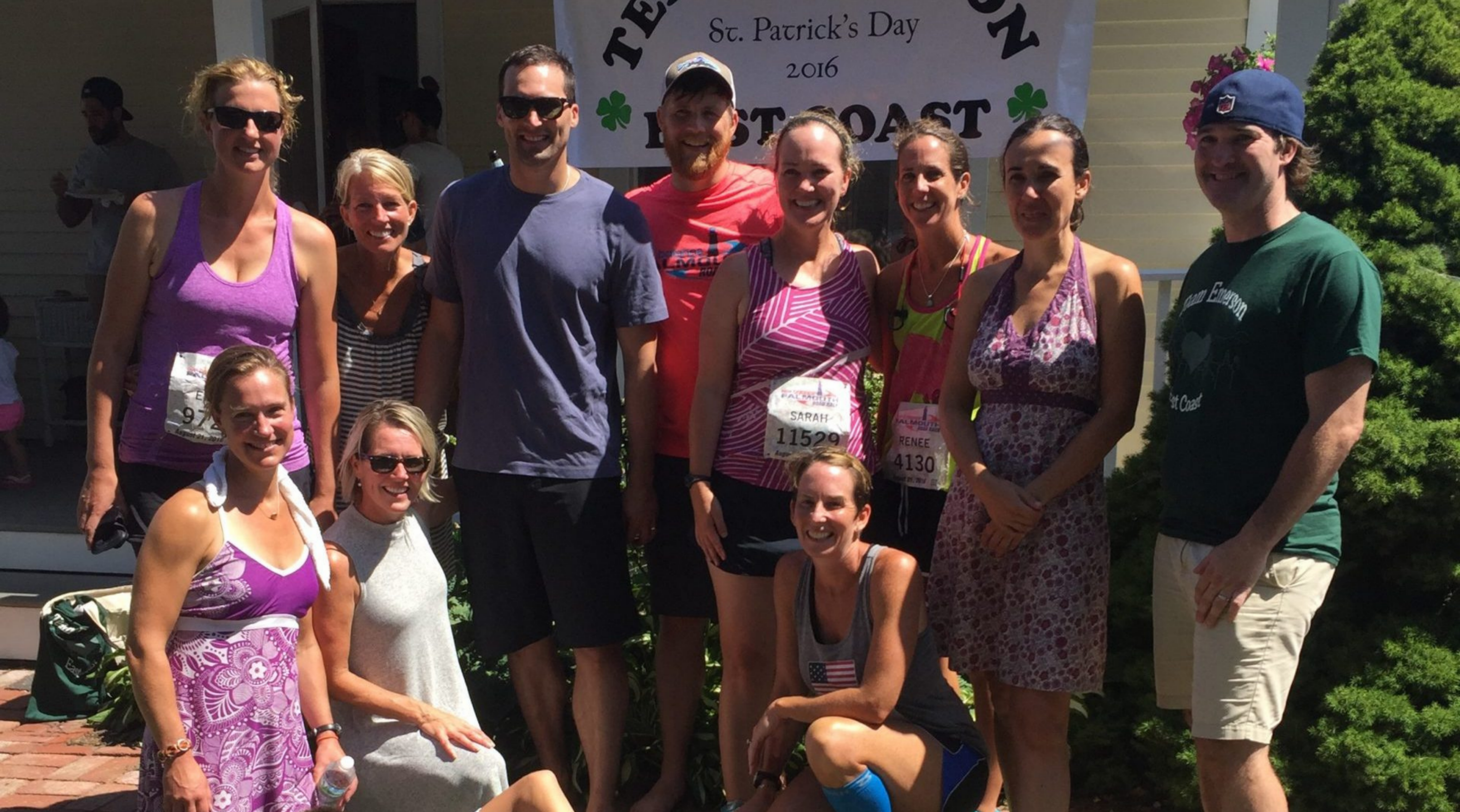
This changed in late 2015, when my daughter Emerson was diagnosed at 8 months old with Type 2 Gaucher’s, an extremely rare and fatal disease. My husband Steve and I went from being new parents with hopes and dreams for our daughter’s future, to being new parents anticipating our daughter’s decline and death. We were shattered. We were fortunate to have a wide circle of incredibly supportive family and friends, but there was a shared sense of helplessness. So, when my brother suggested that we gather to run the Falmouth Road Race as “Team Emerson”, it felt like something that we could all “do”. It was an opportunity for our friends and family to show their love and support, and for us to express our gratitude for that love and support. And it would be a time for us all to be together with Emerson, collectively soaking up all of her goodness that we could in the time that we had.

Unfortunately, Emerson didn’t make it to the race in August. She died in early June at 16 months old, just as we were ramping up our training. I stumbled blindly through the fog of those earliest days of grief. Where I had been efficient and focused and strong in my caring for Emerson, I now felt heavy and adrift. Standing felt difficult, self-motivation to run, impossible.

I don’t remember communicating to our team that we still wanted to run the race, but we must have. The support and momentum for “Team Emerson” grew. Our pediatrician, who had signed up to run with us, began stopping by after work to run with me. I suspect that she was mostly checking on my well-being, but training for the race gave us a reason to get together and gave me a purpose for moving my body, which I desperately needed. I know that there were days that she ran before or after meeting me to run (sometimes probably both) and that our runs were short, often including walking. But she kept showing up and so, so did I. Crossing the finish line of the race, I felt surrounded by love. I didn’t have the capacity at the time to express it, but I always wish that everyone who sent even the smallest good thought during that time could know how much it meant.

Not long after we ran the road race, my husband and I were interviewed by CPN. It felt like an honor to give back. We had been referred to CPN by the Pediatric Advanced Care Team (PACT) team at Boston Children’s Hospital soon after Emerson’s diagnosis, and will be forever grateful, both for the referral and for the families whose stories helped keep us afloat in the middle of so many nights. Connecting with CPN made us feel like we weren’t alone, gave us language for what we were experiencing, helped guide us as we made decisions, and most importantly, helped us to reframe what it means to have hope.

Over the years I’ve stayed connected with CPN in a variety of ways and have also continued to run. A few years ago, many of the original “Team Emerson” members ran a 5k on what would have been Emerson’s 3rd birthday, raising money for CPN in her memory. This planted a seed in my mind that would grow into CPN participating in the Falmouth Road Race’s Numbers for Nonprofits program. This program grants Massachusetts-based nonprofits a preset number of race entries for runners to raise money and awareness for their organization. Each year, over 3,500 runners represent over 300 nonprofit teams. Incredibly, since the year 2000, these teams have raised over 50 million dollars for their causes. Soon after Team CPN was accepted into the program for 2020, however, COVID hit, and the race was switched to a virtual format. While disappointing, if there is anyone who can deal with the “unplanned,” it is the CPN community. Our runners exceeded fundraising expectations and came together for a socially distanced run that felt every bit as special as we had originally hoped. In 2021, the race was back to the in-person format (with a virtual option). It was wonderful to have many of our runners and their loved ones join together post-race at my family’s house, just as I remember my family doing when I was younger.

I am so thrilled to be coordinating CPN’s Falmouth Road Race team again this year. Our runners include CPN families, medical providers, staff, donors, and friends. Collectively, they represent the community that is CPN. Individually, they carry personal stories of courage and love and wisdom, earned through, among other things, continuing to show up. This is beautifully illustrated by CPN sibling Johnny in this video he made for his brother Mateo. Their mother Michele, also a chaplain at Boston Children’s Hospital, will be taking to the starting line with Team CPN this August 21st. I can’t wait to cheer her and the rest of our runners on. Watching the race, I’m sure I’ll feel a familiar sense of excitement and gratitude, only deeper now. These aren’t just other people’s stories anymore, they’re also mine.


To learn more about each of our runners and to support their fundraising efforts, visit our team site here.


Theme: Bereavement: Maintaining Connection, Continuing Bonds

Continuing bonds theory is the idea that grieving is a process of modifying our relationship with a person who has died rather than relinquishing or releasing the bond altogether. Thus, death does not break the bond between a parent and their child, but rather shifts the relationship. This guide for parents will help you recognize and begin to understand how you may find continuing bonds with your child after their death, with examples from fellow bereaved parents.

Theme: Bereavement: Maintaining Connection, Continuing Bonds

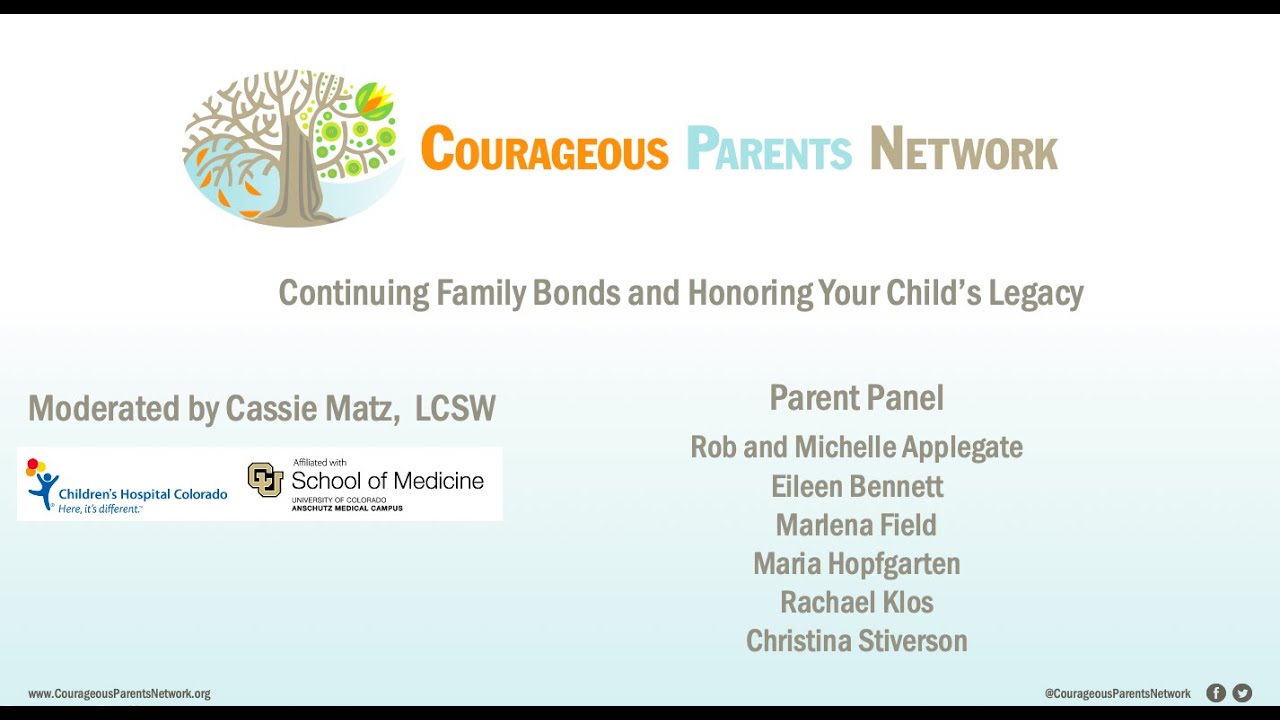
Many bereaved parents find that creating a legacy for their child and continuing their relationship with them in new ways can be healing. Join us as we talk about Continuing Bond Theory with bereaved parents and discuss the ways in which they build their child’s legacy and remain connected to them in their everyday lives.


Theme: Bereavement: Maintaining Connection, Continuing Bonds

Dear Beauty,

Time is crawling to January 20th, the one-year anniversary of the day you took your final breath on my chest in our bed. We had a dance party the night before. Your posse came over: aunts, uncles, grandparents, closest friends, and your loving nanny Tia. We sat in the warm kitchen with music on and passed you from one set of arms to another. Everyone wanted one last dance with you. We didn’t mess around with only slow songs. You danced to Havana and Danza Kuduro, too. Somehow, you mustered the energy to sway and rock with each of us, despite not having had anything to eat or drink for six days. That night, January 19th, we laughed and cried and sang and danced. And we held each other. We let our snot and our tears rest on each other’s shoulders; we didn’t wipe any of them away. We ate ice cream after dinner, as we do every night. And on this night, we rubbed a little bit of fresh mint chocolate chip against your lips. Maybe you’d taste the sweetness.

Reggaeton and country music. Blueberry pancakes and ice cream. Deep, long sobs and outbursts of real, raw laughter. Conversations about what our relationships mean to each other and why we are on this earth.

This is grief in our home.

We lost our first-born daughter, Havi Lev Goldstein, on January 20th, 2021, at 9:04am. She died peacefully in our bed, in our arms. She died from a cruel disease called Tay-Sachs, that strips your mind and body of every function over 12-18 months. Havi was two years, four months and sixteen days old when she died.

My husband, Matt, and I underwent preconception genetic testing for Tay-Sachs disease. We are both Ashkenazi Jewish, a population that has a higher risk for having a mutation in the gene that causes Tay-Sachs. We took our genetic testing very seriously. My testing results came back showing that I was a carrier; Matt’s results said he was not. Given the autosomal recessive nature of the disease, both parents need to be carriers for the fetus to be at risk of inheriting the disease. Months later, we were pregnant with our first child.

Tragically, Matt received the wrong test, and his carrier status was mis-reported. Matt was in fact, a carrier for Tay-Sachs. 15 months into her life, we learned that our daughter, Havi, was now a victim of this fatal, progressive neurodegenerative disease. In an instant, we were transformed from being not only first-time parents, but now first-time parents of a dying child.

From the date of Havi’s diagnosis, December 17th, 2019, to her death on January 20th, 2021, we followed her lead. She never spoke a word, never walked a single step. But she communicated powerfully through smiles and tears, through the brightness of her eyes and the back-and-forth movements of her head. She loved, deeply. And when you closed your eyes and listened closely, her voice was clear.

Havi taught us that life can be even more beautiful and painful than we ever imagined. And when we live at the edge of that deepest beauty and deepest pain, then everything—our hearts, our world view, our community—will deepen and expand.

We honored Havi’s life every Friday night with family and friends in a celebration that we called Shabbirthday. The word is a combination of Shabbat and Birthday. Havi’s favorite food, the only food that she ever crawled toward, was challah, the braided Jewish bread that we eat every Shabbat. And we knew that her birthdays would be limited to two. That was not enough. We wanted more. So, we threw Havi 57 Shabbirthdays before she died. Balloons, cakes, beach walks, fancy dinners, always a challah, and beautiful songs and prayers. We didn’t pretend to be happy on these Shabbirthdays. We weren’t. We were heart broken. We didn’t throw parties to distract or numb the pain. We found moments of beauty and celebration embedded in and between our deepest pain. We knew we needed the love and support of our closest people right there with us, too. And we treated every moment as sacred, not scary. As holy, not superficial.

This is grief in our home.

Since Havi’s death, we continue to honor Shabbirthdays every Friday. Now, we read poems, listen to Cole Swindell’s, ‘You Should Be Here’, and close our eyes tightly to try and recall the feeling of her wrapped tightly in our arms. Sometimes it’s hard to breathe. Sometimes I don’t want to open my eyes at the end of the song. And sometimes, I feel okay. Sometimes I can even smile through the song and cuddle with our beautiful younger daughter, Kaia. Whatever the feelings are, however the anguish of grief is manifesting, I pay attention.

Havi’s story is for anyone who has lost the person they love most in this world; for anyone who has watched someone they love lose their beloved; or for anyone who has yet to be touched by their own tragic loss and is open to learning about what it might feel like for them one day.

For me, Havi’s death is not a one-time event. It happens over and over again every moment she is not where she is supposed to be: Picking out a mismatched set of clothes that look adorable anyway; walking into preschool with her little hand gripping my index finger; pausing between the slides and the swings for a few bites of fig bar at the playground; playing with her little sister who looks up in admiration at her god given best friend. The losses are layered and constant. And they will accrue, every day, and on every missed milestone until the day I die. I’m not sure people understand that about losing a young child.

I think that the only way to be okay is to keep inviting our dead into those spaces, to keep them present in those moments where they should be. And not in a delusional way, either. Only in a way that helps us to create new memories and experiences with them since their life on this earth was so tragically short. Relationships don’t have to end when the physical ends. We don’t need to relegate them to the margins. As our therapist, Dr. Joanne Cacciatore puts it: We keep them right in the front row. From that place, they can participate actively in the life they were meant to have. And we can be proud to include them in it.  And they can continue to encourage us to live a life of fullness and in service to others.

Even after only one year on this earth without Havi, my relationship with her has undergone profound and deepening changes. In the same way that relationships in the world of the living require immense attention and constant adjustments, so too, do our relationships with our dead. There are moments when I can still feel the touch of Hav’s softest cheeks against mine and there are also moments when I feel far away from her. There are times when I can hear her voice in my head and in my heart and times when the silence is everywhere even though I’m begging for her to show up.

A lot of this journey is a solitary one, but it’s made so much easier when other people in our lives keep Havi present. This looks like so many beautiful things: Havi’s name written in the sand; outfits in the color purple; beautiful sunsets over mountains filled with wildflowers; a glass raised ‘To Hav’ before dinner begins; hand-written notes sharing spontaneous memories of Havi; photographs on a bookshelf; text messages on important dates; acts of kindness in the spirit of a beautiful little girl. We do not need to ‘move on’ and we never will. We want to be joined in existing in the space where love and pain coexist for that is the space where we are closest to Havi. We, we all, can be changed forever by the power of loss. Falling into its embrace can make us more powerful, more productive, more alive, more compassionate and more human. But that growth is ours to discover and cannot be rushed or forced.

I wish we were kinder to grieving people. I wish we understood that grief is not scary. Losing Havi is the worst possible thing I could have ever imagined as a new mother. It is tragic and unnatural. But what is natural is to want to keep her close to us, to want to make her proud, to want to make the world better in her name, to want other people to know and love her. Those are all natural, quite beautiful, instincts that keep grieving people feeling like they will be okay, and maybe even that they can become bigger and better versions of themselves.

I know my relationship with grief, and with Havi, is going to change many more times in my lifetime. I only hope that there will be more safe places to inhabit my suffering when it does.

Children are not supposed to die before their parents. But they do. And they do in this country, they do in our neighborhoods. And there are thousands of children, and their parents, who deserve a dance party filled with deep soulful sobs, uncontrollable laughter, and the rhythm of the music keeping us all on our feet for one more day. And most importantly, they deserve to be remembered.

Theme: Bereavement: Maintaining Connection, Continuing Bonds

 SHARED STRUGGLES

My son, Jack, was born on a cold November morning in 1998. Jack made his entrance into this world 7 weeks early. After a mostly uneventful stay, Jack left the NICU six weeks after he was born accompanied by an oxygen tank and pulse oximeter. He joined his two older sisters at home and our family of five settled in, expecting Jack’s need for supplemental oxygen to be short-lived. He just needs more time to grow, they told us

A month after he was discharged from the NICU, Jack had an apneic event at home (and  yes, rescue breaths really do rescue), and he spent the next three months bouncing in and out of the PICU for respiratory distress. Following several surgeries, multiple failed attempts at extubation, and an inconclusive muscle biopsy, Jack was discharged from the PICU with a trach, g-tube and connected to a ventilator to assist with his breathing. Prior to discharge, I was told I needed to choose a pulmonologist to follow Jack on his ventilator. Not being enamored with any of the pulmonologist I encountered during Jack’s PICU stay and finding out that a highly recommended pulmonologist at another hospital was not taking new patients, I was at a loss for who was going to manage Jack’s ventilator. Providentially, one of the PICU intensivists, Dr. Barry Markovitz, offered to take on the unconventional role of managing Jack’s care, along with a critical care fellow he recruited to help.

After several years, when it was clear that Jack would need long-term ventilatory support, his care was taken over by a pediatric pulmonologist who specialized in the management of ventilator dependent children. However, despite this break in the doctor-patient relationship, Barry and I stayed in touch over the course of Jack’s life – me, always seeking out Barry’s advice and reason in connection with Jack’s care, and Barry always willing to listen and help in any way he could.

Jack was ultimately diagnosed with a rare congenital muscular dystrophy known as  Dystroglycanopathy CMD. Jack’s form of CMD affected his muscles, eyes and brain. Despite being born with a disease that stole so much from him, Jack radiated love every day of his life.  My beautiful son, who could not purposefully move his body; who could not sustain his breathing without the assistance of a machine; who never enjoyed the experience of eating food; and who never spoke the words his mind so clearly held, woke up every morning with a smile on his face and eyes that sparkled with the anticipation of a new day. Jack lived a love-filled life for 15 years. On January 5, 2014, Jack died from complications of his disease.

After Jack died, I was lost. For fifteen years, my life was centered around Jack and his intense needs. What was I supposed to do now? Just as he had those many years before in the PICU when I needed someone to manage Jack’s vent, Barry showed up. Eight months after Jack died, Barry suggested we write a book together (although, if you ask Barry whose idea the book was, he will insist it was my idea, but I am certain it was his!) Nevertheless, together we envisioned a “both sides of the story” in the care of medically complex children kind of book. There were books written by parents and books written by doctors, but this would be the first book we knew of that would bring the stories of parents and doctors together. We knew that the people we needed to make it happen – the parents of medically complex children and the pediatricians caring for these children – were exceptionally busy people. Asking parents deep in the trenches of caring for their child and physicians overwhelmed with patient and academic responsibilities to take the time to write a story for the book was, admittedly, an intimidating endeavor. We reached out to our respective networks of parents and colleagues not knowing what to expect, but hoping for the best. The response we received was overwhelmingly kind and supportive, and on April 28, 2021, Shared Struggles: Stories from Parents and Pediatricians Caring for Children with Serious Illnesses was published.

Shared Struggles is a compilation of 46 stories written by parents and physicians that are grouped under four sections: Compassion, Trust, Communication and Hope. The parent stories tell of interactions with physicians that had a significant impact on them and their child and offer context and insight that promote empathy and reflection. The physician stories tell of interactions with patients and families that served as learning moments in their career and promote the humanization of medicine. Following each story is a parent commentary written by me and a physician commentary written by Barry. The commentaries provide an independent perspective on the events and messages conveyed by the story contributor and are intended to encourage reflection, inquiry, and discussion.

Shared Struggles was written over the course of six years, but its roots were planted over twenty years ago in a pediatric intensive care unit when a special connection was made between a little boy named Jack, his mom, and a doctor who agreed to follow a kid on a vent even though it was outside the box. While we never imagined where that connection would take us, it seems only fitting that it would lead to the unconventional bringing together of parents and doctors to share their personal stories and experiences in this first of its kind book.

While working on Shared Struggles, I was in awe of the selflessness of the parents and physicians (many of whom did not even know me) who took time out of their busy lives to write a story for the book. I was deeply touched by their willingness to share such personal, and sometimes heartbreaking, stories, and by their enthusiasm for the need for a book like Shared Struggles. The prevailing messages that came through in this book are that parents are relentless advocates for their children and will do whatever it takes to make sure their child receives the best and most compassionate care possible, and that the physicians who care for our children truly do care about our children and they are impacted and often profoundly changed through their experiences in caring for our children.

As I hold the book in my hands and read the words on the back cover that say I am “the parent of a child born with a chronic complex condition who has more than 15 years of experience interacting with pediatric subspecialists and other healthcare professionals who cared for her son”, it sounds so foreign to me after so many years of being away from “the life.” In editing the stories and writing the commentaries, there were many times I questioned my authority to have any say in the stories and experiences shared. Yet, when I gave myself some grace, the words flowed. Because I do understand the experiences shared, and I also understand that this book is more than just an opportunity to bring parents and physicians together, it is an extension of why I was given Jack and why I was given the connections he brought to me and why I was given the lessons I learned as his mom. Shared Struggles is not my book, it is a collective effort, and will always be “our” book. But it is also Jack’s legacy and a reckoning for me of the “why” of all the hard that came with being Jack’s mom. The opportunity for this book came because Jack lived AND because Jack died. The price was high (too high), but to be given the opportunity to find the good in the hard is a gift I will always be grateful for.

Listen here to the podcast conversation between CPN’s Blyth Lord and co-editors Ann and Dr. Barry Markovitz

Shared Struggles can be ordered on Amazon: https://www.amazon.com/dp/3030680193psc=1&ref=ppx_yo2_dt_b_product_details)

or from the publisher’s website: https://www.springer.com/us/book/9783030680190

*All proceeds from the sale of Shared Struggles will be donated to various non-profit organizations that support children with medically complex children and their families.

______________

The Foreword to Shared Struggles written by pediatric palliative care physician, Dr. Christopher Adrian:

My mentor in palliative care fellowship once told me that most of what we do as palliative care providers can be summed up as helping the hospital learn and understand what’s going on in the patient’s room. By “the hospital” he meant the whole panoply of medical and psychosocial care providers assigned to the patient, orbiting near and far from the bedside, anybody who might open up one of our consult notes to read the documentation of conversations in which we asked parents to tell us about their hopes and worries, about the sources of their strength and support, and most importantly, about who their child is, not as a patient, but as a person, because a parent’s portrait of a child is a portrait of a parent’s values and a family’s values. By “the room” he meant not just the space enclosed by the four brightly colored walls, but the emotional and spiritual milieu in which the patient and family lived, loved, and hoped—the ordinary physical space being a metonymy for an extraordinary metaphysical space that housed not just the bodies of a patient and their family, but also their stories and their spirits.

This book is an exquisite collection of just that kind of story. To read it is to learn just how much goes on inside “the room,” just how rich and terrifying and beautiful any one family’s experience of the hospital can be, how totally different every family is in their unique phenotype of daily struggle and triumph, how very much the same they are in the example of profound loving they make to us all.

But this book collects the story of what’s going on in another room, one that intersects and overlaps with the physical and metaphysical spaces of the patient’s room. The doctor’s room is a workroom on the unit, but also the empty storeroom into which they might retreat to collect their thoughts and feelings, or the car in which they make their commute, and like the patient’s room, the doctor’s room expands to encompass their home, their own family, their friends. It is the head-space and the heart-space in which they attend to the patients and families under their care.

To collect and juxtapose these stories is already to make something beautiful for the world at large and useful for the community of care for children with serious illnesses and their families. But “Shared Struggles” takes the risk of committing itself to reconciling these stories, by means of parent and physician commentary which engage with the content from positions of equal and complimentary expertise. That risk elevates the beauty and use of the book such that it becomes something entirely astonishing and necessary and completely one-of-a-kind: a textbook of connection between physician and patient and family, one that illustrates in real time the process of reconciliation between the lived experience of each party, a reconciliation that is the fundamental act of pediatric medicine.

As pediatric medical providers, we talk about the art of medicine as something we practice upon patients, not often recognizing that patients and families, and parents especially, practice their own art of medicine, not on their children or themselves, but upon us. They are called to manage us, in the course of their child’s illness, just as much as we are called to manage their children, as they partner with us in loving care, seeking always to find a way to accept the help we offer while protecting their child from any harm we might do. You cannot tell someone how to practice such an art any more than you can tell them how to be compassionate, or empathetic, or kind. But that doesn’t mean instruction is impossible. Such attributes, and such art, can be fostered and encouraged into sturdy practice. You can’t simply tell someone how to make a genuine connection with their patient, how to shape their professional boundaries, not as lines in the sand, but as contours along the heart. You can’t just tell someone how to balance advocacy for their child with trust for a provider, how to put faith in the love of a stranger for their child and never lose faith with oneself. But you can certainly show them how to do it, as this collection shows us, with unparalleled richness and sincerity, over and over again.

________________