 English
 العربية
 Français
 Español

Cerebral/Cortical Visual Impairment (CVI)
Cerebral/Cortical Visual Impairment (CVI) is a condition where the brain has trouble understanding what the eyes see, even though the eyes themselves may be healthy. Children with severe neurological impairments and CVI may have difficulty noticing objects, recognizing people, or focusing on what’s around them. This can make learning and exploring the world even more challenging. CVI is a lifelong condition, and children benefit from support from a team of specialists—including neurologists, eye doctors, teachers, and related service providers —who work together to meet the child’s individual needs and help them engage with their environment as fully as possible.

Your Team:
A credentialed expert who evaluates, trains, and empowers individuals with visual impairments to use assistive technology for independence in education, employment, and daily life.
A specialist for visual symptoms or loss resulting from brain diseases.
A therapist who treats through the therapeutic use of everyday activities. They help patients develop, recover, improve, as well as maintain the skills needed for daily living and working.
A medical specialist in the diagnosis and treatment of disorders of the eye.
A licensed, primary healthcare professional focusing on eye and vision health.
A certified professional who teaches individuals with visual impairments to travel safely, confidently, and independently in their environment.
A specialist in the treatment of disease or injury by means of exercise to improve movement and manage pain.
A therapist who can assess speech, language, cognitive-communication, and oral/feeding/swallowing skills as well as provide therapies and treatments to address any issues.
A licensed special education professional who provides direct or consultative instruction to students (birth to age 21) with blindness or low vision.
An ophthalmologist, neuro-ophthalmologist, or an optometrist who is highly knowledgeable about brain and eye disorders can diagnose your child with vision issues. A neurologist can diagnosis certain vision problems including Cerebral/Cortical visual impairment (CVI). Your child’s educational team may include a Teacher of Students with Visual Impairments (TVI), an Orientation and Mobility Specialist (O&M), and a Certified Assistive Technology Instructional Specialist (CATIS). Your child may also benefit from support from an occupational, speech or physical therapist.
What Your Child May Experience
Diagnosis
For a child to be diagnosed with Cerebral/Cortical Visual Impairment (CVI), their vision difficulties cannot be fully explained by problems with the eyes themselves. CVI is often seen in children with severe neurological impairments (SNI) and is identified when a child shows unique visual behaviors, which can vary depending on how and when the brain’s visual pathways and processing areas were affected. Diagnosing CVI involves a combination of steps, including a thorough eye exam, a review of the child’s birth, medical, and developmental history, observations of visual behaviors, and a functional vision assessment to see how the child uses vision in daily life. There is no single test that can confirm CVI, though sometimes additional tests such as brain imaging or eye movement tracking are used to support the evaluation. Because CVI is complex, a team of specialists—including neurologists, eye doctors, educators, and therapists—works together to understand the child’s unique needs and help support their vision development.
Common Signs
CVI can significantly impact visual attention and recognition, making it difficult for a child to visually access and engage with their environment. The signs of CVI can differ significantly from person to person, and it’s likely for someone to experience a combination of these challenges.
You may observe your child in the following ways:
- Inconsistent vision use
- Staring off without intent to engage
- Lack of eye contact
- Vision use more difficult when exhausted or not feeling well
- Batting or swinging to find an item rather than using a visually guided reach
- Meltdowns, overwhelmed, or upset in loud and busy environments
- A shorter attention span or they may seem disinterested in learning tasks
- The need for frequent visual breaks
- Difficulty recognizing common objects
- Lack of interest in new items
- Difficulty stepping off curbs, going down steps, or crossing thresholds
You may also observe your child using their hearing or touch to better understand their world. In addition, individuals with CVI may also have difficulties with motor function, sensory processing, and/or cognitive abilities.
Visual Behaviors in Children with CVI
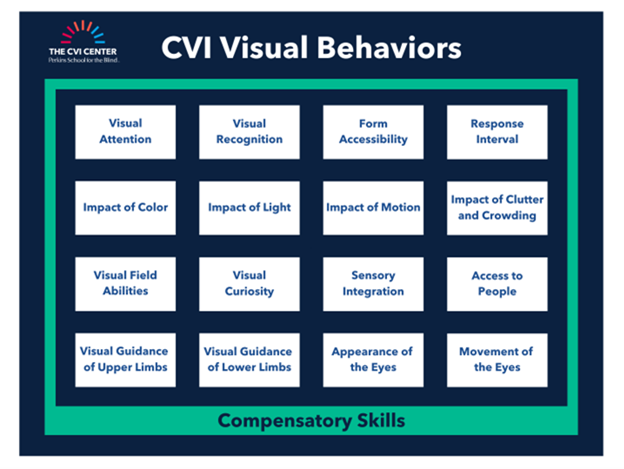
Children with Cerebral/Cortical Visual Impairment (CVI) often show a range of visual behaviors. These behaviors are connected and can affect how a child sees and interacts with their environment at any time. Understanding these behaviors helps parents and caregivers support their child more effectively.
- Visual Attention is a first step toward recognizing objects. For children with CVI, this can look different—they may glance quickly at an object, look indirectly, or focus for longer periods. Attention can be affected by how the child feels, distractions, or noisy surroundings. Familiar or favorite objects are often easier for them to notice.
- Visual Recognition is the ability to identify something just by looking at it. Children with CVI may find this difficult and often rely on other senses, like touch or hearing, to help recognize objects. Building visual memory can take time, so repeating activities and routines is important to help them learn and remember.
- Form Accessibility refers to the types of visual materials a child can best understand, such as real objects, pictures, or printed text. Children with CVI may see and respond differently depending on the form.
- Response Interval is the time it takes a child to notice, look at, and/or recognize something. Some children with CVI may need extra time to process visual information.
- Impact of Color is significant for many children with CVI. Bright, highly saturated colors often capture attention and make objects easier to recognize. High contrast and familiar colors can also help.
- Impact of Light is how a child reacts to light. Some children are naturally drawn to light sources like lamps or windows, while others may be sensitive to bright light (photophobia) and need dimmer environments to avoid fatigue or discomfort.
- Impact of Motion describes how movement affects vision. Some children may notice moving objects more easily, while fast motion or busy environments can be distracting. Tracking moving objects can be challenging for some children.
- Visual Field Abilities refer to how a child uses their central (looking straight at) or peripheral (seeing from the sides) vision. Some children rely more on their peripheral vision, and others on central vision. Eye health or other visual conditions can also affect how they use their visual fields.
- Visual Curiosity is the ability to notice and learn from what’s happening around them, sometimes called incidental learning. Children with CVI may have difficulty seeing objects up close or far away, which can limit their awareness of their surroundings.
- Impact of Clutter and Crowding describes how extra objects in the environment can make it harder to focus. Children with CVI may see one object at a time and benefit from a simple, high-contrast background.
- Sensory Integration is how the senses work together. Children with CVI may find it hard to use vision while also listening, touching, or moving. They may focus on one sense at a time, making it harder to combine vision with other activities.
- Access to People can be challenging. Children with CVI may have difficulty looking at faces, making eye contact, recognizing people, reading facial expressions, or understanding gestures. They often rely on other senses, like hearing, to recognize familiar people.
- Visual Guidance of Upper Limbs refers to using vision to guide hands for tasks like reaching or grasping. This can be affected by both visual and motor skills.
- Visual Guidance of Lower Limbs involves using vision to guide feet for walking, stepping safely, and noticing changes in the ground. This can be harder if gross motor skills are limited.
- Appearance of the Eyes looks at eye alignment, preference, and whether the eyes work together effectively.
- Movement of the Eyes considers how the eyes move in different directions and whether a child can shift focus smoothly from one object to another.
Developing Compensatory Skills in Children with CVI
Children with Cerebral/Cortical Visual Impairment (CVI) often develop strategies, called compensatory skills, to help them understand and interact with their world. These skills allow children to use their other senses—like hearing, touch, smell, and memory—to make up for what they might not see clearly. They also use strategies such as recognizing familiar routines, using context clues, and noticing color or patterns to understand their environment.
You might notice your child using these skills in everyday life. For example, they may:
- Open their mouth only when a spoon touches their mouth
- Respond to a favorite toy only when it makes a sound
- Find a button on a toy by remembering its location
- Predict what comes next in a familiar routine
- Recognize a favorite toy by its color
- Respond to your voice even if they don’t make eye contact
- Know it’s mealtime by smelling food cooking
Parents and caregivers can support these skills by observing their child carefully and learning their patterns. Making the environment easier to see, reducing clutter, optimizing lighting, and positioning your child for the best view can all help. Consistent routines, repeating activities, and using a multisensory approach—combining sight, touch, sound, and smell—can help build familiarity and confidence, making your child feel more comfortable and able to anticipate what comes next. Compensatory skills can also be reinforced in school or therapy settings, creating more opportunities for your child to access and understand the world around them.