
First published on Patient Worthy.
A parent’s perspective by Maria Hopfgarten, Courageous Parent Network Parent Champion
When you bring your typically developing child to the pediatrician, you quickly come to expect a certain rhythm to the visits. The doctor may mention upcoming developmental milestones, caution you about toddler tantrums, or suggest babyproofing before your little one starts crawling. These aren’t just casual tips—they’re examples of anticipatory guidance, a standard and essential part of pediatric care. It’s the way clinicians help families look ahead and prepare for what’s likely to come.
But when your child has complex medical needs, these conversations too often fall away. The focus shifts to the present—managing symptoms, coordinating care, reacting to what’s urgent. And in that shift, anticipatory guidance can be lost, leaving families without the roadmap they desperately need. The consequences can be painful and lasting.
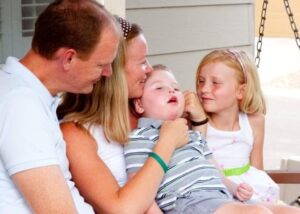 My son Jacob lived with mitochondrial disease for ten beautiful years. Though he couldn’t speak or walk, his radiant smile spoke volumes. Like many medically complex children, his care involved routines that became second nature to us. One afternoon, after a routine appointment, I lifted a 6-year-old Jacob into his car seat just like I had hundreds of times before. Nothing seemed unusual. Later that evening, while preparing him for his bath, I noticed his arm was swollen and discolored. He didn’t express pain—something not uncommon for him—but I knew something was wrong.
At the ER, we were given devastating news: Jacob’s arm was broken. Worse still, because the injury happened at home with no clear cause, child protective services were required to get involved. I was consumed by guilt. How had I failed to protect my son?
When the ER doctor returned after speaking with Jacob’s primary physician, he told us Jacob had osteoporosis, a known complication of mitochondrial disease. This was the first time anyone had mentioned this risk to us. That one missing piece of anticipatory guidance could have changed everything.
If we had known Jacob’s bones were fragile, we could have discussed bone health strategies and screening with his team, modified our transfer methods and adjusted our daily care routines to reduce risk. Most importantly, I would have known that his fracture wasn’t the result of negligence. It was a known possibility—one we just weren’t informed about.
Anticipatory guidance is not about predicting every outcome or preventing every complication. It’s about preparing families—medically, practically, and emotionally—for the road ahead. When clinicians share not only what is happening now, but also what may come, families are empowered to make thoughtful, proactive choices. And when challenges do arise, that preparation helps us meet them with clarity.
At Courageous Parents Network, we believe every family—regardless of diagnosis—deserves this level of care. Anticipatory guidance should not stop at milestones or medications. It must extend to the real-life experiences of caregiving: the physical lifts, the emotional weight, the decisions that shape each day. These conversations can be hard. They require time, empathy, and trust. But when we talk openly about what may lie ahead, knowledge can replace anxiety, and preparation can ease the burden of the unknown.
My daughter Bella was born 4 years ago with a very rare genetic disorder called Pontocerebellar Hypoplasia type 6 (PCH6), a mitochondrial disorder that is degenerative. She was given an 18-month prognosis and doctors told us to take her home, love her, and make as many memories as possible.
And here we are, over 4 years later, making memories. We’ve shared wonderful, problem-free days, and also fought through a lot of very bad days. The word “good” is all relative when you have a child with a life-limiting condition. “Good” is quite fleeting and your understanding of the word changes— sometimes from day to day, week to week, year to year.
Bella sets the mood of the day at our house. When we first brought her home and were trying to find the right cocktail for her seizure medications, there were a lot of bad days. I would sit and just hold her and cry, not being able to do anything to help her poor little brain calm down. When we got the seizures under control, the days started to get better. As we progress through her condition, it means doing what we have to do to maintain “good.” Whether it is more medication, more oxygen, a feeding tube, or more suctioning throughout the day. And I suppose when you deal with it day to day, you don’t really see so much how the disease is progressing and how much more you are doing to hold that line until you look back to where you started. Slowly, you learn to create a new normal and to adapt to it, setting new expectations of what a good day looks like.
I sometimes forget how normal it is and how comfortable I’ve become in talking about Bella, her condition, and our reality. Not that it doesn’t pain me beyond belief to talk about her struggles, but it also is a way to express myself. I am a member of a PCH support group and of course I can say anything to those parents. They know exactly what I’m talking about. It’s their “normal” too. So, it’s not shocking for them to hear what I have to say and consider a day a “good” day. But if I talk openly to others who are not in a similar situation about Bella, our daily life and routine, they are shocked. They cannot imagine living under these restraints, requirements, stresses, exhaustion, and limitations and calling any day a good day.
So what makes a day “good?”
Perhaps it’s just knowing that you did all you could to make your child comfortable, despite how challenging or hard the day may have been.
Maybe it’s just that your child had a few less seizures than usual and you didn’t even need to give extra doses of medication.
Maybe it’s getting the chance to spend more time with your child to play or read a book or just cuddle.
Or giving your child every opportunity to reach their potential.
A good day might be when your child perseveres despite the challenges.
Maybe good is just realizing that you have this one more day to share with your child, and you made the best of it.
 At the end of the day, I feel like I had a good day when I know that I did everything in my power to make Bella’s day a happy one, make her as comfortable as I could, and show her as much love as humanly possible. While sometimes I feel like we go through stages when there are many more bad days than good ones, Bella, so far, has fought through them and returned to her baseline. I know that someday that won’t happen, and she will be tired. But for now, I will fight for those good days with all my being, try to make even the hard days the best they can be, and give her everything she needs and deserves to live the best life of which she is capable. I know that my idea of a “good” day will change many more times during Bella’s time with us. The “normal” will change and I will grow to accept things that I never thought I would need or have to. But as long as she is comfortable, pain-free, and she continues to give me those tiny signals, that only I would understand, that she is happy and wants to keep fighting, I will fight for her, and beside her.
Walk Through a GOOD Day with Bella and Her Mom
I wake up at 6:00 AM feeling relatively rested because Bella slept through the night with no issues; the feeding pump didn’t go off in the wee hours of the morning, her oxygen stayed above 95, and she didn’t have any seizures during the night.
I enjoy a fresh cup of morning coffee and get started on my work. I feel lucky if I get most of it done before Bella’s routine starts and Bella’s two-year old sibling wakes up.
Bella wakes up with not too much gunk or reflux and we can complete her chest PT and morning routine with no issues. She gives me a few early morning smiles. I dress her while telling her how pretty she is. I put her trunk support and wrist braces on, and sit her up in her chair and she is calm. I am able to sit down for a few minutes and drink some of my second cup of coffee while it’s hot; before I have to reheat it three times.
She takes an early nap and wakes up again around noon in time for school (via distance learning). Bella has a fun day at school as we sing songs, work on an art project, and play with a sensory toy that allows her to experience a new smell, feel a new sensation, or hear a new sound. She sees other children, albeit through a screen.
Throughout the day she doesn’t have strong jerkies. She coughs on her own when she needs to, and doesn’t need deep suctioning more than two or three times. The feeding pump doesn’t get clogged or go off at random times.
When her feed ends, there’s not too much reflux and she is comfortable. We read a book (her favorite books are ones that are larger and have bright colors), or watch a show, play a game, or play with her sisters. She smiles as her little sister gives her a toy or a hug.
It’s wonderful if we can fit in a walk, since Bella loves to be out in the fresh air and feel the sunshine on her skin. After the walk, she comes downstairs with me to motivate me while I do a workout.
I remember to give all of her medications on time, and there aren’t any poopy blowouts. Evening comes and Bella accompanies me in the kitchen while I make dinner and her food. We listen to music together. She’s good company in the kitchen and I love to have her close so I can look over and see those rosy cheeks.
She doesn’t get any early evening jerkies or have reflux. I give her the evening chest PT treatment while talking to her about the day, and get all the gunk out so she can sleep peacefully. I lay her on the couch next to me to rest while we finally all come together as a family to relax for a bit before going to bed.
She is calm and cuddles in with her soft blankets and falls asleep on the couch. I put her in her crib and she falls asleep. All her stats are where they need to be, and she is peaceful and quiet. Her dad and I get a few minutes to talk, cuddle, or just sit together before one of us goes up to bed and another stays on the couch to sleep next to Bella that night. Bella gets her late medications and remains asleep. I get to bed before midnight.
And as I drift off, I remember that it is in fact Bella who gave me the best day of my life—the day she was born and she made me a mommy. Now it is my turn to make every one of her days the best day of her life.
Beth and her husband Bill live in Ashburn, VA with their three daughters, Kayla Joy, Isabella (Bella) Grace, Lilliana Faith and their dog Hunter. The family purchased an RV to travel with Bella who loves being out and about in nature with her family. Together they took a Make-a-Wish trip to Morgan’s Wonderland and Sea World. Currently, Beth is working on a quilt for Bella. Each piece represents a memorable experience with her daughter.
My friend Liz lives ten miles north of me. The journey between our homes can be made on a highway, but the more direct route hugs the blue-gray coastline of the Salish Sea. Densely populated stretches of land alternate with forests that cascade down hills towards the sea, lining narrow beaches. The Olympic mountains dominate the western horizon and shield us from the open ocean. Our inland sea is gentle, providing shelter to marine life, boat traffic, and us.
I met Liz, not because we lived 10 miles apart, but through impulse born of desperation. In the unhinged, delirious weeks of grief that followed my son Lucas’s death, I roamed the streets and the internet in equal measure. On the streets, I wandered aimlessly. I often ran to the water. The sea, it turns out, is a good place to scream. Train tracks run along many beaches, and between crashing waves and thundering wheels, there is space for the primordial howl of grief.
On the internet, I searched for someone, anyone, that had lived this journey. Who understood the forces that had shattered our lives. No one I knew understood what it was like to fight for your child for two and ½ years, and then abruptly experience their death.
I found Liz on the internet, where she wrote about her son Colson. I learned that Colson died from the same rare mitochondrial disease that killed Lucas. Improbably, Liz lived nearby. Maybe, I thought, she could help me? When I reached out on social media, I was surprised that she wrote back right away.
Liz suggested we meet at a coffee shop near the sea. As we set our things down at a tiny table, she looked at me with understanding and offered a wordless hug. No one had looked at me like that since Lucas died. No one I knew understood. The invisible cord of tension wrapped around my chest loosened its grip, and I found myself crying on her shoulder. She did not pull away.
We talked for hours at that tiny table. I learned that Colson died two years before Lucas. At the same Children’s Hospital, in the same stretch of early December. Colson was a beautiful little boy with soft, pillowy cheeks and blue-gray eyes that reflected the sea on a sunny day. He and Lucas were very different, but they also had much in common. A diagnosis, doctors, many medical complexities.
In our conversation, Lucas was welcome. My gregarious, smiling boy. I could share his whole story: the devastating diagnosis and resultant suffering, his bubbly personality and beautiful life. When I stumbled through the parts of Lucas’ story that I find most excruciating, Liz met me with kindness and compassion. Before I left, she pressed books into my arms and gave me another hug.
Driving home, I felt a subtle shift, a sense of relief. Nothing had changed, but I was no longer alone. Liz had offered new guideposts for grief, in the forms of books and ideas and her own tenacious grip on life. And beyond guideposts, I realized that perhaps Liz had offered me something else. Was it possible that in this awful life without Lucas, I had also met a friend?
Adult friendships are not easy to make. The easy camaraderie of high school and college does not necessarily translate to the rhythms of adulthood. If you become a parent, your adult relationships are often shaped by your children. As a rare disease parent, the only friends that will remain are those that choose to learn this new life alongside you. They will be a different kind of rare. You will conclude (once again) that rare is wonderful.
Liz and I are very different, but like our sons, we have much in common. We are both the eldest of six children. We believe donuts are an essential food group. We grew up in strict faiths that we no longer observe. Perhaps most importantly, Liz and I share a passion for poetry, for reading, and for writing. She is a skilled writer and omnivorous reader. A few months after we met, she introduced me to a literary arts community, helped sign me up for my first writing class in years, and encouraged me to blog in this space for CPN.
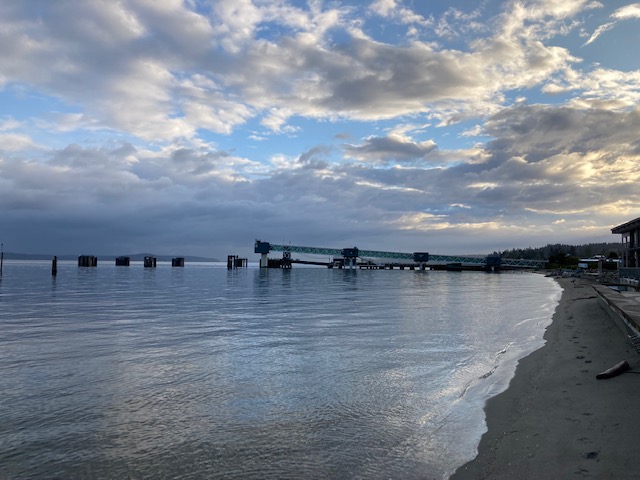 We often meet near that coffee shop and walk along the sea. When I saw Liz most recently, we stayed out on the wind-whipped coastline until we were stuttering with cold. A train went by, drowning out all conversation. I did not feel the need to scream.
As I told Liz, I have only just begun to grasp that Lucas is dead. Fourteen months into a life I do not want, I see that I cannot will him back. He is not just in the other room. In understanding Lucas’ absence, I see his presence in different ways. Perhaps it is inevitable that I would see this friendship with Liz as a gift from Lucas and from Colson.
Would I rather have Lucas back than any gift? Yes, a thousand times over. All bereaved parents would tell you that. Am I simultaneously and profoundly grateful for this friendship forged in grief? Yes. These realities can co-exist, if only because they already do. One does not vanquish the other.
In a week where many people celebrate love and friendship, I celebrate a rare friendship. A friendship that offers a gentle place for grief. A sheltered sea, perhaps, when so much else feels like traversing the open ocean.
I know this friendship was made possible by our deep and abiding love for our two rare boys. Lucas and Colson, it is because of your unique and irreplaceable lives that we are here. That a new friendship was formed. The words fall short of their meaning, but I’ll say them anyway: We love you.
________________________________________________________________________________________________________________
Kim Gilsdorf writes and lives with her family in Seattle, the traditional land of the Duwamish people. She works for Perigee Fund, an organization dedicated to supporting early childhood mental health. Her favorite title is “Mama” to her two children, Lucas and Sophia. Lucas lived with and died from a rare disease, Leigh Syndrome, and his life has forever changed the meaning and purpose of hers. You can find Kim’s writing on Instagram at @kgilsdorf.
I’ve always believed in the power of words. It’s amazing to think that a series of symbols can inspire, educate, entertain, convince, unite, divide, and heal us. They can make us fall in love – and out of love, too. The right words make us believe in a vision or an idea or a politician. The wrong ones make us turn away.
I spend a lot of time engaged with words, whether reading, writing, or even playing three word-games every morning before I get out of bed.
One of my closest work friends has never let me live down the time I held up a three-day meeting that everyone else was ready to end because I wasn’t convinced we had the brand statement we were working on exactly right. “Words matter,” I declared. There were more than a couple of eye rolls in the room, but you can bet when we emerged 90 minutes later we’d crafted a perfect document.
So when my daughter, Dalia, was diagnosed with MERRF Syndrome, I parsed through every word the doctors said. I pored over every entry I could find on Google and compared notes with my husband and father, who were doing the same thing.
But for the first time in my life, the words made everything feel blurrier. They rendered me more confused, not less.
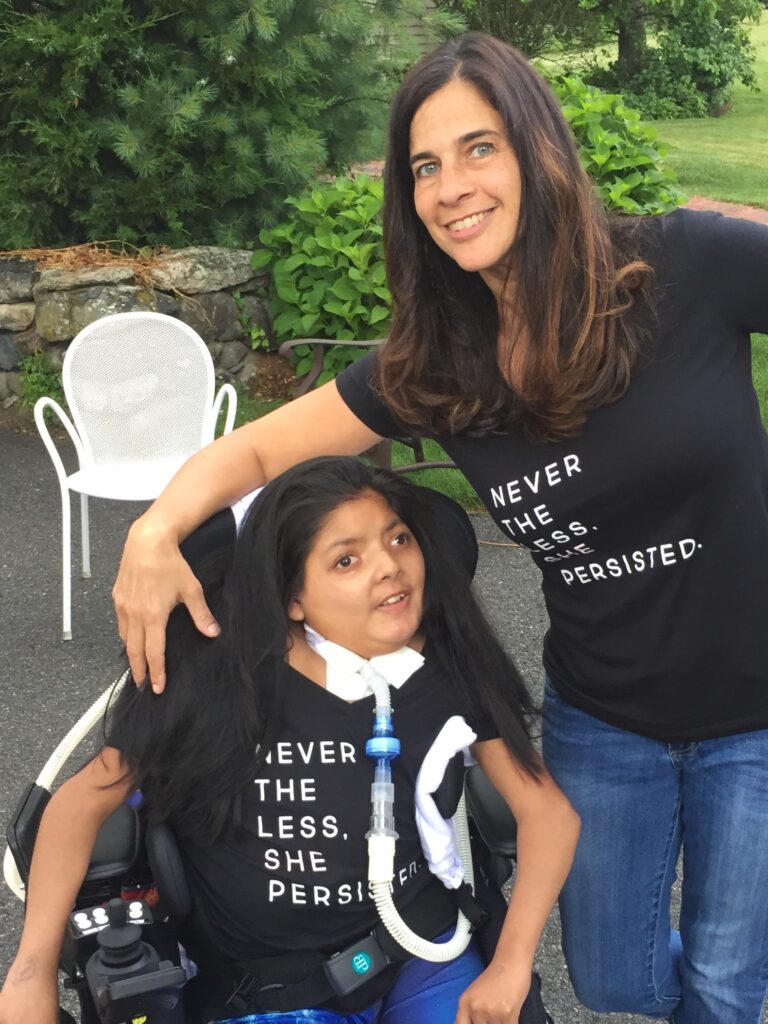
The doctor said Dalia had a mitochondrial disease. I didn’t know what mitochondria were. He said the disease was degenerative. I could guess what that meant, but I had no understanding of the likely speed or degree of the degeneration. The more he said, the less I heard. “Every organ relies on mitochondria to function properly,” he explained. “If your mitochondria aren’t working like they’re supposed to, neither can your body.”
What in the world was he talking about? It was simply too much to take in, so I tuned him out, focusing instead on the mental images of Dalia playing with her brothers, snuggling in bed while I read to her, and dancing to Katy Perry. The images diffused the harshness of his decree.
When it came time to share the diagnosis with family and friends, I couldn’t come up with the words. Instead, I shared a definition of MERRF from the National Institutes of Health. Let somebody else’s words do the heavy lifting, I figured.
But I chose to ignore the very definition I shared with my inner circle. I viewed the list of symptoms as a menu, rather than a prescription. I chose to believe that while she had muscle twitching, hearing loss, and short stature, she’d be spared the blindness and dementia. Those words made the blood in my arms burn and my fingers tingle. They made me sweat and feel queasy. I picked the words I could stomach, as it were.
Once my people knew about the diagnosis, the burden of finding the right words shifted to them. The problem was that nobody knew what to say.
And who could blame them? I didn’t know what I wanted to hear.
I didn’t like it when they told me about their daughter’s sprained wrist or the stress they were feeling getting ready for a vacation or the birthday party they were planning for their son. Those things suddenly felt foreign, like fading memories of an old movie I used to love. But I didn’t like it when they censored what they told me either. If my friends couldn’t share authentically with me, how would the friendships survive?
There was also a whole new category of words that made me cringe inside.
“I can’t imagine.”
“You’re a superwoman.”
“God only gives us what we can handle.”
Of course I knew that people were trying their best, acknowledging that what we were dealing with was really, really hard, beyond words even. But the words they chose stung nonetheless.
I’m sure I’ve been the one saying the cringey things more times than I can count. I’ve never been particularly comfortable sitting in silence and have used words to try to fix things for others, even when those things were beyond fixing.
I’ve learned though, that sometimes words don’t really matter. What matters more is simply showing up. When we’re grieving or suffering or going through hardship we just need to know we’re not alone. Maybe that does look like sitting in silence. Maybe it looks like sharing a meal or taking a walk or just listening to what our friend who’s in pain wants to share.
And sometimes, it can even look like just acknowledging somebody. Recently I was in line at the grocery store when a teenager in the aisle next to me began to shout, “Hello! Hello! Hello!” Shoppers and checkout clerks and baggers all turned to see where the noise was coming from and quickly averted their eyes once they figured it out.
I looked at the girl and said, “Hello.”
The girl’s mother turned to me with tears in her eyes and said, “Thank you.”
I looked right back at her, my own eyes tearing up, and smiled. A simple “hello” meant so much more. “I see you. I see your daughter. I honor you both.” I knew that’s what she heard because I’d been that mother more times than I can count.
The words don’t have to be perfect. They just need to come from the heart.
________________________________________________________________________________________________________________
Jessica Fein writes about the mingling of joy and sorrow, mothering a child with a rare disease, and staying rooted when life tries to blow you down. Listen to her podcast, “I Don’t Know How You Do It,” .
Her memoir, Breath Taking: Rare Girl in a World of Love and Loss, is coming in May, and is available for preorder now at Amazon.com and Bookshop.org. Visit her website or connect with her on IG for real talk about love and loss @feinjessica
If I’d given it any thought ahead of time – before the anticipatory grief and the ambiguous grief and the conventional grief wrapped around me like a weighted blanket – I’d have imagined the sadness. Grief as I understood it then comes when you lose someone you love. Sadness would be the obvious response. And because I learned about the supposed “five stages of grief” in my Intro to Psych course, I wouldn’t have been surprised to experience a bit of anger or denial, too.
But the layers of guilt took me by surprise when they showed up and settled in for an extended stay.
In general, guilt is something I’m fairly intimate with. I feel guilty when I burn the chicken or don’t help my child study adequately for his test or forget my friend’s birthday. But the kind of guilt I’ve met through all aspects of grief has little in common with these fleeting feelings of remorse.
When my daughter Dalia had a tracheostomy and lost her ability to speak, she came up with new ways to communicate. She’d point and nod and mouth the words she once enunciated in her sweet singsong voice. And sometimes, she’d slap the bed.
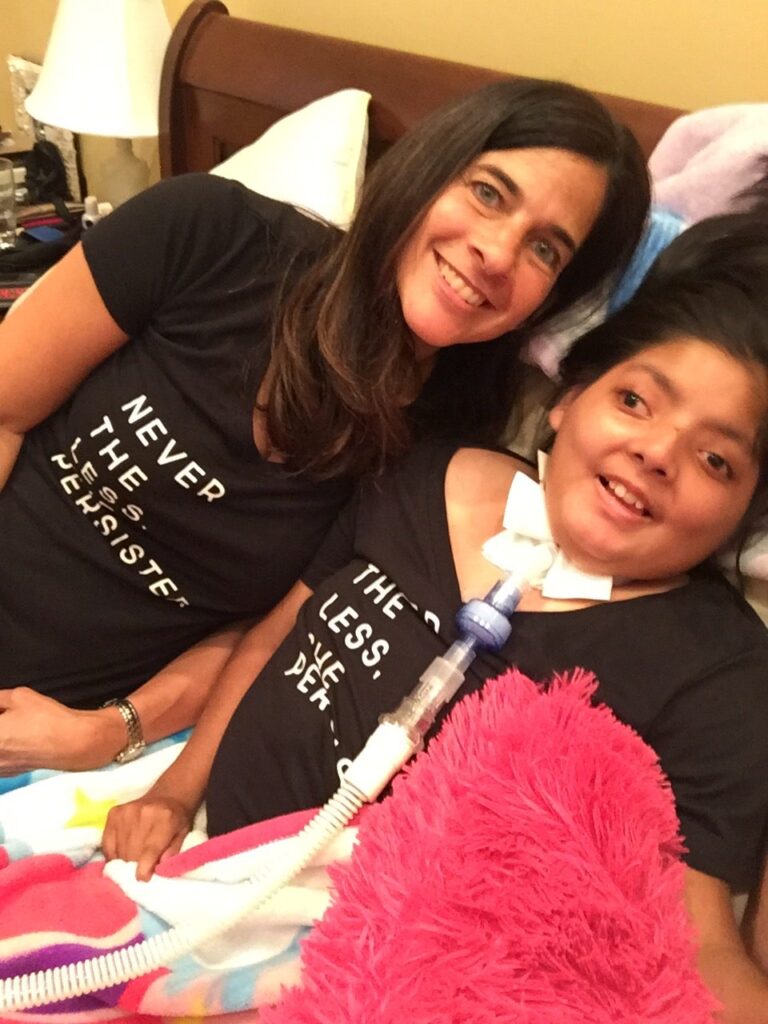
At night, after I emptied the syringes of medicine into her g-tube and set up the food pump and read from her favorite book and sang the good-night song to her, I settled into the armchair to wait for the overnight nurse. But Dalia didn’t always want to go right to sleep. She hit the bed to summon me, wanting more blankets or fewer, wanting me to rearrange her pillows or rub her forehead. I got up quickly the first and second and even third time. But by the fifth or sixth I was annoyed. I was tired. I wanted to read my book. I knew she was teasing me with her continued requests.
How in the world could I have gotten frustrated? I felt guilty the next day and I feel guilty today, years later. Dalia couldn’t fix her own blankets or pillow. I’d give my limbs to be able to do it for her now.
There were also times when I felt sorry for myself. Why did my daughter have a rare disease? Why couldn’t I go out to dinner with my husband without hiring both a nurse and a babysitter to take care of my kids? Why did I have to squeeze appointments with my daughter’s physical therapist and pulmonologist and respiratory therapist into my busy workday?
Then I saw Dalia’s eyes light up when I went to pick her up early from school for the appointments. I watched her work so hard to move her legs during therapy or kick her legs with glee when she heard “Shake It Off.” She didn’t seem to feel sorry for herself at all. I felt guilty for being upset about the relatively small challenges I was facing while she was meeting her huge ones with grace and smiles.
On the flip side, I found a way to feel guilty when I was happy, too. When we raced Dalia up and down the ramps at the skatepark in her wheelchair or had water fights with the saline bullets or danced together, even when all Dalia could move was her shoulders, joy pushed sadness to the fringes of the room. But then guilt peeked around the corner. How could I be happy with the way things were? Did that mean we weren’t trying hard enough to change the trajectory?
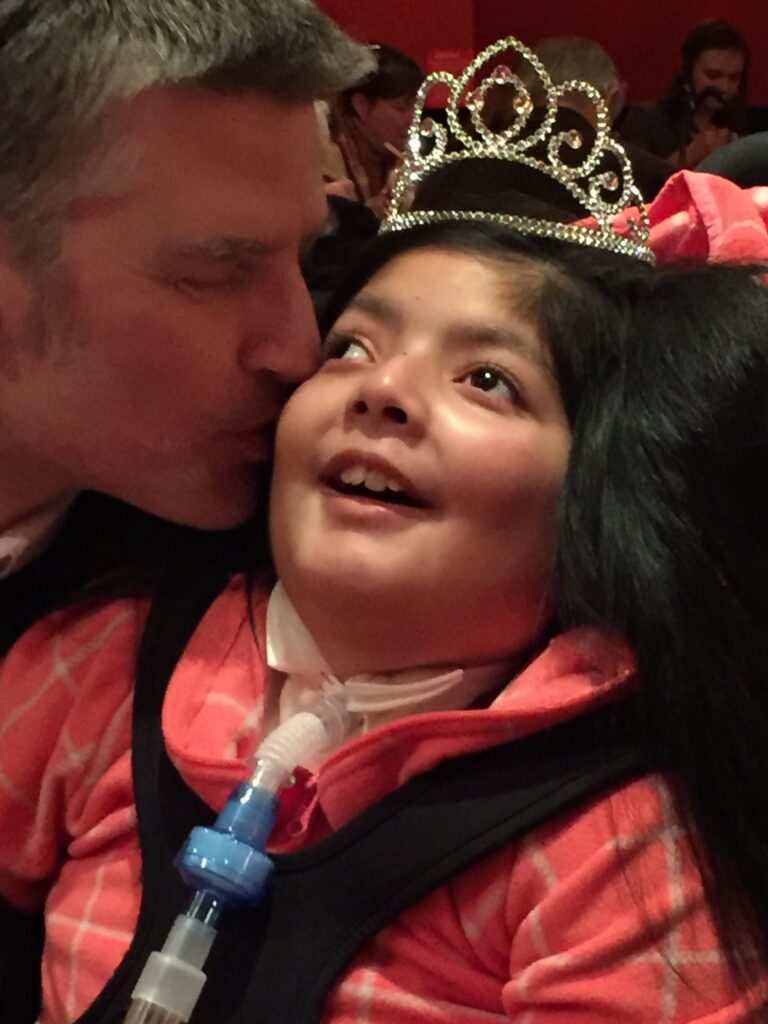
Since Dalia passed away, there have been so many times guilt has reared its head. When my husband and I took our other two kids on a hiking trip to Arizona I felt guilty having so much fun doing something that wouldn’t have been possible when Dalia was alive. When I enjoy the freedom of being able to go out to dinner at a moment’s notice or take a trip to New York without weeks of planning, I feel guilty.
Years after my father died, I found a sealed envelope with my name on it in one of his files. It was a letter he’d meant for me to read after he’d passed away. In it he wrote, “Never feel even a twinge of guilt when you laugh, when you forget, when you live as fully as you can.”
Now, when I feel guilty, I think about what my father said. I believe Dalia would agree with him.
So where does that leave us as we brave the season of gratitude? Can we be grateful when we’re grieving? And if we feel grateful, should we then feel guilty?
There’s a saying inscribed on throw pillows and journals and half of the other merchandise in Home Goods: “Choose Happy.” The saying gives me pause. I love the idea in theory, but it seems wildly simplistic, a chastisement for people who have every reason to be sad.
But if we can choose what we do feel, maybe we can choose what we don’t feel, too. I wonder if it’s possible to choose not to feel guilty. That’s a throw pillow I could get behind.
There’s nothing to be learned from guilt at this point. I know I lived every minute as fully as I could with my daughter. I know that moments of frustration or sadness were par for the parenting course. Most importantly, I know she’d want her memory to bring me joy, not regret.
Besides, I am in fact eternally grateful. I’m grateful that I got to be Dalia’s mother, that she showed me what it means to be brave and empathetic and to radiate joy.
There will always be room for grief. I welcome it as a reminder of my love. But I’m going to do whatever I can to close the door on guilt. Grief and gratitude can stay as long as they want, but guilt isn’t welcome here anymore.
________________________________________________________________________________________________________________
Jessica Fein writes about the mingling of joy and sorrow, mothering a child with a rare disease, and staying rooted when life tries to blow you down. Listen to her podcast, “I Don’t Know How You Do It,” including her discussion with Kelly Cervantes.
Her memoir, Breath Taking: Rare Girl in a World of Love and Loss, is coming in May, and is available for preorder now at Amazon.com and Bookshop.org. Visit her website or connect with her on IG for real talk about love and loss @feinjessica
How can something so universal also be so utterly isolating? That’s the paradox of grief. Even though most of us will experience it in our lifetime, it can feel like nobody understands the nuances and texture of the pain we’re experiencing. We can feel alone when we’re in crowds, in our home, and even when we’re with someone else who shares intimately in our loss.
In Normal Broken: The Grief Companion for When It’s Time to Heal But You’re Not Sure You Want To, Kelly Cervantes makes us feel like maybe we aren’t so alone after all. Kelly comes across as a bestie, a guide, and a researcher, helping us see that our loss isn’t something we need to “get over,” rather something we can honor as a testament to our deep love.
Though I devoured the book in a couple of sittings, it isn’t simply a book to be read. It’s meant to be a workbook, inviting us to reflect on the multitude of feelings swirling inside of us and journal about them in the pages provided at the end of each chapter. Writing prompts are there for those who want them, but we’re given permission to write about whatever each chapter brings up for us. And oh, does Normal Broken bring up a lot.
From the outset, Kelly assures us that even though healing might feel like a betrayal of the person we lost, it actually doesn’t mean we’re forgetting. Healing and forgetting are not synonymous. Instead, our loss and the scars it creates should be honored, celebrated, and even decorated. As Mary Oliver wrote in Uses of Sorrow: “Someone I loved once gave me a box full of darkness. It took me years to understand that this, too, was a gift.”
Grief is so multifaceted, and Kelly explains that like life, it doesn’t have to be measured in milestones. Kelly knew her daughter Adelaide, who had severe medical needs, wouldn’t reach the typical milestones her friends were looking for in their children. Things like rolling over, taking a first step, saying “mama” and “dada” weren’t what Kelly was waiting for. Instead, she celebrated “inchstones,” the small things that might otherwise be overlooked, like lifting a foot while in a gait trainer or sitting unassisted for a few seconds. Later, when Adelaide’s condition was confirmed as neurodegenerative, Kelly began noticing and honoring her own inchstones.
Kelly credits this inchstone philosophy with carrying her through the last months of Adelaide’s life and then guiding her through her grief process. “Celebrate getting out of bed, getting dressed, doing laundry, or leaving the house,” she writes. “Celebrate meeting up with a friend, feeling emotionally stable, or making it through a day without a nap. By focusing on my inchstones, I was able to lighten the weight of life’s grander pressures.”
And indeed the smallest thing can feel like pressure in the midst of grief. Kelly writes about the complexity of interacting with other people when we’re grieving. Even the most basic questions, like “how many kids do you have?” can be devastating. She tries different strategies to protect herself from being ambushed by seemingly harmless small talk, like rehearsing conversations and inviting discussion about Adelaide so she’s not caught off guard. She finds grace in realizing that people’s awkwardness around grief is about them, not her, and that she can control how their comments affect her.
The hope, of course, is that by reading about Kelly’s transformation with things like socializing, we might be able to jumpstart our own transformation. A trusted guide can hold our hand and walk us through the bumpy road, but also help us see a clearing up ahead that we might have struggled to find on our own.
Normal Broken is bursting with lessons and advice, but they’re never offered in a pedantic way. Over and over I nodded along as Kelly brought up thoughts or uncomfortable feelings I worried were mine alone.
“Who was I if I wasn’t Adelaide’s mother? If I wasn’t the caregiver for a medically complex and disabled child who required my near-constant attention and devotion?” Exactly!
“I simultaneously hated and loved how much I was needed.” Yep!
“How do I want to be remembered? Not as a mother who lost her child and lived in debilitating grief forever after. I want to be remembered as a woman who fought for her child and then went on to fight for others, who loved deeply, laughed loudly, and shared generously. Likewise, I don’t want Adelaide to be remembered solely as a child who suffered and died. This is part of her story, but is not her whole story. She was also a brave and resilient little girl who clung to life, warmed the heart of every person she met, and loved a good snuggle right up until she didn’t.” Precisely.
Kelly also validates the paradox at the very core of grief. It’s okay to not be okay and it’s okay to be okay.
We can be so hard on ourselves as grievers. Why aren’t I able to be productive? Why do I hate everyone who isn’t in the throes of grief? Why can’t I stop eating? But we also feel guilty when we’re functioning well. How can I smile or laugh or dance when my person is gone forever?
We beat ourselves up for grieving too much and also for grieving too little. We need to be gentler with ourselves, to treat ourselves as we would a best friend. “Embrace the beauty in your broken bits,” Kelly writes, “unpack the grief, and let yourself be okay because inevitably the not okay will be back. And if some happy sneaks up on you one day while you’re driving around with the windows down and a jam on the radio, give it a big old hug and enjoy the ride.” I’m trying, Kelly, I really am.
Whatever stories or lessons resonate with you most, the biggest takeaway from Normal Broken is just that – we are broken, yes, but we are normal broken. The details of our loss are surely unique, but there are every day in every community on every street, other people who are experiencing profound loss, too.
“I’m not under any misconception that I am special enough to be the only person feeling the way I do. My grief, my anger, my determination, my joy, and all the thoughts that come along with them are not unique to me,” Kelly writes. They’re not, as it turns out, unique to any of us. And knowing that can make all the difference.
The goal is to find other people who are normal broken, people who “get” you – the ones who will sit with you in the pain and dance beside you in the joy. Reading Normal Broken may be just the thing to get you started.
________________________________________________________________________________________________________________
Jessica Fein writes about the mingling of joy and sorrow, mothering a child with a rare disease, and staying rooted when life tries to blow you down. Listen to her podcast, “I Don’t Know How You Do It,” including her discussion with Kelly Cervantes.
Her memoir, Breath Taking: Rare Girl in a World of Love and Loss, is coming in 2024 from Behrman House Press. Visit her website or connect with her on IG for real talk about love and loss @feinjessica
I used to wish I had a crystal ball. Every time I was at a crossroads, I longed for a glowing orb that would tell me how things were going to turn out.
During five years of fertility treatments, all I wanted to know was when I’d become a mother. I felt like if I just knew that by age 32, or 34, or whenever it was, I would have a baby or two, I’d be fine. It was the not knowing that pained me.
When I was deciding between the job that came with a regular paycheck or the creative path that whispered to me, I wanted a sneak peek of how each choice would unfold – which would be more lucrative, more impactful, more fulfilling. Trusting my intuition felt like too big a gamble.
When my husband and I ultimately made the choice to adopt our babies from Guatemala we gave up any notion that we could predict or envision our future. We couldn’t look at our own talents or smarts and imagine what our children might inherit from each of us. There was no late-night musing about which one of our coloring they’d have, whether they’d get my green eyes or my husband’s blue ones.
And there was no way at all to know that our daughter Dalia would be born with a rare degenerative disease, MERRF Syndrome, that would show itself when she was just 5 years old and take her life at 17.
The very day of Dalia’s diagnosis, after the confusion landed but before the fear set in, I told my father I was glad we hadn’t known about the disease earlier. Had we known, had we found out about a little girl available for adoption with an insidious illness, I would have passed. I’d have asked to wait for the next child who became available. I wouldn’t have been interested or prepared for the challenges in front of me.
And I never would have met the child who was meant to be mine.
The crystal ball would have shown me a little girl with leg braces and a walker, a teenager in a wheelchair. I’d have seen the trach tube and the hearing aids, the chest brace and the goggles. I’d have noticed her beauty, too, but I’d have been distracted by everything else.
And there’s so much more I wouldn’t have seen.
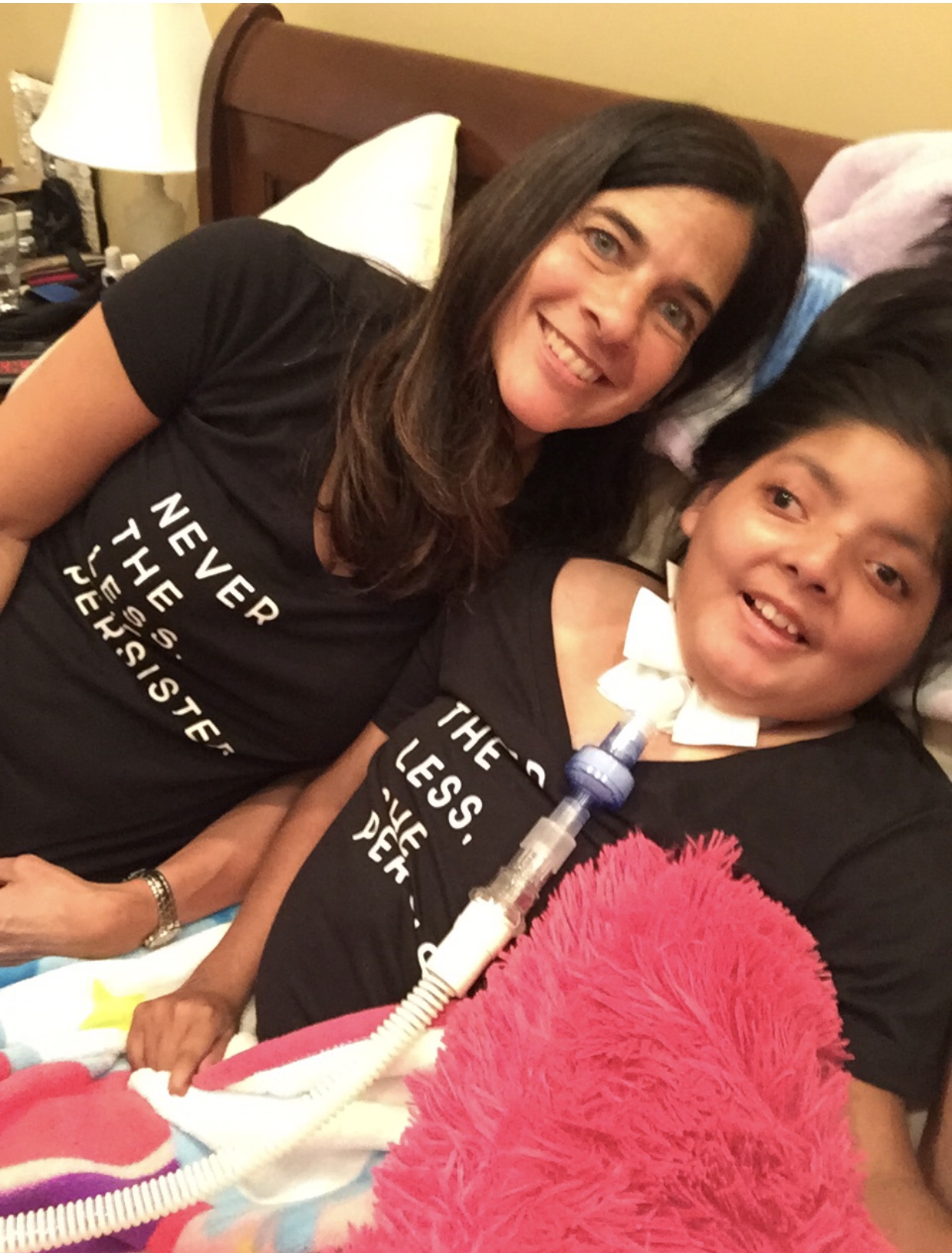 I wouldn’t have seen this child’s bravery, how she was more worried about her dad’s poison ivy than her own weakening muscles. How she’d beg to go on the roller coaster “one more time” so she could feel the freedom of sailing through the sky, unencumbered by legs that didn’t cooperate. I couldn’t have known how sweetly she’d rub my back when I came home from work even though her day had undoubtedly been more trying than mine.
I wouldn’t have seen her strength of spirit, how her little body couldn’t hold it all and so it spilled over to everybody she met.
I might have seen her smile, but I wouldn’t have known it was contagious.
A crystal ball wouldn’t show me that because of Dalia I’d learn that joy and sorrow can coexist. It would take me a while, but I’d follow Dalia’s example of creating fun and wanting to play even when everything felt scary. I’d learn that when there’s no light at the end of the tunnel, it’s possible to make the tunnel itself beautiful.
In the crystal ball I’d have seen two siblings and I’d have worried that they weren’t getting enough attention with their sister’s needs demanding so much time and energy, and that may well have turned out to be true. But it wouldn’t have been clear that Dalia’s siblings would become heroes because of her, that they’d learn to celebrate differences rather than fear them, and that they’d have a degree of empathy I can only aspire to.
I wouldn’t have seen that my heart would be broken and overflowing at the same time, and I wouldn’t have known that was possible.
I’m glad I didn’t have a crystal ball, and I don’t long for one anymore.
When we see something from afar, we get a limited view. It’s impossible to understand the nuances, the textures, and the pixels that make up the full picture. How our life with Dalia looked from the outside was so different from what it was really like.
Yes, it was scary and hard and devastating. It was also gorgeous and transformative.
I wouldn’t have asked to parent a child with a terminal disease; but had I known what I was in for, I would have begged to parent Dalia.
________________________________________________________________________________________________________________
Jessica Fein writes about the mingling of joy and sorrow, mothering a child with a rare disease, and staying rooted when life tries to blow you down. Listen to her podcast, “I Don’t Know How You Do It,” wherever you get your podcasts. Her memoir, Breath Taking: Rare Girl in a World of Love and Loss, is coming in 2024 from Behrman House Press. Visit her website or connect with her on IG for real talk about love and loss @feinjessica
When my husband and I were told our 9-year-old daughter Dalia had become “an eyes-on patient,” we had no idea what that meant, literally or figuratively.
We were meeting with the social worker, who was prepping us to return home after three months in the pediatric intensive care unit. “Now that Dalia has a trach and is ventilator dependent,” she began, “one of the two of you or a nurse trained specifically in Dalia’s care will need to watch her at all times.”
It made no sense. What about sleep? What about work? What about Dalia’s school day?
We were lucky, she said. We qualified for more than 100 hours a week of nursing care paid for by a combination of our health insurance and Medicaid. “Some patients don’t get nearly that number of hours. And some families need to pay out of pocket.”
We didn’t feel lucky.
We couldn’t possibly have understood then the mixed feelings we’d come to have for the cavalry of nurses who would come in and out of our home – and our lives – over the next eight years.
When you leave the hospital with a newborn, you might feel surprised you’ve been trusted to care for this brand new person. You’re exhausted and overwhelmed and trying to figure out how to feed the baby and install a carseat and tend to the tears. Your friends and family can show you the ropes, assuring you it will all be second nature in no time.
When we left the hospital with Dalia, we weren’t only exhausted and overwhelmed, we were also terrified. And there wasn’t a single person we knew who could help us figure out how to change a trach or clear a clogged food pump or use a cough-assist machine. We were prepared to love any nurse who materialized at our house to guide us.
I envisioned a nurse floating down from the sky a la Mary Poppins and creating order out of the chaos.
As it turned out, we would meet some nurses along the way who seemed as magical as Mary. But for every A-plus caregiver, there were three or four who were barely passing.
We might have known before that there was a national nursing shortage. Maybe we saw a headline at some point or heard a news segment playing in the background while we cooked dinner. But we never thought about what that meant for the patients and families who had days – or even worse, nights – uncovered, or what it felt like to find nurses sleeping on the job because they’d been working back-to-back shifts without a break.
We didn’t realize that to a certain extent we’d need to take whoever we got when it came to the nurses. There was no picking and choosing, no pile of resumes to sift through. And that was a problem, because the nurses were our lifeline.
The first time we discovered a nurse sleeping on the job, we were horrified. Our eldest child returned from school to find Dalia’s nurse taking a nap on the living-room couch – while Dalia was in her upstairs bedroom. That was the only day nurse we found sleeping, but we had to wake several who were dozing at night. That wasn’t all. We had one nurse quit mid-shift because she thought our house was haunted, and another who told us she thought we were God’s soldiers.
But there were other nurses whose competence calmed us and who ultimately became like extended members of our family. And really, with the amount of time they spent in our home, they knew more about the ins and outs of our daily lives than our actual extended family. It was so different from the nurses in the hospital, where we were clearly on their turf.
Our home was no longer a private sanctuary where we could be as loud, messy, or cranky as we needed to be. Now there were people in our home, under the best of circumstances, more than 100 hours a week. And that was hard for me, a naturally social person, and even harder for my husband, who’s more introverted.
It was a catch 22 of sorts. We desperately wanted and needed the nurses. In those early days we depended on them to help us keep our daughter alive. As time went on and we became expert in Dalia’s care – more knowledgeable even than most of the doctors – we needed the nurses so we could have some semblance of life as we once knew it. No day nurse meant no work for my husband or me, no school for Dalia. No night nurse meant one of us staying up all night by Dalia’s bedside. We traded our privacy for the security they offered.
But while It was an intensely personal relationship, it was also oddly one-sided. After all, these nurses were with us when we were most vulnerable. They were there for the regular everyday stuff and also the high-stakes moments. They were in our daughter’s room overnight, while the rest of us slept. But we knew little about their lives outside of our home. Several years into our relationship with one of our most dependable, competent nurses…someone to whom I literally trusted my daughter’s life, I realized I didn’t even know her last name.
And yet for all the ambivalence I felt, all the last-minute call-outs and nurses who slept on the job, that social worker was right. We were lucky.
We were lucky that we had nurses like Jane and Lori who gracefully balanced being a part of our family life but also apart from it, knowing when to step in and when to step back. We were lucky that they loved Dalia, and our other children, too. We were lucky they were experts at their job and that they provided a continuity of care between our home and Dalia’s school. And we were lucky that they treated Dalia with respect and dignity even as her functionality slipped away.
Last week, our youngest son played in his town-league baseball game. It was a chilly night, and as I huddled under a blanket with Nurse Jane, passing chocolates back and forth, I thought about how different our relationship is than any other I have. Dalia passed away just over a year ago, and Jane was there with us at her bedside until the very end. We couldn’t have imagined it any other way. I don’t see her every day anymore, but we’re inextricably linked. I look at her and I feel all we shared from those shaky days at the beginning through the ups and downs of the eight years that followed. She knew Dalia and she loved Dalia. She saw her for who she was at her core, for the pure love and kindness she exuded, and she reflected that love and kindness right back to her. She’ll always be part of our family, and for that we are lucky.
________________________________________________________________________________________________________________
Jessica Fein writes about the mingling of joy and sorrow, mothering a child with a rare disease, and staying rooted when life tries to blow you down. Listen to her podcast, “I Don’t Know How You Do It,” wherever you get your podcasts. Her memoir, Breath Taking: Rare Girl in a World of Love and Loss, is coming in 2024 from Behrman House Press. Visit her website or connect with her on IG for real talk about love and loss @feinjessica
When my husband and I started fertility treatments decades ago, the only person I told was my sister. This was pre-social media and pre-living out loud. It wasn’t that I was embarrassed, it’s that I thought what we were going through was intensely personal and not anybody else’s business.
One day at work, three women decided to collectively share the fact that they were all pregnant. They danced from cubicle to cubicle waving their ultrasound pics. My colleagues cheered over the white blobs and murky waves. I ran to the bathroom and hid until they passed my desk. Nobody at work knew what I was going through, and I’m sure the women would have been mortified if they had any idea how their joy twisted a knife in my sorrow.
A few months later, I was going on a business trip where I was required to share a room. Along with my “casual business attire” and laptop, I brought three-days worth of medications and needles I’d use to inject the fertility meds. I imagined what my colleague/roommate would say if she found my supplies and figured I should tell her my secret before she came to the conclusion that I was shooting up something other than concentrated hormones.
It wasn’t her response that surprised me, it was how her response made me feel. She was appropriately sympathetic and supportive. She told me her sister had gone through fertility treatments and that she’d even helped her with the intramuscular shots a couple of times. She let me squeeze her finger while I counted to three before inserting the needle in my thigh and became my confidante through the subsequent years of treatment.
And suddenly I felt less alone. I’d thought if I told people what I was going through I’d feel even more different. Instead, I felt seen and held.
Fast forward a decade or so, and there I was, yet again, in a situation that felt utterly isolating. When my daughter Dalia was 9, we spent three months in the PICU after a cold became pneumonia, leading to extended intubation and, ultimately, a tracheostomy. When we left the hospital, it felt like we were bringing home a newborn. Dalia was so fragile. There was equipment we didn’t understand and dozens of protocols we needed to master.
The difference, of course, is with a newborn everyone is celebrating. There are friends and family to show you the ropes and spell you so you can take a nap or have a night out. With our daughter, nobody could relate in any way to what we were going through. Everything we were experiencing felt foreign to the people in our village. It was as though we had been plopped in a new country where nobody spoke the language we were desperate to learn.
By now, of course, social media was ubiquitous. It was possible to find people who’d been thrust into medical parenting, ambiguous grief, and pervasive uncertainty just like we had.
I’ll admit that at first I lurked. I read other people’s vulnerable accounts of what they were experiencing. I realized there were in fact people who spoke our new language, they just weren’t people I knew personally.
Slowly, I began to share. I was careful at first because talking about my fear or anxiety felt like a betrayal of my daughter. How could I be afraid or anxious when she was handling what was happening to her body so gracefully?
But the more I opened up to other parents who could relate, I realized that my feelings were valid. Together, we could talk about our big fears, and our small ones too. We could say we spilled a syringe-full of meds all over the bed sheet and the other person would know what we were talking about. We could share that we felt a level of exhaustion that made our month-long bout of mononucleosis seem like a visit to Canyon Ranch, and we’d get it.
And something unexpected happened. Sharing that I felt weak or unequipped for the task at hand and being able to have supportive conversations about that made me stronger. I began to speak more authentically not only with people who “got it” on a personal level, but with others in my world, too. I didn’t broadcast my fears widely, but I communicated more openly with the people I trusted. I loosened my armor. In turn, people had a deeper understanding of my reality and a greater appreciation of what life looked like for my family.
So many medical parents and grievers I talk to tell me how much they hate it when people say, “you’re so strong.” I hate it, too. But if we don’t share the mess and the beauty of our lives, how can we expect people to appreciate that what looks like strength is an amalgamation of fear, courage, fierce determination, frustration, sadness, boundless love, and so much more?
Over time, I’ve not only become comfortable with sharing my story, I’ve become committed to it. I now see that inviting people in isn’t only a way to connect authentically, it’s also a way to raise awareness about rare disease in general and my daughter’s disease, MERRF Syndrome, in particular.
But more than that, sharing my story is, by definition, a way to share Dalia’s story. It gives me license to talk about her, honor her, and extend her legacy – all three of which bring me joy and are my mission now.
Stories open our eyes and open our hearts. When we share our real story, not the shiny polished version, other people learn about us, and equally important, we learn about ourselves.
James Joyce taught us that, “in the particular is contained the universal.” Nobody’s story looks exactly like our own, but the more we can share the truth and the glorious and goriest details, the more people can connect and relate. It took me a while, but I know that now.
And I don’t hide in the bathroom anymore.
________________________________________________________________________________________________________________
Jessica Fein writes about the mingling of joy and sorrow, mothering a child with a rare disease, and staying rooted when life tries to blow you down. Listen to her podcast, “I Don’t Know How You Do It,” wherever you get your podcasts. Her memoir, Breath Taking: Rare Girl in a World of Love and Loss, is coming in 2024 from Behrman House Press. Visit her website or connect with her on IG for real talk about love and loss @feinjessica
When my daughter Dalia was diagnosed with MERRF Syndrome at age 5, I shattered. I didn’t realize it then, but every bit of the overwhelming and confusing diagnosis made a hairline fracture in my soul that grew more painful with time.
At 9, Dalia caught a cold that became pneumonia, requiring intubation and then a tracheostomy. We spent three months in intensive care and when we returned home Dalia needed a ventilator to breathe and used a g-tube for her food and the more than a dozen meds she took each day.
I was in pain and exhausted. Fear flowed through my veins, swimming right alongside the nutrients and oxygen that sustained me.
But I kept all this to myself. My role, I knew from the start, was to be strong. I couldn’t let down my guard for a minute. Dalia and my two other children and my husband needed me. And besides, there was too much to do to give in to the fear and sadness. There were nursing shifts to coordinate and meds to administer and equipment to stock. I had a job to do at home and another one that was paying me. And above and beneath all of it was the most important thing I had to do – give all three of my kids the most normal and happiest childhood possible.
Who was I kidding though? Nothing about our lives was normal.
At first, before the trach and the g-tube, we tried to minimize Dalia’s diagnosis with all three of our kids. We didn’t know how fast the disease would progress or where in her body it would strike next, so we focused on what was in front of us each day. Physical therapy and speech therapy and all the other therapies took our time. We made spreadsheets to manage the logistics and focused on the pixels that made up each day instead of the big picture.
My husband and I never made a formal agreement with each other, but we intrinsically understood that we’d present a united strong front for our family. We didn’t want them to be afraid. We wanted to bear the fear for them.
Later, when the disease progression was undeniable, my husband and I stepped up our game. We never cried in front of the kids, or even in front of each other. We told them that we were focused on making each day as happy as possible for Dalia, and we meant it. We told them the most important thing was that Dalia knew how much we all loved her, and I suppose we meant that, too. What we didn’t tell them was what was obvious. Dalia was getting sicker; our hopes for a recovery were now fantasy.
We also didn’t tell them that we were scared and angry. We didn’t tell them how sad we were, and we didn’t show them, either.
Our doctor, who was a partner in Dalia’s care whom we trusted, respected, and grew to love, suggested we share more with Dalia’s siblings. Every few months, he’d offer to come to the house to join us in a conversation with them where we could discuss what was happening. He’d answer their questions, he offered. He’d explain the physical changes and be a sounding board for the emotional implications.
Over and over, we politely declined. We might have all been living a bit of a charade, but wasn’t that better than the alternative? We thought a conversation would terrify them. We didn’t want them to know how dire the situation really was.
In retrospect, of course, this seems absurd. Dalia was losing her functionality. She couldn’t talk anymore. Then she couldn’t point or nod her head, “yes,” or shake it, “no.” She couldn’t blink so we had to tape her eyes shut when she slept to prevent her corneas from drying out.
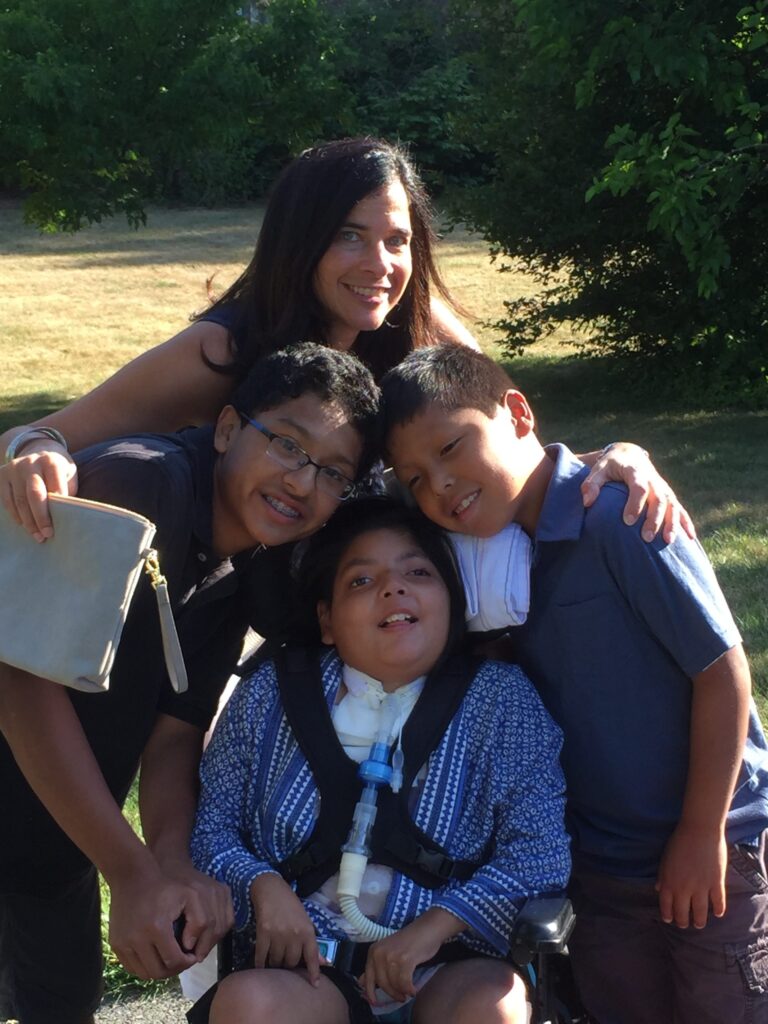
But we still brought her to the dinner table every night. We went on long walks, taking turns pushing her wheelchair. She went to a special school on the grounds of a hospital with a private nurse beside her. And we carried on.
But then one night, shortly after my husband and I had turned in for the evening, our eldest, then 16, came into our room sobbing. “Something’s wrong with me,” he began. I bolted up in bed. “What’s going on?” I asked? “Does something hurt?” It took a while for him to get the words out, but when he did they poured.
“I’m just so scared about Dalia. I pray and I pray and I pray, and she doesn’t get any better. She’s the best person I know. I don’t understand why this is happening to her. But you two are fine,” he said, looking up at my husband and me. “You’re so strong. What’s wrong with me?”
Now, finally, the fractures split wide open. I broke down in front of my son and my husband and I realized how overdue my breaking was.
All along we’d been trying to protect our kids, and in doing so we’d built a barrier between us. Our “strong front” was disorienting at best and scary at worst. I imagine now that at night my children sat in a room together wondering if my husband and I understood just how bad things really were. Meanwhile, my husband and I were downstairs in our room wondering if our kids understood the same thing.
My husband and I wrapped our eldest in our arms and wept along with him. It was excruciating, but it was also a huge relief. We apologized over and over. We promised him his feelings were valid and to be expected. We told him we felt the same way he did. We promised to be more honest moving forward.
When people ask me now what I wish I’d known then, the value of open and honest conversation with all of my children rises to the top. But I know it now and I’m not likely to forget it. And I know that being whole for my children means letting them see where I’m broken.
________________________________________________________________________________________________________________
Jessica Fein writes about the mingling of joy and sorrow, mothering a child with a rare disease, and staying rooted when life tries to blow you down. Listen to her podcast, “I Don’t Know How You Do It,” wherever you get your podcasts. Her memoir, Breath Taking: Rare Girl in a World of Love and Loss, is coming in 2024 from Behrman House Press. Visit her website or connect with her on IG for real talk about love and loss @feinjessica