
During my son Lucas’s life, I often struggled with how many therapy sessions to schedule. There was so much we could do for Lucas. Physical, occupational, feeding, and speech therapies were just the start. Yet nothing we did would fundamentally alter the course of his disease. What should we do?
I know I’m not alone in this struggle. Most Courageous Parents Network families probably take their children to therapies. We do this with love, dedication, and hope. Whether our child has a neurological disorder or another illness, we want to improve the quality and length of their lives. Still, therapy requires a lot of effort and determining what is “helpful” is not easy.
As I talked about in my recent blog, our hopes influence our approach. Jane Witmer, my son’s occupational therapist, helped me develop an approach to therapy that acknowledged our uncertainties about what was helpful. We focused on activities that helped Lucas find joy in daily life.
Because Jane was able to help us adjust our approach without ever diminishing Lucas’ potential or strength, I asked if she would reflect with me on how therapists can support children like Lucas and their families. I hope other families and providers find her reflections helpful as they support the children in their lives.
A conversation between Occupational Therapist Jane Witmer and Parent Kim Gilsdorf
Kim: Hi Jane – thank you so much for having this conversation with me. Can you start by telling Courageous Parents Network families why you work as a pediatric occupational therapist?
Jane: The families! Being an Early Support Specialist (birth to age 3 years) allows me to work just as closely with the caregivers as with the children. I love being able to partner with caregivers and helping them find what is meaningful for them and their family.
Kim: How would you describe the purpose of occupational therapy for a seriously ill child, particularly if they have a neurological disorder like Lucas, and will progressively lose skills?
Jane: The purpose of working as an OT with any child and their family is to meet them where they are and walk alongside them in their journey. The same applies to PT, speech, feeding, and other early support therapies. We bring our expertise in developmental skills like posture, movement, feeding, social interaction, and play. The families bring their love, knowledge, and priorities. Especially with rare conditions, the family typically knows more than the therapist about the condition. We work together to help the child find meaning and joy in their life. The ways that a child with a serious illness finds meaning and joy may look different, but the goals are the same.
Kim: Parents have a wide spectrum of approaches to therapy. Some may not want to engage at all. Others, like me in the early days with Lucas, engage with a level of desperation and hope that may not match the reality of what therapy can deliver. What kinds of conversations should therapists and parents have to build an alliance and develop shared goals?
Jane: Such a great question! The therapist bears a big responsibility in building open communication with the parent and truly listening. We may enter a session with ideas we think will be best, and what turns out to be best for the caregiver or child that day may look very different. By remaining open and really listening or asking what a parent is hoping to get from the session, a therapist can shift the focus to try to meet the need that day. A parent whose child was undergoing unbearable chemotherapy once told me the best thing I ever did was to genuinely smile at their child every time I came. I will never forget that. Any other agenda became less important once I got that feedback.
You, ever the proactive and totally involved parent, surprised me once by letting me know that sometimes, you needed to watch Lucas play and have fun with me. You needed a tiny (and well-deserved) break. I really respected your honesty and was so happy I could help in that small way. Besides, I knew you were watching and learning even though you were “taking a break”. It really helps therapists when parents openly share what their priorities and hopes are. It also helps when parents tell me honestly when I am off track. I so appreciate the parent who says, “That’s a great idea, but I’m not going to do that!” or something similar. I can work with that!
Kim: Sometimes, our medical systems begin to remove therapy time once a child’s baseline begins to decline. What advice would you give families facing this challenge?
Jane: How awful. First, Early Support (sometimes called Early Intervention or Birth to Three services) will continue whether or not insurance will pay. Also, there are some therapy programs like one funded by The Elks in Washington State, that are no cost to families. A hospital social worker should know of programs like these and be able to connect families to them. I would also counsel a family to look to their palliative care team for help with finding therapy support. Additionally, patient advocacy groups often have wonderful resource ideas.
Finally, one does not need to be a therapist to love and play with a child. Seek support from your circle of friends and family to provide plenty of love and play. Children find ways to do their own therapy if allowed to be playful and given access to things they enjoy.
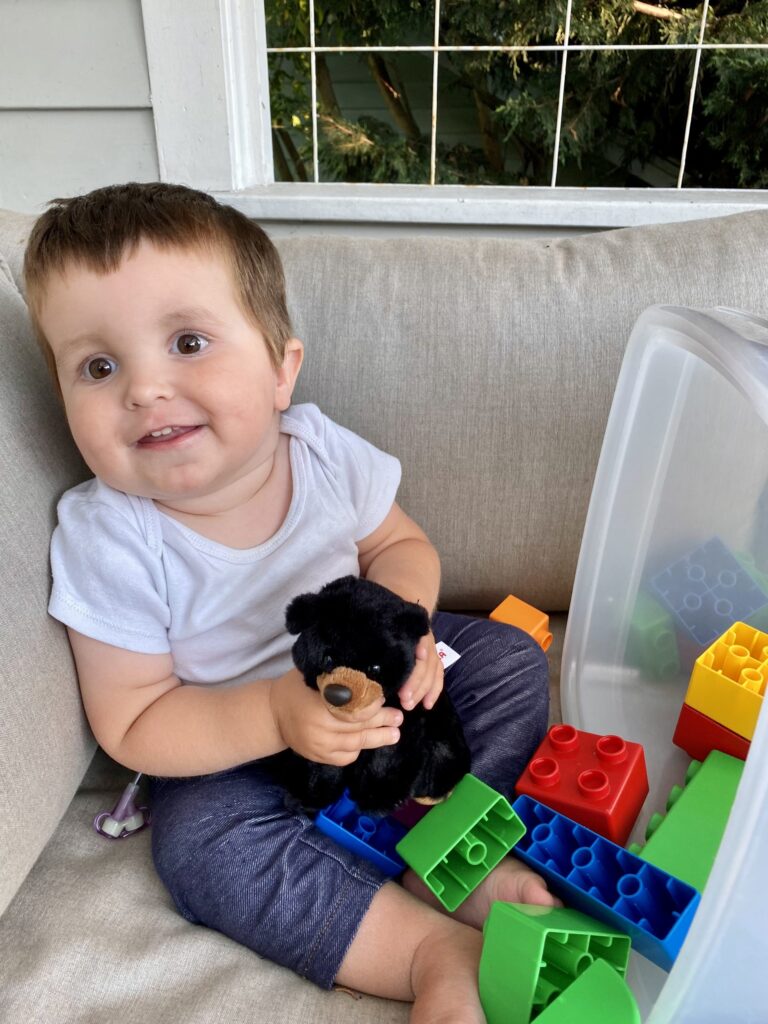
Kim: I know you were deeply affected when Lucas died, which is a testament to your care for him. How do you care for your own mental health when a child you support dies?
Jane: I am so lucky that I work with a wonderful group of people who support each other. I am also lucky that my work provides monthly reflective practice groups where we can process the emotions that occur when doing this work. With Lucas, I was extra lucky because you invited me to share in events to remember and honor him and that helped me so much.
Kim: Can you end by sharing a favorite memory of working with Lucas?
Jane: There are so many! His triumph early on when he figured out he could pull to stand against the fence and push the blocks through the holes. And that we would fetch the blocks for him! I will never forget his enthusiasm for telling us just how to carry out the play activity and the satisfied look he got when we finally got it right.
And the smile that came from his entire being! Mouth, eyes, cheeks, and even chest slightly moving outward when he looked through the window and saw me arriving. Most of all, I loved when he saw me and said “Hug!” It was never a question; it was a command and an expectation.
Jane Witmer is a lead therapist at Wonderland Child and Family Services in Seattle, Washington.
________________________________________________________________________________________________________________
Kim Gilsdorf writes and lives with her family in Seattle, the traditional land of the Duwamish people. She works for Perigee Fund, an organization dedicated to supporting early childhood mental health. Her favorite title is “Mama” to her two children, Lucas and Sophia. Lucas lived with and died from a rare disease, Leigh Syndrome, and his life has forever changed the meaning and purpose of hers. You can find Kim’s writing on Instagram at @kgilsdorf.
I shifted Lucas in my arms, picking up his feeding pump backpack in one hand and a cup of syringes in the other. It was a sunny spring morning and we were headed into our backyard to meet Jane, his occupational therapist. His face lit up with a smile when he saw her walk through the gate. “Hug?” he asked excitedly, waving a tiny arm to punctuate the question.
It was a measure of Jane’s skill that Lucas saw her as a playmate. Her role as a pediatric Occupational Therapist (OT) was more complex. The work of a pediatric OT is to help children improve self-regulation, self-care, and play skills in partnership with their caregivers. If possible, OTs help children reach new developmental milestones.
My son Lucas was unlikely to reach the developmental milestones that show up in a pediatric therapy evaluation. Just after he turned one, he was diagnosed with Leigh Syndrome, a mitochondrial disease and severe neurological disorder. As with other rare neurological disorders, children progressively lose abilities. Currently, there is no treatment or cure.
Shortly after Lucas was diagnosed, his neurologist suggested that exercise could sometimes help slow disease progression in children with a mitochondrial disease like Leigh Syndrome. Given the stark landscape of treatments for Leigh Syndrome, with clinical trials either closed to us or years in the future, exercise was the only proactive treatment. I decided we needed to do all the therapies available.
In the backyard, Jane helped me set up a water table so we could entice Lucas to try standing. I started with Lucas on my lap. Surveying the bobbing toys, his eyes grew wide. Reaching out to splash, he made his signature noise of excitement– “Ahh!”
Adjusting his orthotic braces, we carefully helped him rise to a standing position. He leaned against the water table to support his weight. After playing for a moment, he clenched the edge and started to panic. He couldn’t simultaneously support himself and use his hands to reach for toys. We tried again, but every time we stood him up his face started to crinkle in pain and frustration. He didn’t have the strength to sit down safely on his own.
“Good job, buddy. You are doing so well!” I tried to encourage him. Internally, I was wrestling with my own frustration. I was still so new to the world of rare disease. I didn’t know there were standing frames to help Lucas experience this position securely. I didn’t want to believe that exercising would never stop Leigh Syndrome from advancing. All I knew was that I had so little to offer my child, and I just wanted him to be OK.
I tried to get Lucas back into position, my hands lifting up his reluctant body. Jane gently asked me: “Do you see how hard Lucas is working?” I stared at her, confused. None of the many therapists we worked with had ever described Lucas this way. They said he had a beautiful smile. They said he looked tired. Most often, they told us we just needed to find “the right motivation” for him to make progress.
Jane took over supporting Lucas, talking as she worked. “See how his neck is trembling? He is working hard to hold his head up while he makes the enormous effort of stabilizing his core. When he tries to stand, his knees lock and his entire body trembles. He wants to do what we’re asking, but it is really hard work.”
Something crumpled inside of me as I watched Lucas. He was indeed trembling. What we were asking was beyond his strength. I gathered him back onto my lap, comforting him. Once he recovered he reached for the water table ready to play again.
After Jane left, her words kept reverberating in my mind: “Lucas is working so hard.”
Years ago, I read that play is the essential work of children. It is how they learn, develop, and build relationships. Lucas’s disease and resultant disabilities didn’t change that for him. If he couldn’t engage in therapy, it wasn’t because we had failed to motivate him. The problem was our expectations.
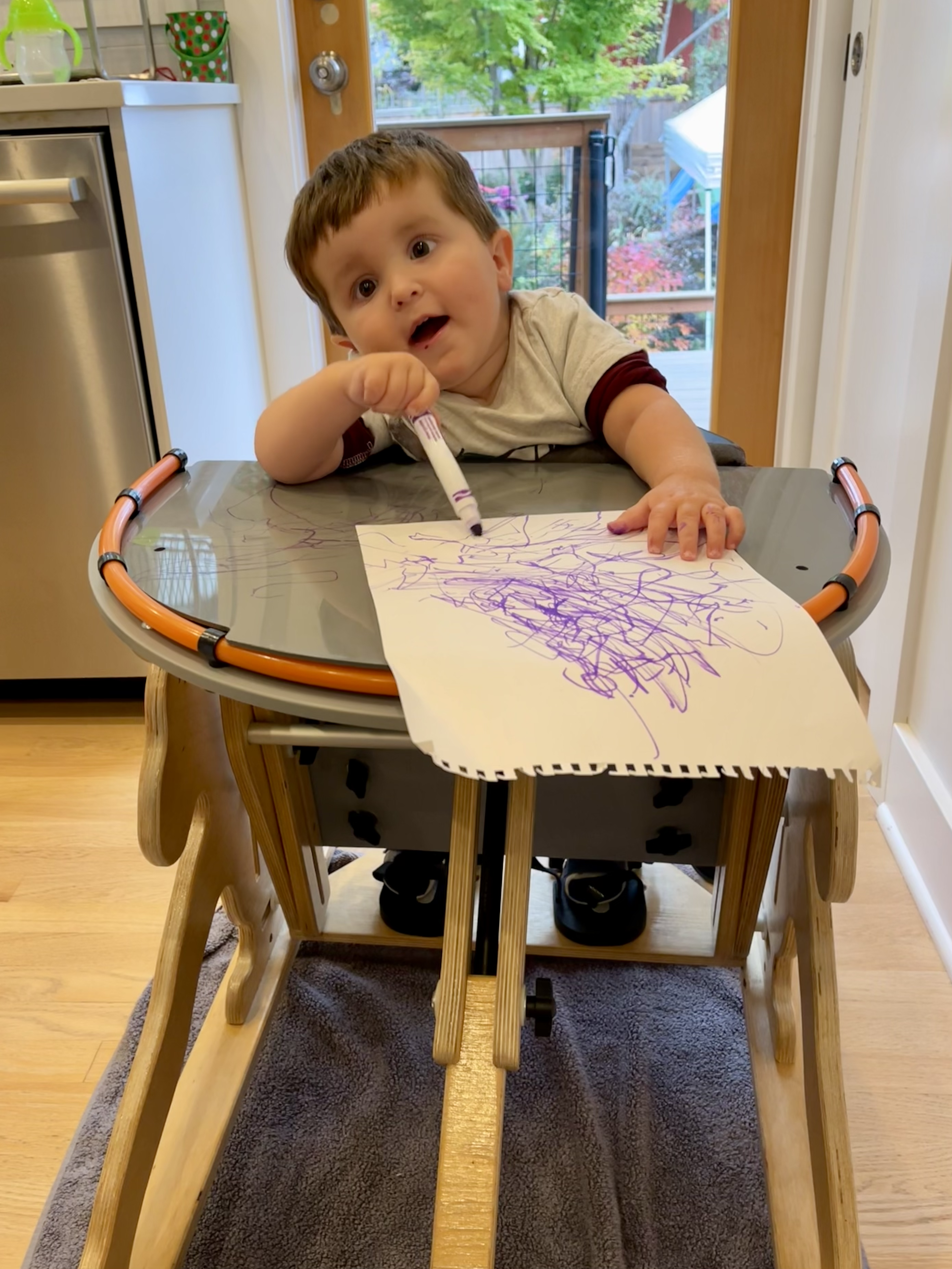 I had been focused on a world where Lucas battled Leigh Syndrome through exercise and didn’t regress any further, like the stories of families I had found on the internet. Stories that were not ours. Even though I knew my son better than anyone, my desire to fight this cruel disease sometimes blinded me.
A few weeks later, Lucas would experience a swift and global regression impacting every sphere of his development. Most of the games and activities he enjoyed quickly left his grasp. The water table was only possible if he was carefully supported on our lap, and his erratic arm movements made it less fun.
In the months of progressive loss that followed, we adjusted our expectations over and over. Our goals in therapy adjusted too. We focused on creating moments of joy with Lucas. We worked with his occupational therapist, Jane, to understand each new baseline. We stopped some physical therapy entirely knowing that his energy was precious.
In these months, Lucas had some of the most joyful moments of his life. Jane found a portable chair that could be used in the park, so he could sit with other kids and interact at their level. She brought over giant toy cars outfitted with safety harnesses, so he could feel like he was “driving” around our house. Lucas continued to surprise us all with his capacity for focus and delight, even in the midst of great discomfort.
In some ways, I think Jane’s most important work as an occupational therapist was helping me navigate Lucas’ changing baseline with clarity. It is hard to see clearly when you don’t want to see your child lose their abilities at all. Still, knowing how hard Lucas was working meant we celebrated every tiny win. And therapy became a tool for us to bring Lucas joy, even as his body changed in ways that were hard for us all to bear.
A conversation between Occupational Therapist Jane Witmer and Parent Kim Gilsdorf
During my son Lucas’s life, I often struggled with how many therapy sessions to schedule. There was so much we could do for Lucas. Physical, occupational, feeding, and speech therapies were just the start. Yet nothing we did would fundamentally alter the course of his disease. What should we do?
I know I’m not alone in this struggle. Most Courageous Parents Network families probably take their children to therapies. We do this with love, dedication, and hope. Whether our child has a neurological disorder or another illness, we want to improve the quality and length of their lives. Still, therapy requires a lot of effort and determining what is “helpful” is not easy.
Jane Witmer, my son’s occupational therapist, helped me develop an approach to therapy that acknowledged our uncertainties about what was helpful. We focused on activities that helped Lucas find joy in daily life.
Because Jane was able to help us adjust our approach without ever diminishing Lucas’ potential or strength, I asked if she would reflect with me on how therapists can support children like Lucas and their families. I hope other families and providers find her reflections helpful as they support the children in their lives.
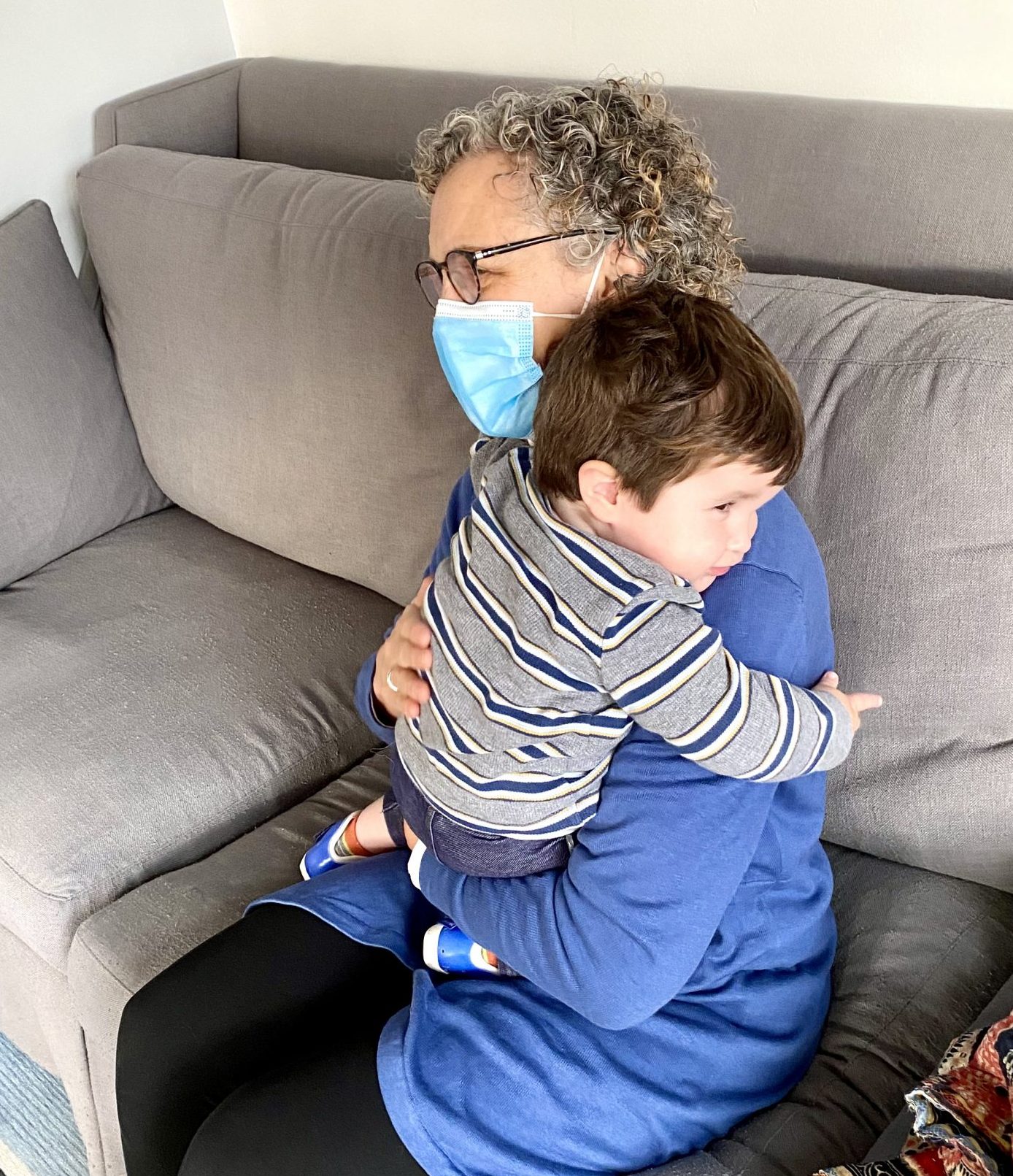 Kim: Hi Jane – thank you so much for having this conversation with me. Can you start by telling Courageous Parents Network families why you work as a pediatric occupational therapist?
Jane: The families! Being an Early Support Specialist (birth to age 3 years) allows me to work just as closely with the caregivers as with the children. I love being able to partner with caregivers and helping them find what is meaningful for them and their family.
Kim: How would you describe the purpose of occupational therapy for a seriously ill child, particularly if they have a neurological disorder like Lucas, and will progressively lose skills?
Jane: The purpose of working as an OT with any child and their family is to meet them where they are and walk alongside them in their journey. The same applies to PT, speech, feeding, and other early support therapies. We bring our expertise in developmental skills like posture, movement, feeding, social interaction, and play. The families bring their love, knowledge, and priorities. Especially with rare conditions, the family typically knows more than the therapist about the condition. We work together to help the child find meaning and joy in their life. The ways that a child with a serious illness finds meaning and joy may look different, but the goals are the same.
Kim: Parents have a wide spectrum of approaches to therapy. Some may not want to engage at all. Others, like me in the early days with Lucas, engage with a level of desperation and hope that may not match the reality of what therapy can deliver. What kinds of conversations should therapists and parents have to build an alliance and develop shared goals?
Jane: Such a great question! The therapist bears a big responsibility in building open communication with the parent and truly listening. We may enter a session with ideas we think will be best, and what turns out to be best for the caregiver or child that day may look very different. By remaining open and really listening or asking what a parent is hoping to get from the session, a therapist can shift the focus to try to meet the need that day. A parent whose child was undergoing unbearable chemotherapy once told me the best thing I ever did was to genuinely smile at their child every time I came. I will never forget that. Any other agenda became less important once I got that feedback.
You, ever the proactive and totally involved parent, surprised me once by letting me know that sometimes, you needed to watch Lucas play and have fun with me. You needed a tiny (and well-deserved) break. I really respected your honesty and was so happy I could help in that small way. Besides, I knew you were watching and learning even though you were “taking a break”. It really helps therapists when parents openly share what their priorities and hopes are. It also helps when parents tell me honestly when I am off track. I so appreciate the parent who says, “That’s a great idea, but I’m not going to do that!” or something similar. I can work with that!
Kim: Sometimes, our medical systems begin to remove therapy time once a child’s baseline begins to decline. What advice would you give families facing this challenge?
Jane: How awful. First, Early Support (sometimes called Early Intervention or Birth to Three services) will continue whether or not insurance will pay. Also, there are some therapy programs like one funded by The Elks in Washington State, that are no cost to families. A hospital social worker should know of programs like these and be able to connect families to them. I would also counsel a family to look to their palliative care team for help with finding therapy support. Additionally, patient advocacy groups often have wonderful resource ideas.
Finally, one does not need to be a therapist to love and play with a child. Seek support from your circle of friends and family to provide plenty of love and play. Children find ways to do their own therapy if allowed to be playful and given access to things they enjoy.
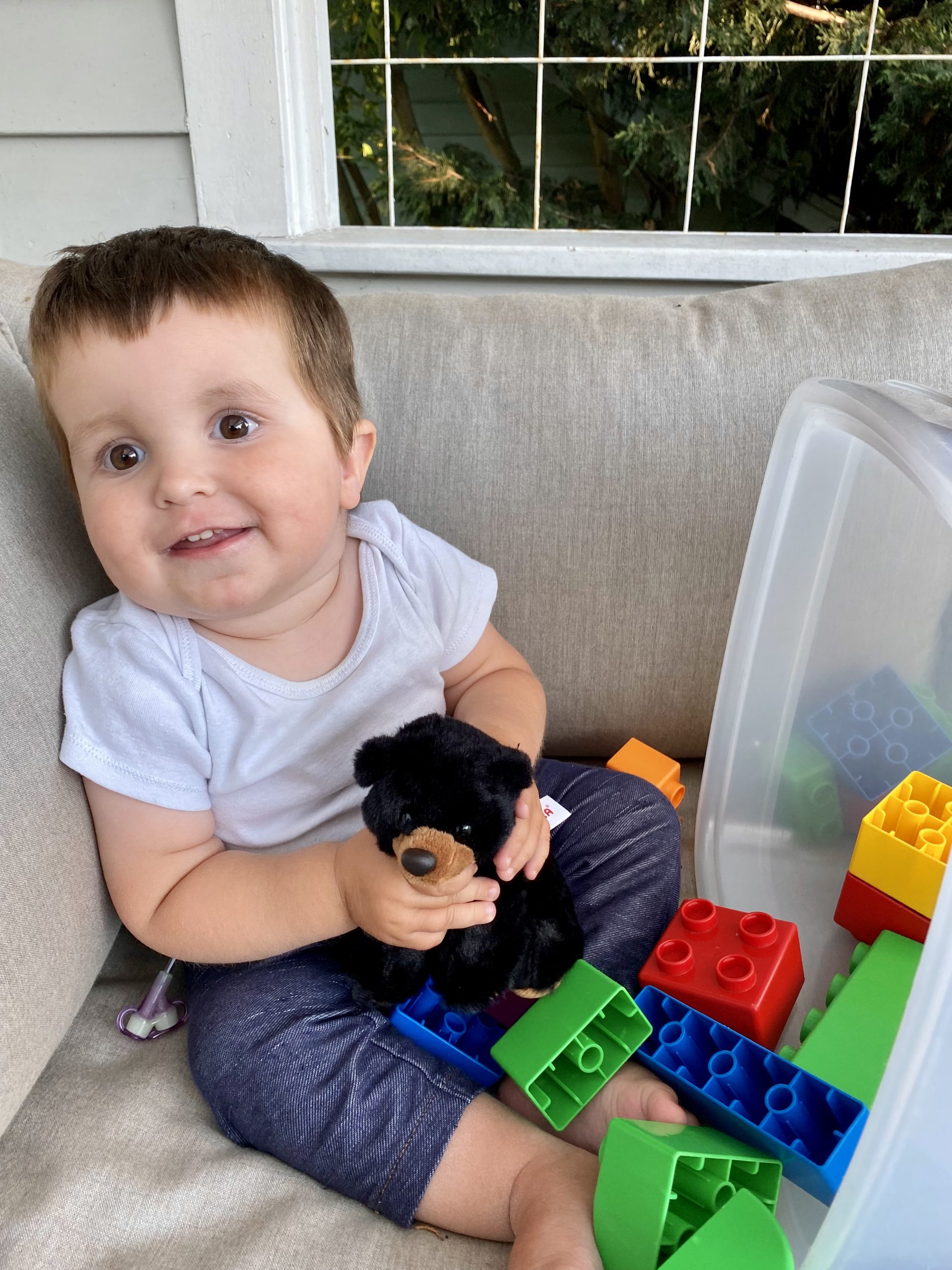 Kim: I know you were deeply affected when Lucas died, which is a testament to your care for him. How do you care for your own mental health when a child you support dies?
Jane: I am so lucky that I work with a wonderful group of people who support each other. I am also lucky that my work provides monthly reflective practice groups where we can process the emotions that occur when doing this work. With Lucas, I was extra lucky because you invited me to share in events to remember and honor him and that helped me so much.
Kim: Can you end by sharing a favorite memory of working with Lucas?
Jane: There are so many! His triumph early on when he figured out he could pull to stand against the fence and push the blocks through the holes. And that we would fetch the blocks for him! I will never forget his enthusiasm for telling us just how to carry out the play activity and the satisfied look he got when we finally got it right.
And the smile that came from his entire being! Mouth, eyes, cheeks, and even chest slightly moving outward when he looked through the window and saw me arriving. Most of all, I loved when he saw me and said “Hug!” It was never a question; it was a command and an expectation.
Jane Witmer is a lead therapist at Wonderland Child and Family Services in Seattle, Washington.
________________________________________________________________________________________________________________
Kim Gilsdorf writes and lives with her family in Seattle, the traditional land of the Duwamish people. She works for Perigee Fund, an organization dedicated to supporting early childhood mental health. Her favorite title is “Mama” to her two children, Lucas and Sophia. Lucas lived with and died from a rare disease, Leigh Syndrome, and his life has forever changed the meaning and purpose of hers. You can find Kim’s writing on Instagram at @kgilsdorf.
We never know how we are impacting the people we meet. We hear this a lot; and yet it’s rare that we get real confirmation of it. But sometimes we do. It’s been more than six years now since that Sunday morning when I called the On-Call pediatrician at the Pediatrics practice that was partnering with ours for off hours, and asked her to see Miriam, my 3-week old girl. I’d had problems feeding her since birth, she’d gone from crying around the clock to being lethargic and never crying, and then finally I found her body cold to the touch and her tiny hand looking puffy as if there was fluid inside it. And even though I had no idea that anything was wrong, my intuition told me to call the doctor in panic. The doctor told me to come in right away. I hurriedly dressed Miriam and nearly ran out of the house, asking my husband to come with me and calling my in-laws to come over to watch our other three children.
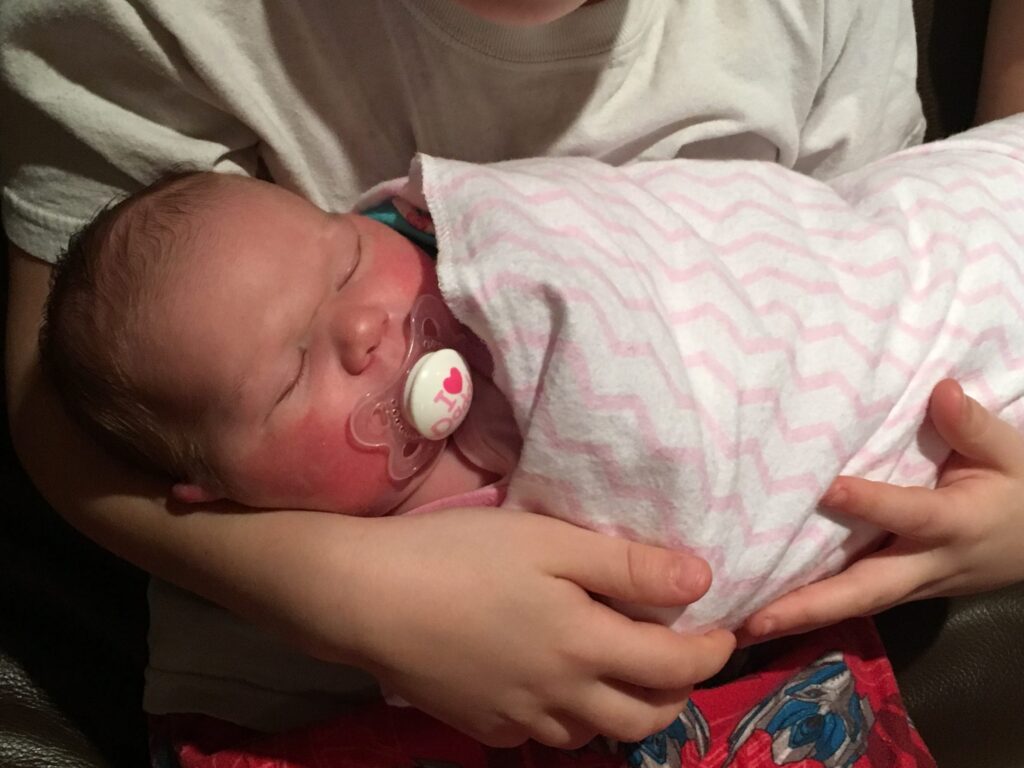
As the doctor began examining Miriam, she stopped immediately and said she needed to call 911. I remember starting to cry right then, and crying all the way in the ambulance and in the emergency room. I cried – not because I knew that my beautiful baby, my only little girl, would be diagnosed with a horrible fatal mitochondrial disease and die a few weeks later. And not because I knew that it was my last time ever seeing my baby in her pretty clothes, that I put on at home, in her car seat. And not because I knew that a few weeks later I’d push the car seat and her clothes as far as I could into the shelf in her NICU room, and tell the nurses that I wouldn’t be strong enough to deal with it, and if they could please donate it or take care of it as they wish. And also not because I knew that this was our last car ride with her, and that the future that had just started for our family would never ever be. I didn’t know or imagine any of this at that time. I think I cried from shock. I believed things would be just fine, that doctors would help Miriam and that we’d be back home within a few hours.
This doctor who sent us to the hospital later called my cell phone but things became very serious very quickly and I was unable to pick up. Nurses at the hospital told me that she called to check in, and how shaken up she was, and that she’d told them that this was one of the most frightening moments in her career as a doctor. We found out that she had called 911 because Miriam’s breathing was irregular and her temperature was dangerously low. We found out that had we not been seen when we were, Miriam would likely have died that same day at home. We would likely never have found out why, as she would not have been tested for a rare disease,. Things worked out in a tragic yet also tragically miraculous way.
Miriam was put on life support right away at the emergency room following a brief explanation from a doctor, “We just need to give her something to help her breathe” and admitted to the NICU. She lived for four more weeks.
When we are in the middle of a tragedy, when we are touching death, every encounter we have feels very significant, deep, intimate; every word is significant and stays with us forever. After Miriam was gone it seemed like something else needed to be said or done, otherwise it felt unfinished. So in the weeks following Miriam’s death, I tried to get back to the kind people who had crossed our path during her brief life, including those we encountered medically.
My husband and I ordered a beautiful art piece for the nurses break room at the hospital where Miriam stayed for them to enjoy and to remember her. I also visited the pediatrician’s office and brought her a butterfly mug that reminded me of Miriam and flowers. The doctor told me that Miriam was a beautiful baby. I remember thinking that she was the last one to see Miriam as a real baby, before she had a breathing tube and tons of devices attached to her tiny body.
Fast forward to last month, six years later: I received an email with the subject “Thinking of you” and found a message from this pediatrician. With her permission, I share it here:
Dear Sophia,
I’m just writing to let you know the impact that your beautiful baby Miriam has had on me as a person and a pediatrician. I keep the butterfly mug that you gave me in a prominent place in one of my kitchen cabinets, so I think of Miriam every single morning as I reach for my coffee mug. She reminds me to be humble as a pediatrician and a parent. She reminds me of the fragility of life. She reminds me that sometimes bad things happen, even if we try our hardest to prevent them. And sometimes I just get an aching pit in my stomach when I think about you and your family, and how hard this has been for all of you.
I’m sorry I didn’t write sooner–I’ve written this note to you in my head so many times, but didn’t send it–it’s been hard to find the right words to stay. But I want you to know that I carry the lessons taught to me by Miriam every single day.”
I read the email over and over. I had not expected to receive any message from her. Even more than that, although I always remember this doctor being very affected by our story, I did not know that she still had the mug, and did not imagine that she was looking at it and thinking of us daily, or that she wanted to write for so long but was afraid to do so. In receiving this message, I experienced how important it was and how good it felt to now know these things. I was so grateful that she had sent the email six years later.
Yet, just as when asked “How are you doing? ” I didn’t know exactly how to respond. Should I share that I forever have a part of me missing and my husband feels the same? Or should I say that we’re doing really well? Should I share that in the last 6 years I have emerged into a new brave and resilient version of myself, that my marriage has evolved to a new much higher level, and that I’ve been blessed to see my boys grow and see over and over how kind, smart, and compassionate they are; that I’ve found myself asking them for advice rather than the other way around and that I’m constantly amazed at their wisdom, maturity, and sense of humor? Should I share that I’ve been able to leverage my data expertise to help the rare disease community, to build a worldwide patient registry for Leigh syndrome, and that this work in Rare brought some of the most rewarding experiences, as well as some of the most difficult and demoralizing; and that the hard ones have helped me find my voice and use it? And should I mention that no matter how well things are now, I deeply miss, want, and feel what could and “should” have been? All of these things are true. But it feels too much and too hard to gather into an email response or one conversation. I did respond that I was so glad to receive this email, which is very true. In a world that is so often painful and hard, it’s so good to get a reminder that kindness matters, that we never know who we are impacting, that sometimes saying the things we want to say is important and meaningful and that for doctors or patients, it is wonderful when we can just see and understand each other as humans.
Sophia lives in Newton, MA with her family. She bridges her personal and professional experiences and is the Leigh syndrome patient registry director and a board member with the Cure Mito Foundation (curemito.org).
The streets near my home in Seattle are checkered with apple trees, and the smell of their fruit fills the air. Apples start to litter our sidewalks and streets in September, where they are crushed by kids racing bikes around the neighborhood. School is starting soon, and the air is filled with chatter and anticipation.
The anticipation I feel smells more like dread. September holds reminders that I am not ready to face: of changes I was powerless to stop, of loss that I could not predict or control. If you have a child with a terminal disease, with no opportunity for treatment in their lifetime, you know this swirl of anticipation and dread.
Last September was the final fall my son Lucas would experience, though we did not understand that at the time. Every day between now and the 1-year anniversary of his death in December holds complicated reminders of disease progression.
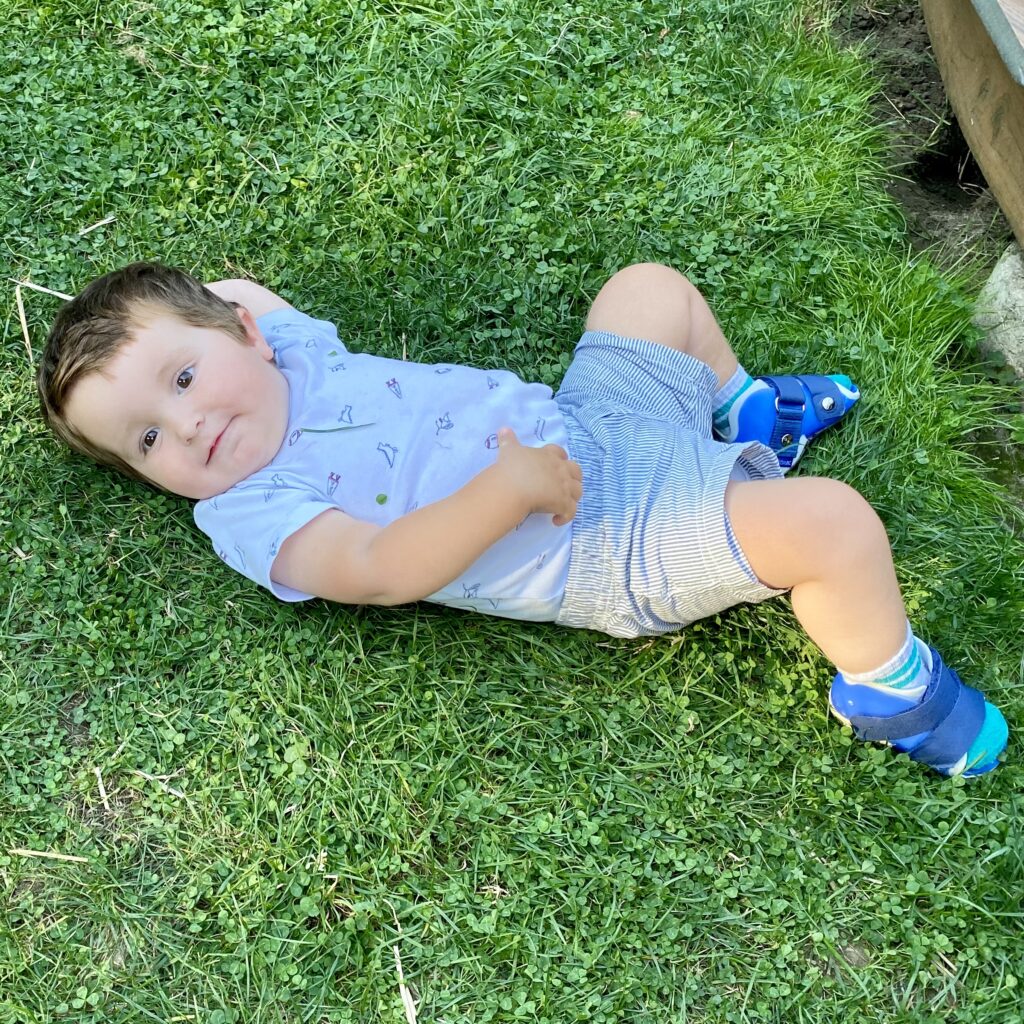
Sometimes, walking through the house, I am transported back to last fall. The shoes I wore walked quickly then, driven by caregiving responsibilities. My mind reverberated with worry, terror, exhaustion, and love. On the evenings we made Lucas laugh, on the days family showed up to help, our relief and joy was profound. I can still feel the push-pull between what I wondered about his health, and what I wanted. I can feel the weight and comfort of Lucas in my arms. And then, in an instant, he’s gone. I rush to his room, frantic, but I only find my own grief.
Then I’m pulled forward into this September, the one happening now. Lucas’ sister is calling me. She is a delightful five years old, exploding with energy, creativity, and curiosity. This month she starts kindergarten, and her anticipation is colored almost entirely by fear.
At age five, a child’s understanding of death is opaque, not fully differentiated from separation. Since Lucas died, Sophia often panics when we are apart. In Costco last week, I walked a few feet away from the cart where she sat, searching for something in their enormous freezers. I heard her scream and rushed back across the aisle to pick her up from the cart, where she had dissolved into hysterical tears. As I crouched in the swirl of Costco, hugging and rocking her, I felt guilt, and frustration, and a bone-cracking sadness. Eventually we disentangled and finished our shopping, sticky with tears and sweat. This week, I answered her questions about when I am going to die with false confidence. I understand that her fears are an age appropriate response to Lucas’ death.
Kindergarten arrives. We talk to the principal, counselor, and teachers. Her school welcomes us with grace and kindness. They amend schedules and routines to reduce anxiety, they share their own stories of grief. We adults do all we can, and I know how fortunate she is to receive this thoughtful support. Still, my heart aches when I see how deeply she misses her brother, how changed she is by his death.
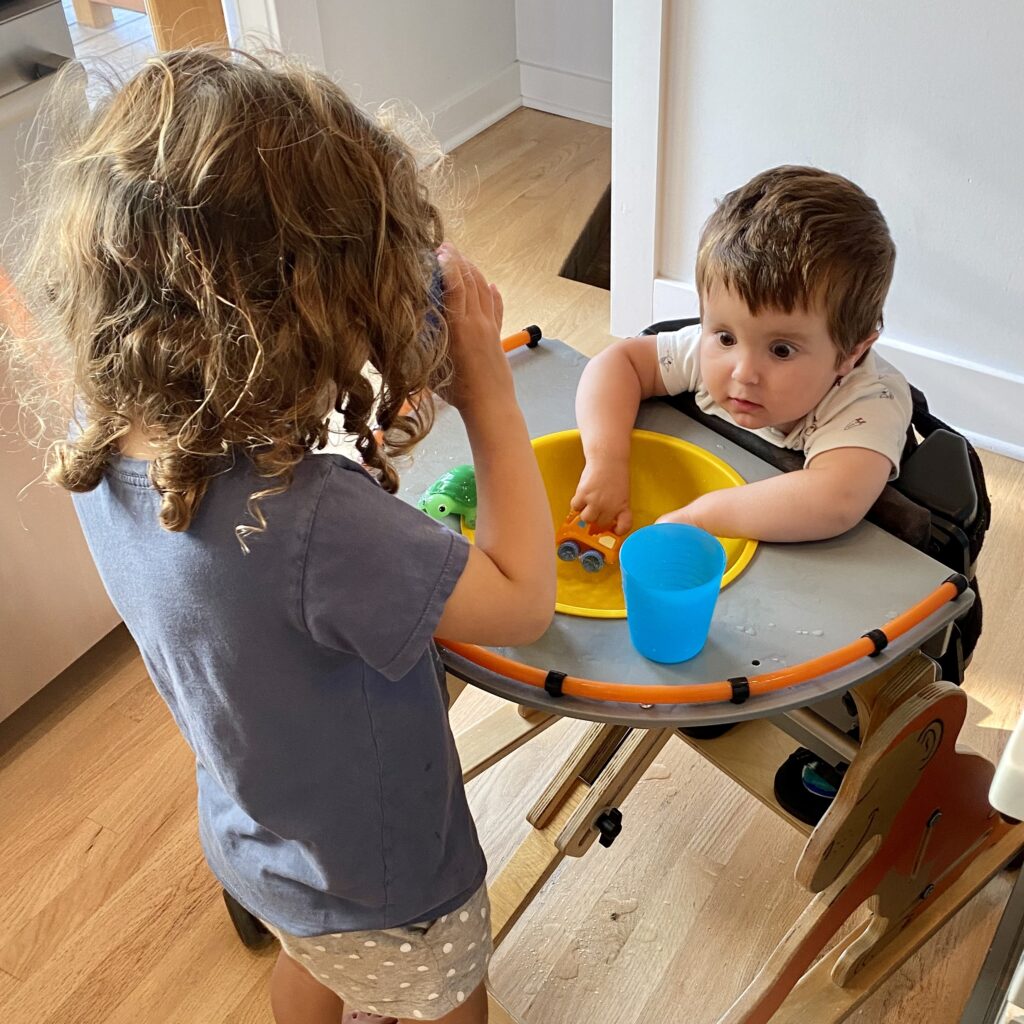
Sophia informed me recently, with sadness and resignation, that she’s not a big sister anymore. When I protest, she insists: “My baby brother died.” And then she falls silent, impervious to my attempts at comfort. I could not answer her plea last December to “bring my Lucas back.” I cannot make her see herself as a big sister today.
We never required that she help with Lucas, but she took pride in caring for him. We marveled at how easily she found ways to include him in play, even as he lost abilities and she grew. In September last year, Lucas liked to lay on the floor and watch her bounce around the room. He couldn’t sit up on his own, so one afternoon, she invented a “peek-a-boo” game that worked from his vantage point on the floor. I can still hear his breathless laughter, mixed with her triumphant giggle. I can see exactly where he lay on our floor, his little arms waving with delight.
It is easy to forget how deeply children grieve, because they don’t talk about it like adults. But they grieve as deeply as we do, and my daughter will carry grief with her forever. It will shift as she grows. I know it won’t always look like separation anxiety and sensory overwhelm. Someday she’ll understand death as permanent and distinct from separation. Someday she’ll ask more questions about Leigh Syndrome and mitochondrial disease, and I hope we can raise awareness and funding for a cure together. Someday she’ll tell her own story about Lucas, to whomever she chooses. It will always be her story. I only see it dimly, through the lens of being her mother. All I really know is that Lucas: his laughter, his presence, his absence — will be with her always.
As I hug her goodbye on the first day of kindergarten, I simmer with my own emotions. Why must she navigate the rest of her life without her gregarious, smiling little brother to cheer for her and give her a hug? Why am I supporting my grieving daughter instead of advocating for my living son? Why are so many disabled children like Lucas left behind and excluded by their school districts, hamstrung by inadequate funding and policies? I kick the wood chips on her playground with disgust. I am angry. I am angry that Lucas is dead.
I pause, and take a deep breath. I feel the tension rising in my chest, the ache of living at once in two Septembers. The one I wanted, and the one I am in. The one where Lucas was alive, and the one where he is dead. I know my task is to integrate these Septembers. I sift through memories and emotions. I hold him as close as I can, while I watch her change and grow.
** For more on supporting grieving children, our family has appreciated resources from the Dougy Center and @child_life_grief_notes. CPN also has many resources to support the sibling.
________________________________________________________________________________________________________________
Kim Gilsdorf writes, runs, and lives with her family in Seattle, the traditional land of the Duwamish people. She works for Perigee Fund, an organization dedicated to supporting early childhood mental health. Her favorite title is “Mama” to her two children, Lucas and Sophia. Lucas lived with and died from a rare disease, Leigh Syndrome, and his life has forever changed the meaning and purpose of hers. You can find Kim’s writing on Instagram at @kgilsdorf.
Before Lucas was born, before he was diagnosed with two rare diseases, and before he died, I was an amateur endurance runner.
Endurance running was a gift. It required my focus, and released me from daily obligations. My mind and body carried me further than I had imagined possible. Across snowy glaciers and rocky moraines, hard climbs led to expansive views and moments of deep joy.
I mostly put these pursuits to the side when I became a parent, though I still loved to take my daughter hiking. I ran short loops, close to home. The loops became even shorter and closer after my second child, Lucas, was born. By the time I felt like running again, I knew that something was seriously wrong with Lucas’ health. I was consumed by the effort to find out what was wrong, to help him stop vomiting, to figure out why he was so weak. When he was hospitalized for failure to thrive at 1 year old, and received a devastating, terminal diagnosis with no treatment, my focus on his care intensified. My husband and I wanted to help Lucas have the best life possible. We wanted him to enjoy his days. We wanted to make him laugh. Oh, how we loved his laugh! We wanted to minimize his suffering. Everything else faded out of sight.
I still ran, mostly to keep from falling apart. Outside, my mind and body worked together in familiar rhythms. My focus was not on ascending mountains, but on the subjective experiences of Lucas and his big sister. Everything felt high stakes, and I was profoundly underprepared. On the runs, I would try to sort through complicated care decisions and emotions. Sometimes I just put one foot in front of the other.
I remember one of these runs vividly. Lucas had been screaming inconsolably whenever I set him down or left his side, though he seemed mostly OK when I was with him. I couldn’t figure out what was wrong. And I couldn’t hold him all the time. I wasn’t just his mom, I was his caregiver. There were medication and formula changes to navigate, feeding tube routines to adjust, therapies at home and in the clinic, research to do, advocacy for his care, appointments that needed scheduled or moved up. I had another child, a husband, and a part-time job that all needed my attention and care. Tired and frustrated, I felt like I was failing everywhere.
There was no time, but I sneaked out on a run anyway while Lucas napped, and my husband kept watch. I was looking for space to sort through symptoms and emotions. It was clear Lucas felt deeply upset when I wasn’t holding him, though other trusted caregivers could help. Looking back, I see now that his disease was progressing faster. He was losing strength and skills. Speaking was very difficult, so he couldn’t ask me to stay, or perhaps he felt like I wasn’t listening well. Either way, every temporary separation from his mama in the context of his inability to move or talk seemed devastating.
On that run, I realized that while I couldn’t take away the disease, I could do something. Even if it was very small. I decided at bedtime that night, I would focus on his experience of our relationship. I would work to connect with him, to make bedtime extra beautiful. I would help him to know that I cared about him deeply. I put aside the to-do list and messages waiting for a response.
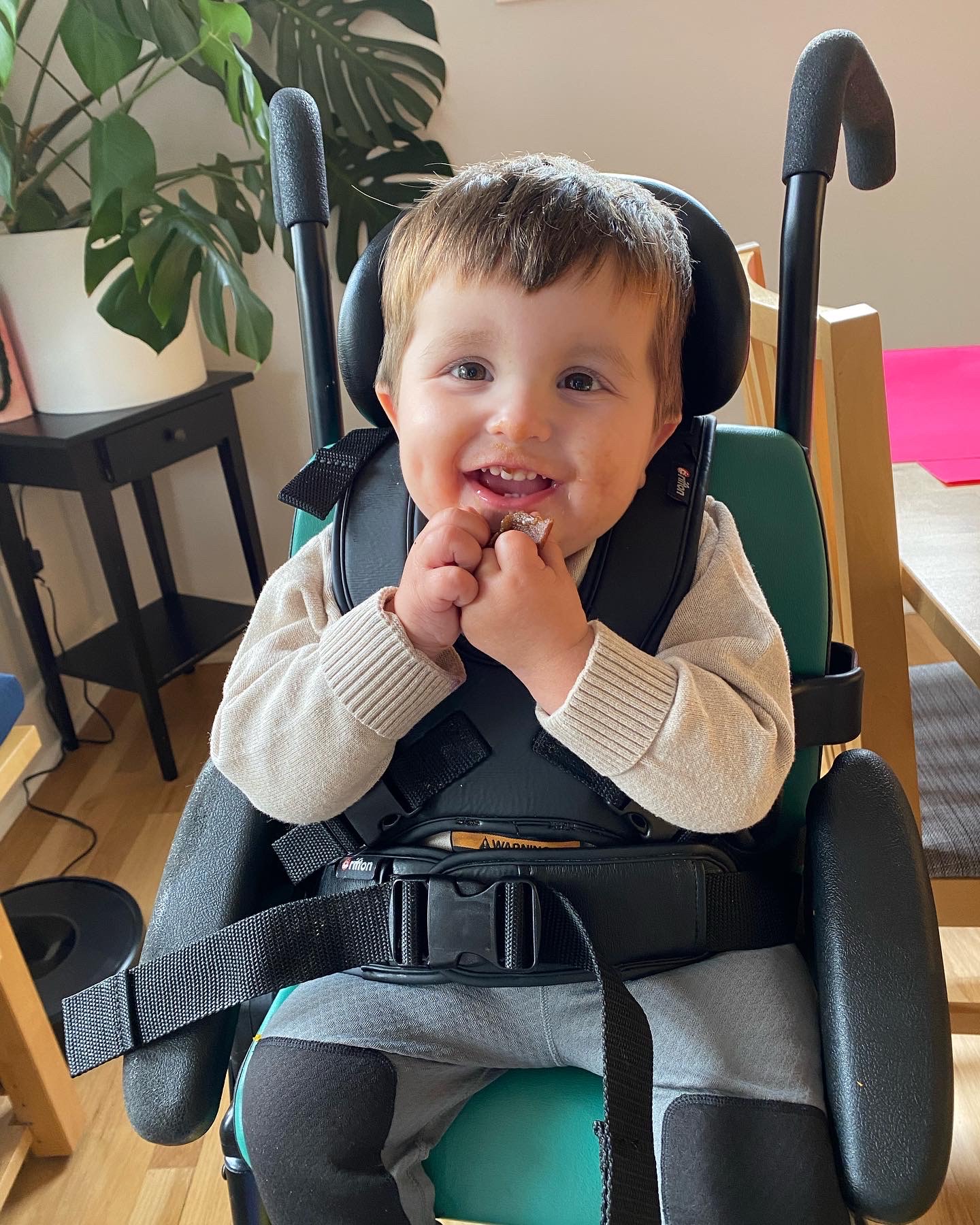 That night, I held him close, and read every one of his favorite books. As I read, I found myself weeping. Holding him on my lap, I wept for all the things I could not fix. I wept for his feelings of frustration, and for my own. I wept because I loved him so deeply, because he was perfect and beautiful, and because he was not going to be OK. I rested my cheek on his head and let my tears run into his hair.
When we had read all the books, I cradled him like a little baby and kissed his cheeks until he smiled from ear to ear, just as I did every bedtime. I told him how much I loved him. I asked him to forgive my frustration. I can never know how much he understood, but his quiet presence and steady gaze told me that he loved me too. That I would always be his mama. That I could not fix this awful disease, but I could do something important. As I sang him to sleep, I felt grateful for the beauty of being present with him, even when it hurt.
—
Lucas has been dead for five months now, a sentence that is excruciating to write and to live. I can never cradle him in my arms again, never ask in the same way for his love and forgiveness. I weep every day, but not into his soft hair. I can’t kiss his perfect cheeks. While I believe that a parent’s bond with their dead child continues, the devastation of his physical death is excruciating. He was only two and a half years old when he died. I feel robbed of time, desperate to have him back.
I thought I knew a lot about endurance, but enduring the grief of Lucas’ death feels more like sitting in an active forest fire than going on a long mountain run. I try to stay present, amidst the heat and crackling branches and flames. Some days it is too painful, and I just close my eyes, willing the nightmare to end. I didn’t choose this. I might be learning something, but I really don’t care. I would give it all back in a second if I could hold my son again.
A few weeks ago, family and friends included me in a trail relay race in the mountains. I didn’t want to leave home, where Lucas feels closest. But I was signed up for Team Lucas, named in his honor. We made the drive. I started my leg under the blazing sun, my 5 year old daughter waving a little sign with Lucas’ face to cheer me on.
Out on the trail, I felt relieved when the physical effort quieted my churning brain. When the steep ascent mellowed into a meadow, one clear thought emerged. “I would give anything to be enduring another hospitalization with Lucas instead of being on this run.” The bargains with the universe that my brain invents are endless, as I try to find a way back to Lucas. This one felt ironic. Sometimes during hospitalizations, I would look out the windows, wishing Lucas and I could be outside on a run in his stroller. Neither of those wishes can ever come true.
 As I ran, I wondered what another hospitalization would feel like for Lucas, if my bargain with the universe worked. His primary diagnosis was a mitochondrial disease called SURF1 Leigh Syndrome. (He also had a rare allergy disorder, Eosinophilic Esophagitis). The spectrum of how Leigh Syndrome presents varies widely across affected children, but it is a serious, terminal, neurological disorder. Many affected children die within two or three years. Like all mitochondrial diseases, it dramatically impacts energy. Your body cannot make the energy it needs, and as your body grows and requires more energy, symptoms often become worse. In short, living with Leigh Syndrome requires profound endurance, just to show up every day. It isn’t the kind of endurance activity that someone signs up to do. It is not fun or rewarding. It’s devastating.
I thought about how Lucas showed up fully, every day. He would smile at me when I bathed him, delighted with the feeling of water, even if it were the third time that night and he was exhausted and dehydrated from vomiting. There were many nights he came joyfully to the dinner table in his adaptive chair, even when he could no longer eat by mouth. He always wanted to be included, and we wanted him with us too. In his last months, he kept his eyes wide open when they struggled to focus, determined not to miss a single thing. He always tried to lift his arms for a hug, even when his tremors were so pronounced that he wobbled and collapsed.
I’ve always thought of endurance as a dance between your body and mind. But showing up every day in the midst of something you did not choose, also requires a lot of heart.
Dear Lucas,
I love you forever. Thank you for your beautiful heart. Thank you for being so present with us in your life. You told us what you needed so clearly, and when I listened, we grew closer. I’ll always be grateful for the way you drew people to you, mostly without saying a word. Your laughter and dimples, the weight of holding you, reverberates in every cell of my body. Being your mother is forever my journey. It brings expansive views. The very deepest sorrows and joys.
Love, Mama
________________________________________________________________________________________________________________
Kim Gilsdorf writes, runs, and lives with her family in Seattle, the traditional land of the Duwamish people. She works as a Program Officer for Perigee Fund, an organization dedicated to supporting early childhood and parent mental health. Her favorite title is “Mama” to her two children, Lucas and Sophia. Lucas lived with and died from a rare disease, Leigh Syndrome. His life has forever changed the meaning and purpose of hers. You can find Kim on Instagram at @kgilsdorf.
The mother and father of a 5-year old with Leigh’s Disease, a mitochondrial condition, talk about they did loads of research online, on their own, including Google Alerts, and learned about an experimental trial. “We had to educate ourselves in order to provide the best for our child.”
The mother and father of a 5-year old with Leigh’s Disease, a mitochondrial condition, talk about how their daughter’s positive response to an experimental study drug means she has more time but they don’t know how much or what to expect. “When she gets sick, we don’t know if this is going to be the one.”
The father of a 5-year old with Leigh’s Disease, a mitochondrial condition, talks about how his job is to do all he can to help his daughter, including with experimental trials.
The mother and father of a 5-year old with Leigh’s Disease, a mitochondrial condition, talk about how pressed and rushed they felt at the beginning, after the diagnosis, to make decisions, to adjust and adapt to highly medical matters. “The transition from hospital to home was a lot to digest. There’s no way a parent can digest so quickly. And you mourn the life you’re not going to have.”
The mother and father of a 5-year old with Leigh’s Disease, a mitochondrial condition, talk about the challenge of adjusting to having a medically complex child. “Special wheelchairs, equipment and school make you admit your child is different.” The mom cried a lot when her child first went to a special school. “But that’s part of the journey.”