
CPN is proud to share this intimate piece from mom Meredith Mathews. With her permission, we have added links to CPN resources relevant to what she and her husband were looking for or thinking about as they anticipated and navigated their daughter’s end of life.
A Journey of Care 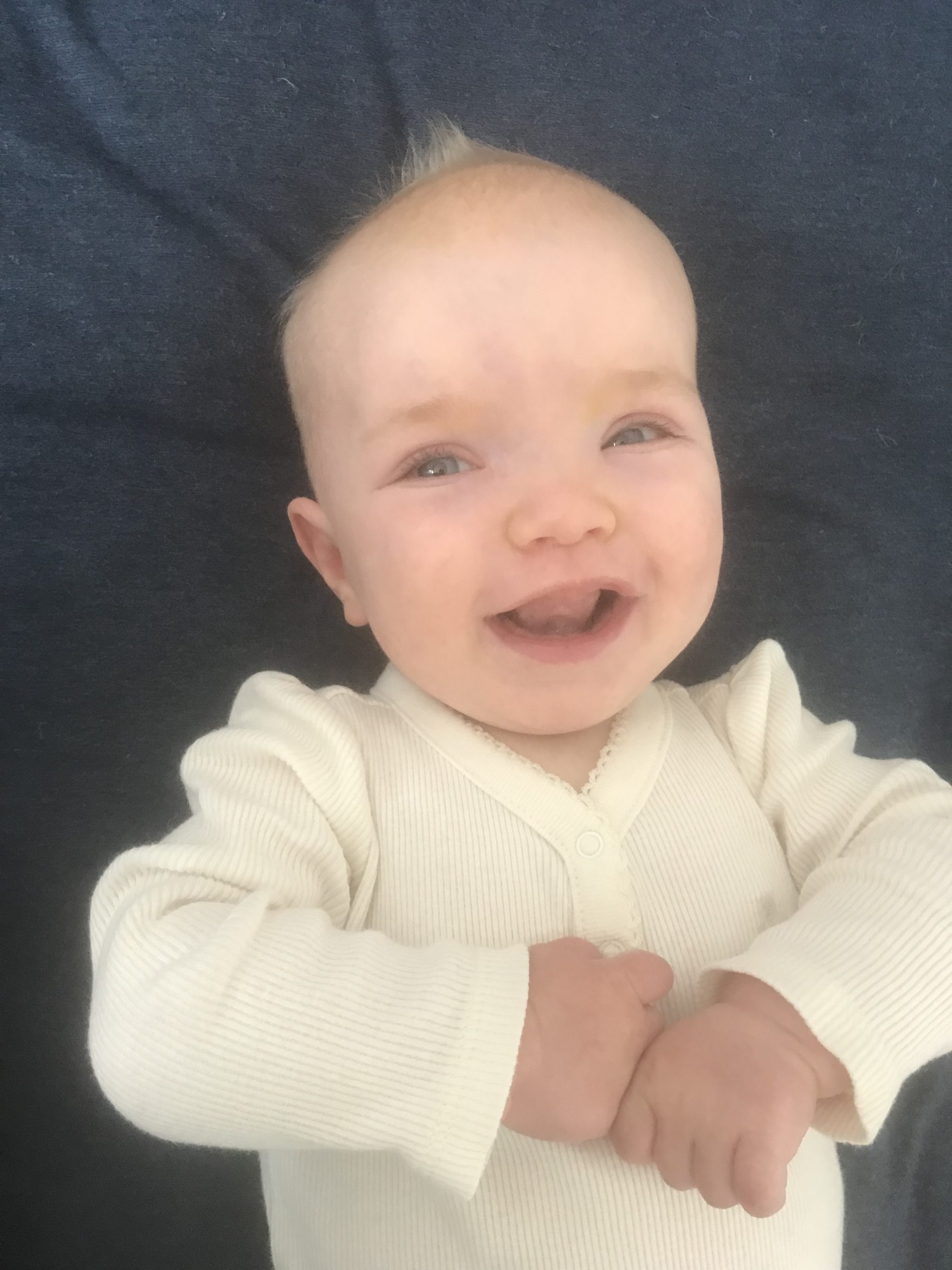
Meredith Matthews
When our daughter, Hannah, was given a terminal diagnosis at 6 months of age, life as we knew it shattered. Her condition came with a two-year life expectancy, and over that time she would slowly lose the ability to move, eat and interact with the world. My husband and I requested a meeting with the palliative care team to understand what our options were. What does choosing quality over quantity of life look like for a child? I needed to know the details, the stories, anything to understand how to ensure our child’s death was painless. For her, but also for us. We learned that there are no exact answers or guidebooks.
We heard the advice: “Just take it day by day, be present.”
Advice that was lost on me in those first few weeks. It was hard. Over the next 15 months we gave Hannah all the love we could, while reconciling with our new reality , and bracing ourselves for a final goodbye.
My husband and I started therapy a few months after her diagnosis. Two issues kept coming up. One was my fear of life after she died — the searing pain that would surely destroy me, the gaping hole left in the routine of caring for someone and, the all-consuming silence. The second was how we would be able to make the decision to help her die. How can anyone make that call? Would we regret our choice in hindsight, thinking it too soon, or would we intervene too much, extending her life but also her suffering?
Hannah was a calm and happy baby, who loved bath time, bouncing, music and stroller walks. As she approached her first birthday, she moved and reacted less. We were not getting much feedback from her anymore, and there was uncertainty around how much of her day she was truly experiencing. My rendition of Feliz Navidad no longer elicited a smile, but we sensed she wasn’t in pain. Slide on a winter hat and she would scrunch up her face and whimper. Touch her skin with cold hands and she would yelp out. These moments were so reassuring to us as they were confirmation that she could feel and would express discomfort. Eventually a feeding tube was placed, and over the next few months she continued to slip away. Once the seizures started, her already weakened systems began to fail. We were admitted to the hospital for aspiration pneumonia, and the palliative care team gave us two choices; help Hannah return to baseline with a slew of medication and hope for a few more weeks, or return home and help her die in peace and relative comfort. We chose option two. I recall leaving the hospital that afternoon for a walk and some fresh air, feeling a huge weight lift from my shoulders. A decision I had been dreading was complete, and I held on to the hope that we had, at least, a few weeks together still.
***
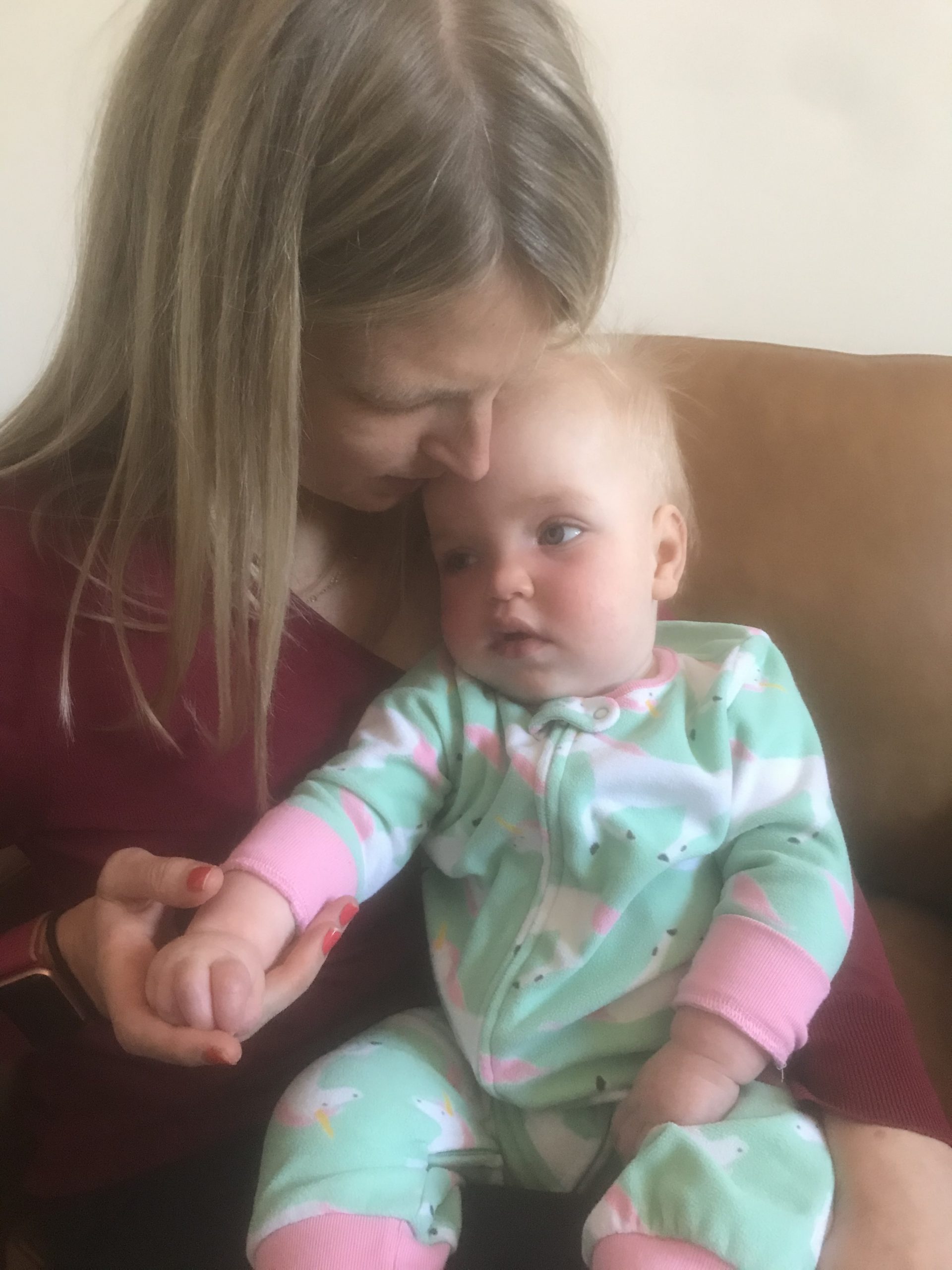 Over the next 16 days, we did not feel alone. The day we arrived home from the hospital, the palliative care team stopped by, followed shortly by a delivery of oxygen and pain medication so strong I was shocked. The team checked in constantly. Her comfort, their highest priority. We weren’t going to be left blind on this journey, as I had so often felt at times with her disease.
Hannah was fairly stable compared to other children with her condition. The team indicated that she may essentially sleep the next few weeks away. I told myself I could handle the emotional side of things if that were the case. It wasn’t as simple as that, though. There were several aspects of transitioning her to end of life care that I was not prepared for. Much of it had to do with relinquishing the role as caregiver, as we knew it, and embracing a different perspective. As caregivers, you are programmed to provide. In palliative care, being a caregiver sometimes means not acting, not providing, not fixing the problem. Your objective as a parent is now the complete opposite. This was a fundamentally challenging shift to accept.
Hannah was happiest when asleep, and most uncomfortable during and after meals, which were also triggering seizures with alarming frequency. And so it seemed the best route toward a peaceful death for my daughter was to remove her nutrition. The first time I really sobbed, was at the thought of no longer providing her with the home blended food I whipped up each morning. I remember pulling open the bottom freezer drawer, and staring at the bags of blended up food in 2oz portions. And it hit me.
“I will never need these again.”
Feeding her healthy food felt like that was the only normal parenting tool I had left. But her increased comfort was immediate without feeding her. My sadness was replaced with calm.
The second time I really sobbed was when we were told to taper down her water. Her course of antibiotics finished, and we no longer needed to flush her tube with water. We were dropping from 50mL to 20mL a day. This small difference felt inhumane to me. I pleaded my case not to drop her water, knowing full well this would draw out her death. I think this was my last-ditch effort to rescind our choice, and the realization that we were active players in this process, not just bystanders. Thankfully, the team was gentle but firm. Her comfort once again improved with less. Sadness was once again replaced with calm. She was on the right path. I would eventually get there too.
At first, we monitored her vitals at night, and then periodically throughout the day. I was curious. I also wanted to avoid, if at all possible, the chance of her dying alone while we slept. As her stats migrated outside the normal range, I panicked. The need to problem-solve and fix was strong. The team, while sympathetic, reminded us that it was normal for these numbers to change, and that usually, these values are not monitored for this exact reason. Even though it was expected we never stopped monitoring her vitals. We accepted the fluctuating values. We accepted that she may die alone. She was on the right path. I would eventually get there too.
The team nurse warned us that Hannah would lose a significant amount of weight, and that this would likely be very difficult to watch. Again, advice that was lost on me. About 10 days in, her weight loss became so apparent it broke my heart each time I bathed or changed her diaper. I was proud of the chunky monkey I had created – testament to her nutrition and the care we were providing a dying child. Now, we just had to sit back and watch her disappear. Do nothing. She was on the right path, but I never joined her on this one. When I look back at photos from this time, her weight loss is still something I notice with a pained heart. Sadness never replaced.
Our routine outside of feeding her carried on as normal. She was mostly comfortable those first few days, but week two brought on periods of restlessness and discomfort where she was unable to sleep. After a particularly bad round of seizures, she could not settle and was extremely weak and confused. It felt like her brain was still firing, but her body had no energy to carry out the signal. We tried ativan, morphine, and oxygen. Nothing helped. I suspect her metabolism had stopped by this point. Our team ordered a pump that delivered a very small dose of sedative every 20 minutes. This was a pivotal turning point in both her comfort, and ours. It also felt like the last time we were able to truly do something for her, to help her. The journey was much more peaceful from this moment on. She was no longer in pain. And I think we finally joined each other, side by side, the rest of the way.
Ultimately, her final four days were everything we had hoped for. She was comfortable, and mostly slept. We continued our stroller walks for her daily doses of fresh air. We sang her favourite songs while moving her arms and legs around; the usual dance routine. Once her breathing pattern quickened and she was no longer responsive, we knew the end was close. We pushed the coffee table aside and covered the living room floor with pillows. We camped out there for the next three days, taking the nights in shifts. The Christmas tree and multicoloured lights cast a warm glow. Her final moments had my husband and I at her side, holding her hands. A kiss on her forehead as she took her last breath. And then there was silence.
***
Now that I am on the other side, I understand that while my recurring fears surrounding her death were valid, they were inaccurate. Of course, there is pain, a gaping hole. There is also peace. I am able to see now, with clarity, that the last six weeks of her life were difficult for her. She was suffering. As much as my heart wanted to choose option 1 that day at the hospital, anything to buy us more time, I knew that choice was for me, and not for my daughter or for our family. The most difficult aspects of letting Hannah die were the times we tried to fight it. I don’t regret them. We were terrified and they came from a place of love. We feel so much gratitude to our palliative care team for guiding us, without judgement through such a difficult time. We know how lucky we are that we were together as a family for her final breath – a harmonious moment for the three of us, and a peaceful end to shepherding our daughter through her very short life on this earth.
As I reflect back on our time together, I do find myself thinking of those 16 days often. How desperate I was for information of other’s palliative experiences. Much like birth, death doesn’t always follow your best laid plans and it may be helpful to know what is in the realm of possibility. My husband and I, forever changed, think about death in a different light now. No longer is it some abstract concept, but an inevitable step we will all take. We are not fearful of death. Instead, we are curious about experiencing something our daughter has. I just hope we can be as fortunate as she was. Comfortable, peaceful, and surrounded by those who love us.
Meredith, her husband and their newborn son Colin live in Toronto, Canada. Their first child, Hannah, had Infantile GM1 Gangliosidosis. She died December 5th,2020 at the age of 21 months.

We just miss you, Coop. There isn’t really another explanation for the heaviness that continues in our hearts. Two years later. Two years seems like such a long time ago and at the same time, I can walk through every exact detail of January 19, 2017. Cooper was pure love. It radiated from him.
I talked myself into my own rationale about Coop’s prognosis, thinking we had a good ten years with him. The doctors said he would live to,” early childhood” So, I negotiated 10 years old in my mind and with God.
10 years old was early childhood to me.
But, I wish I knew we would only be given until 3 years old. I wish I had understood that the doctors only put that label on him because they also didn’t know what his longevity of life would be. I wish I knew how fast it would go.
But, he is free of GM-1 now. I could never begrudge him of that freedom.
After pounding heaven with prayers for a cure and that this awful diagnosis was a big lab mistake, I stopped. I never prayed for Cooper to live. I knew he wasn’t going to. This demon of this life limiting condition was much bigger than any of us. I only prayed that COOPER would stay COOPER for as long as possible and when he couldn’t do that, I wanted him to be at peace. That was my biggest prayer…..and it was answered to the fullest.
As much as I wish I didn’t have to be a bereaved parent, I know with utmost certainty and conviction that I would never trade the title of ‘Coop’s Mom’, for anything. I was given a gift and a privilege. I hate my situation on any given day but at the same time, I feel like the luckiest woman in the world to have had the honor of caring for him. Michael feels the same. He is the only person that can be ‘Coop’s Dad.’ We are so lucky!
We have morphed and changed over two years. It hasn’t always been easy. Our relationships are always changing — I feel for the better — but it is constant work. We are all just trying to find our way. Everyone naturally grieves differently so add in five people that live under the same roof, that suffered an immeasurable loss, and the constant thought rings… Is everyone OK?
But, what our family has learned is that:
- It’s fine to feel a little heavy on any given day.
- It’s fine to miss him.
- It’s fine to stay home. I actually enjoy this most out of the five of us. Some of the most creative Coop’s Troop Foundation thoughts, help to others and ideas came in solitary.
- It’s fine to be a complete mess at work, at school and in life. But, only for a minute. Pick it up. Coop would never want us to be miserable for a long time and dwell in darkness. Always let joy be the compass.
- It’s fine to be normal sometimes.
- It’s fine to not owe anyone an explanation; grief is hard. Grief is always changing. We do what is best for us.
Finally, you can never escape your own feelings or what is in your heart, so pause and take a listen to what it has to say. Coop is usually trying to intercede and point us in the right direction.
I always recall Deacon Joe and the words he spoke at Cooper’s funeral: We may not have received the miracle that we all prayed for (a cure), but God did answer the prayers. Cooper brought lots of hope and WAS the miracle to so many.
“The fact that our hearts yearn for something Earth can’t supply is proof that heaven must be our home.”- C.S.Lewis
We miss you extra today, Coop.
Kyla, age 12, shares her thoughts about being William’s big sister, shortly after his death from GM-1.
I’ve struggled today. Do I post about what today is or do I let it pass….. Do I talk about it or let it sit under a rock and coast the day into tomorrow.
Reflection has led me to post about it. I need to. I need to reflect on all the good, not just the heartbreak of what is today.
Today is DD…..Diagnosis Day; for the evil that is GM-1 gangliosidosis.
March 9, 2015. Etched. Engrained. Can never forget it.
One year ago today was the devastation that came to our family. Parents’ nightmare! We heard words that no parent should hear…..
Life Limited
Pass away in early childhood
Palliative Care
No cure
Special needs
Seizures
Loss of skills
On and on and on…..
I zoned out for a bit after that. Michael, being the stoic and astounding husband, took it all in.
I was PISSED! Outraged and mad at God. Beyond words, angry.
…………..looking back, I see God. I see him trying to guide us down the right roads and in clear directions. Intuition nagged at me. God sent us to the heaven- sent medical team we have today. It has taken me a long time to come to this realization. He was always there.
I still believe in miracles, every single day!
I have one in my home, he is wrapped up in a now feeble little boy.
I will never stop believing in the great people, kind people, gracious people and hopeful people that manifest in our lives to this day. That is a miracle, in itself. Thank you!
Cooper Matthew, one year later, is frail. He is a shell of his former self. Pictures are methodically chosen. It isn’t always pretty. I don’t always post the hard things. It is too big a cross to continuously bear.
With his regression has come positivity, and that is why I had to post. One full year, 365 days, we have become diehard special needs advocates. We’ve fought and won every battle we needed this year for Coop. We found the perfect school for Cooper to enjoy quality of life and like peers, learned about equipment and adaptive devices that we never knew existed, been speakers and have been asked to present with some of the best in the field on hospice, palliative care and rare diseases, speaking and hoping we reached one person that needed to hear it on that specific day. The amazing people in our life, one year later, is something I can’t find a word to describe.
We are starting a new adventure also. Boston Children’s Hospital is starting a new venture. They are opening a specialized Lysosomal Disease Clinic this year. Michael and I will be one of four chosen parents to sit on the parental advisory board for this exciting new clinic. We can’t wait to be part of this!
Cooper is so much more than a diagnosis. He forces us to appreciate life more than ever. He has taught us empathy and true love. He has taught his siblings empathy and true love. Cooper has not one sin, not one single unkind thought in his fragile body. He speaks mountains without ever having uttered a single word. All he knows is pure love and to love back. ?
One year in. We take it day to day. Moment to moment.
On DD, we ask for a simple thought or prayer as we travel into year two. We don’t know what it holds or how many years we have to hold onto. A simple pause to send Cooper a prayer would be all we can ask for today!
A mother and father reflect upon the various ways in which they grew as they kept the family together and cared for and advocated for their son.
A recently bereaved mom talks about the poignant adjustment to how different the house feels and sounds and how different the flow of her day feels.
A recently bereaved mother and father talk about the bittersweet, novel experience of now being able to travel freely with their other children.
A mother and father describe the various ways they are memorializing their 8-year old son who has recently died. Part of his legacy is that mom is now studying for her MSW to help future families.
Recently bereaved parents talk about all they learned during their son’s 8 years, including the perspective they gained.
A mother and father talk about their focus on quality-of-life for their son, the challenges of decision-making, and how their son “showed us what to do.” They fought their fear of regret by letting their son guide them and trusting the process.