

Four Practices for the Parent Who Cannot Stop Searching
Caregiver parents know a desperate kind of searching. It begins with a midnight symptom search and quickly devolves into a need for relief from the discomfort of not knowing. Psychologists call this Deprivation Curiosity: the kind of curiosity driven less by genuine interest and more by compulsive anxiety, where unanswered questions begin to feel unbearable, like an unreachable itch.
This itch has ramifications. It loosens our critical filters. We treat anecdotes like data and find patterns everywhere, even when they are not really there, a phenomenon called apophenia. Eventually, the need for answers hardens into a mask of certainty. We grip a diagnosis or prognosis not because the evidence holds, but because uncertainty itself feels impossible to hold. We cannot bear to let our conviction go. Our anxiety learns to wear a false face of conviction.
Underneath all of it runs the more insidious belief: that not knowing means we are failing our children. That a good parent must be relentless in their search. That to leave a question open is tantamount to denying the presence of a wound we would be obligated to close.
At some point, if you search long enough and honestly enough, the searching breaks down into what is called aporia, which translated literally, means roadlessness. It’s a sense of directionlessness that comes from the realization that effort, even when applied correctly, does not always produce certainty. The standard response to aporia is despair, or a redoubling of your search efforts. But a particular philosophy known as Pyrrhonianism offers another possibility. Instead of forcing certainty where none exists, it suggests that a deliberate suspension of judgment, learning to stay open to uncertainty, was not only a more rational reaction but one that would lead to peace. They encourage fostering a willingness to examine reality openly without demanding that it close around our judgments of that reality. And what followed, the ancient philosophers reported, was ataraxia, a state of being unperturbed, a tranquility that arrives not as a reward for finding the answer but as a consequence of releasing the grip on needing one.
This is the shift from Deprivation Curiosity to Interest Curiosity. You seek because the inquiry is inherently interesting, not because the ignorance is intolerable. Someone who can do this successfully is known as a zetetic, from the Greek zetein, to seek. For the zetetic, the inquiry is the point.
None of this is easy to practice. Knowing the difference between Deprivation Curiosity and Interest Curiosity doesn’t automatically move you from anxious searching to open inquiry any more than knowing what hunger is stops you from reaching for the nearest snack. This reorientation is slow and messy, often bogged down by our expectations of what we believe we owe our children and ourselves. It isn’t easy, but it is possible to practice.
One framework is NEWS:
Notice what we are thinking and what we are doing
Examine the judgements you are making
Wonder about the reality of the child in front of you, rather than the story your anxiety is telling you
Surrender to the unknowing
Notice
I have started more Google searches than I would ever reasonably be able to finish. Not only due to the limitations of time and space, but because what I’m seeking may not exist. What has helped me the most with these doom spirals is to pause, right in the middle of the search. Not at the end, not when you’ve finished the thread, in the middle, the moment you start to feel your eyes strain, while the tabs are still open and the itch is still active. Ask yourself: Am I seeking an attainable truth, or am I looking for relief from this anxiety?
You don’t have to answer it immediately. You don’t have to stop searching. The question alone introduces a small gap between you and the momentum of the scroll, a half-second of observation that didn’t exist before. Sometimes you will find that you are genuinely investigating, following a thread because it is interesting and the answer might actually help. Sometimes you will find that it is two in the morning and you have been reading the same forum for an hour and you are not looking for the truth anymore; you are looking for someone to tell you it will be okay. Both answers are honest. Only one of them is the itch.
Examine
Sometimes I wonder whose side my mind is on. I will take some small inconvenience and build it up into a great, sprawling, impossible nightmare of an obstacle. The Pyrrhonists observed that much of our suffering comes not from circumstances themselves, but from the labels we attach to them. We do not just encounter an outcome; we encounter an outcome we have already decided is bad, bad in itself, bad by nature. And once something is bad by nature, it must be fixed, avoided, or solved. The search becomes urgent because the alternative is intolerable.
I’m not talking about unfounded optimism. I’m not saying you need to reframe all your pains as pleasant. And I’m definitely not saying that the diagnosis doesn’t matter, or that everything happens for a reason. What I am saying is to question whether the outcome you are fleeing is actually, inherently, necessarily as catastrophic as the itch is insisting it is. Feeling bad about your reality is not the same as your reality being bad. Not every unanswered question is a crisis. Not every unnamed thing is a threat. Some of them are just…unknown. And unknown, on its own, is not the same as bad.
When the urgency loosens even slightly, the search changes character. You are no longer fleeing something. You are, perhaps, just looking.
Wonder
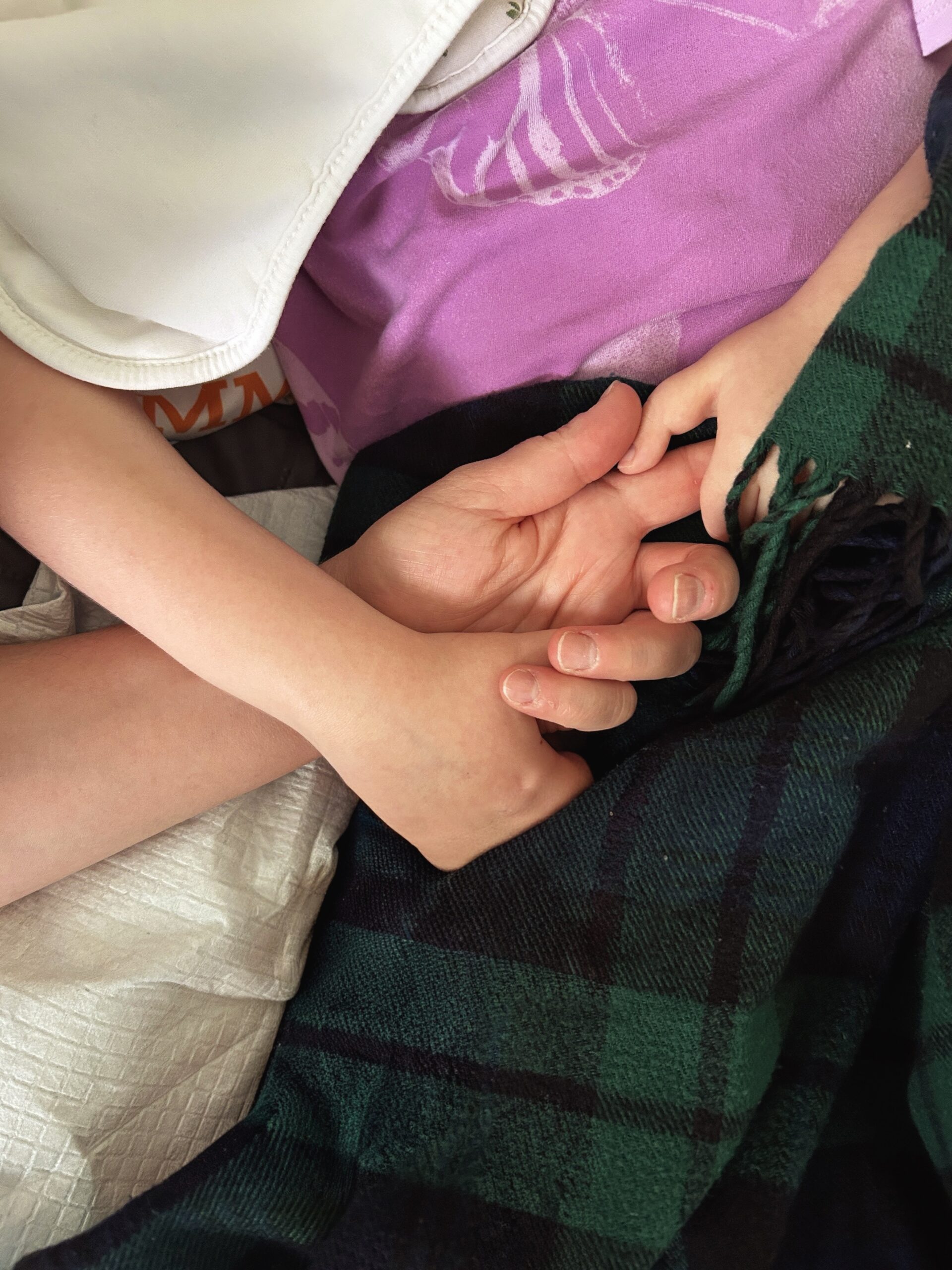
I have caught myself mid-scroll realizing I could not tell you what she did that morning—what made her settle, what her hands were doing. I had been looking, but not at her.
I now make an effort once a day, as often as I can manage it, to look for something about my child that has nothing to do with her diagnosis.
Not her symptoms. Not her therapies. Not what she can’t do yet or what we are still waiting to understand. I train my attention on something else entirely—the way she tracks a sound, what she does with her hands when she is content, the specific quality of her attention when something catches it. This is the texture of who she is becoming that has nothing to do with any of the search terms I have ever typed.
In encouraging you to do the same, I am by no means suggesting that you bypass the hard work of acknowledging their medical complexities. This is not denial. It is refusing to let the medical framework be the only framework, refusing to let the problem-solver’s narrow field of view be the only view available. Our children are not diagnoses with humans attached. They are unrepeatable, exceeding any label, perpetually more than what we know about them.
Surrender
Journaling has been a part of my life almost since I learned to write, and recently I’ve started writing down all the things that I don’t know. I like a good old-fashioned notebook with a pen. There’s an intentionality that comes with the ink and a reminder that comes with my smudged left hand, but a note on my phone works too. And yet I tell myself it requires time and space that I just don’t have. Deep down I know that’s a deflection of the real struggle.
The real struggle is in what to write. Creating a list of the things you are comfortable not knowing sounds easier than it is. Not the things you have given up on. Not the things you are pretending not to care about or wish you didn’t have to think about. Write the things you can actually hold open, with some degree of equanimity, as questions that don’t yet need to close.
It will probably be a short list at first. That’s fine. The point is not the length of the list. The point is the act of naming the open questions as open questions. Celebrate these as open doors for future inquiry rather than gaps that need to be filled immediately. The Pyrrhonist in you knows that the unanswered question is not the end of the road. Perhaps we should replace the question mark (?) with an ellipsis (…), to transform the nature of the query, and leave your curiosity open.
And some of what you write there, you may find, has been waiting a long time to be set down somewhere that isn’t a search bar.
The itch of Deprivation Curiosity will return. The tabs will multiply. The doom spiral has a way of finding you in your weakest moments. But in between those moments there is a child in front of you, becoming someone, right now, in ways that no search engine will ever be able to index. These practices of Interest Curiosity are just small ways of making sure you don’t miss it.
 Stephen Hager goes by his second middle name (he has three), Bud, because it’s easier to remember and baristas never misspell it. Along with his wife he is a caregiver for their 8-year-old daughter, Emma, who has pachygyria, a rare neurological disorder. He believes in taking an active approach to advocating for his child and others like her. To this end, he sits on various advisory councils at Children Hospital of Orange County (CHOC), volunteers on consulting and directing boards for various non-profit centers and lends his writing skills where he can. Experiencing a lack of support for parents of medically complex children, Bud founded a support group through CHOC focusing on parent-to-parent interaction. He is also a professor of psychology and has a small private psychotherapy practice.