

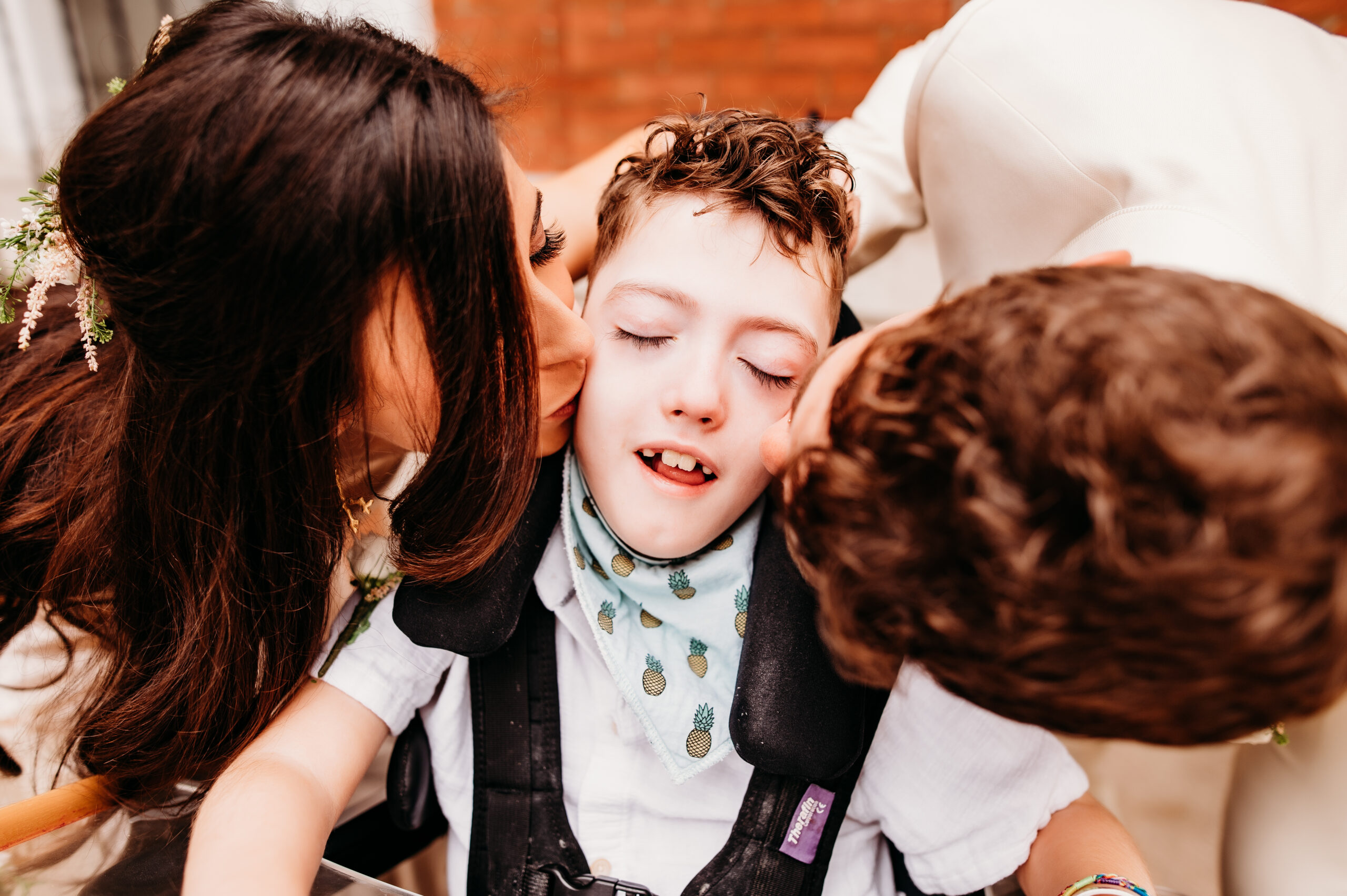
First published on Patient Worthy.
There were so many anxious years leading up to this moment. Thoughts of this impossible decision rattled around my brain and squeezed my heart for years. And now the day had finally come.
Kept company by a small dim light in the back corner of our PICU room and the hum of the bipap ventilator, I was frantically making a pros and cons list of what my son Bubba’s life would be like should we pursue a tracheostomy. Desperately trying to recall all the information given to me by our specialists, I felt like I was sinking due to the weight of a seemingly impossible decision. I laid down – a vain attempt to surrender to the mental exhaustion. Pulling the blankets back over my head, I quickly found myself rolling over on my side, retrieving my phone and diving back into exploring the options for a tracheostomy.
In the years leading up to this day, Bubba’s respiratory status had been declining. Bubba was born with a rare neurological condition, Neuronal Migration Disorder with Cortical Malformation, which had greatly affected his muscle tone and subsequently his respiratory system. For years as I watched Bubba grow, I also watched how respiratory illnesses were becoming more gruesome and day to day activities brought on significant breathing problems. When our specialists started to drop subtle hints that a tracheostomy could be in Bubba’s best interest, I knew I needed to begin preparing for the decision day.
A tracheostomy seems like an easy, no-brainer, almost “easy button” decision when your child is faced with airway obstruction and a progression of their condition. When the tracheostomy talk started to appear on our radar, I soon realized the decision for a tracheostomy was far more complicated than I had ever realized. Being a seeker of valuable input, I spoke with friends whose own children had tracheostomies to learn what the care and their day to day looked like. I knew I also needed the advice of a trusted medical professional to explore the myriad of questions circulating in my brain. Bubba’s neurologist had a deep understanding of who my son was as a person, his finicky medical complications and our values as a family. As parents, we often seek the “expert opinion” and in this case I was desperate to have that from Bubba’s neurologist. In her honesty, she shared her reservations about how a tracheostomy might contribute to Bubba’s quality of life. In my heart, I had similar reservations too and hearing the same worry reflected from our trusted neurologist shaped my mindset for the looming tracheostomy decision: it was a hard no.
But here I was, a year later debating the decision all over again. I knew I needed yet another opinion. I sought out the opinion of two otolaryngologists and wondered if their opinions would be the same. Both doctor’s findings were identical: Bubba’s airway was collapsing, and his lung function was declining. The doctors offered options rather than opinions – a tracheostomy or keep Bubba on bipap ventilator. They explained a tracheostomy would provide a stable airway, but there was no indication that it would prevent further airway collapse below the tracheostomy and it wouldn’t reverse his disease progression. The less invasive option of bipap ventilation provided less risk, but the medical team was certain that with that choice Bubba would only be left with a few months to live. Furthermore, Bubba’s entire medical team was unsure if his body would recover from surgery and be able to ever wake up again from sedation. As I tossed and turned on the hospital couch bed, tears filled my eyes. I felt no matter what decision I made, it still meant Bubba faced significant decline in his condition and likely the end of life. I was overwhelmed with a feeling of defeat.
As the sun rose the next morning, I quickly got myself ready and was determined to make the decision. Pushing up a chair beside Bubba’s bed, I studied him as he still slept. The bipap ventilation mask covered his entire face, but he seemed comfortable. The days prior, Bubba had required his bipap mask almost constantly as he would desat quickly once it was removed. As I grasped Bubba’s hand in mine, I felt a bit more clarity, I couldn’t send Bubba into a surgery without absolute certainty he would come out on the other side with a better quality of life. Furiously, I dove back into researching the options for a tracheostomy before Bubba’s team arrived for morning rounds. Thankfully, the day before my palliative care team reminded me of the resources on Courageous Parents Network. I read through the tracheostomy decision guide and reflected on Bubba and our life together. I explored the videos and connected immediately with the parents who chose not to proceed with a tracheostomy for their child. Being able to hear from another parent who faced the similar impossible dilemma and was choosing to forgo the “easy button” solution was comforting to me.
In the end, I realized that choosing to pursue a tracheostomy wasn’t giving up on Bubba. By not choosing a tracheostomy, I was choosing the path that honored who he was and the life we had built. This decision was not made from fear, but out of love, deep reflection and an understanding that more intervention does not always correlate to more life.
Although it was one of the most difficult decisions I’ve ever had to make, I eventually found peace in knowing that I was no longer acting out of desperation. Instead, I moved forward with the confidence that this was what Bubba truly needed—comfort, dignity, and the unwavering presence of a mother attuned to both her child’s needs and her own inner guidance. The anxiety that had weighed on me for years didn’t vanish entirely, but it was eased by the clarity and love that came with the decision. In that space, I was able to simply be with Bubba—holding his hand, loving him deeply, and continuing our journey together.
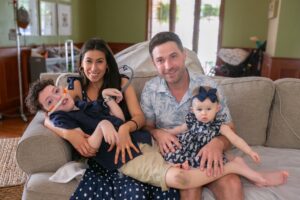 Blair Young-Whitworth is a devoted mother, corporate professional, and passionate advocate for children with complex medical needs. She is the mother of two children, including her beloved son Bubba, who was born with a rare neurological condition—neuronal migration disorder with cortical malformation due to a MED13 gene mutation. Bubba passed away in 2024 at the age of 10, leaving a lasting impact on all who knew him. In his memory, Blair continues to channel her love and experience into advocacy, working with Courageous Parents Network as a Parent Champion to support and empower other families facing similar journeys. In addition to her role in the corporate world, she dedicates her time to government advocacy and is a Lay Educational Advocate, helping families navigate the special education system.