

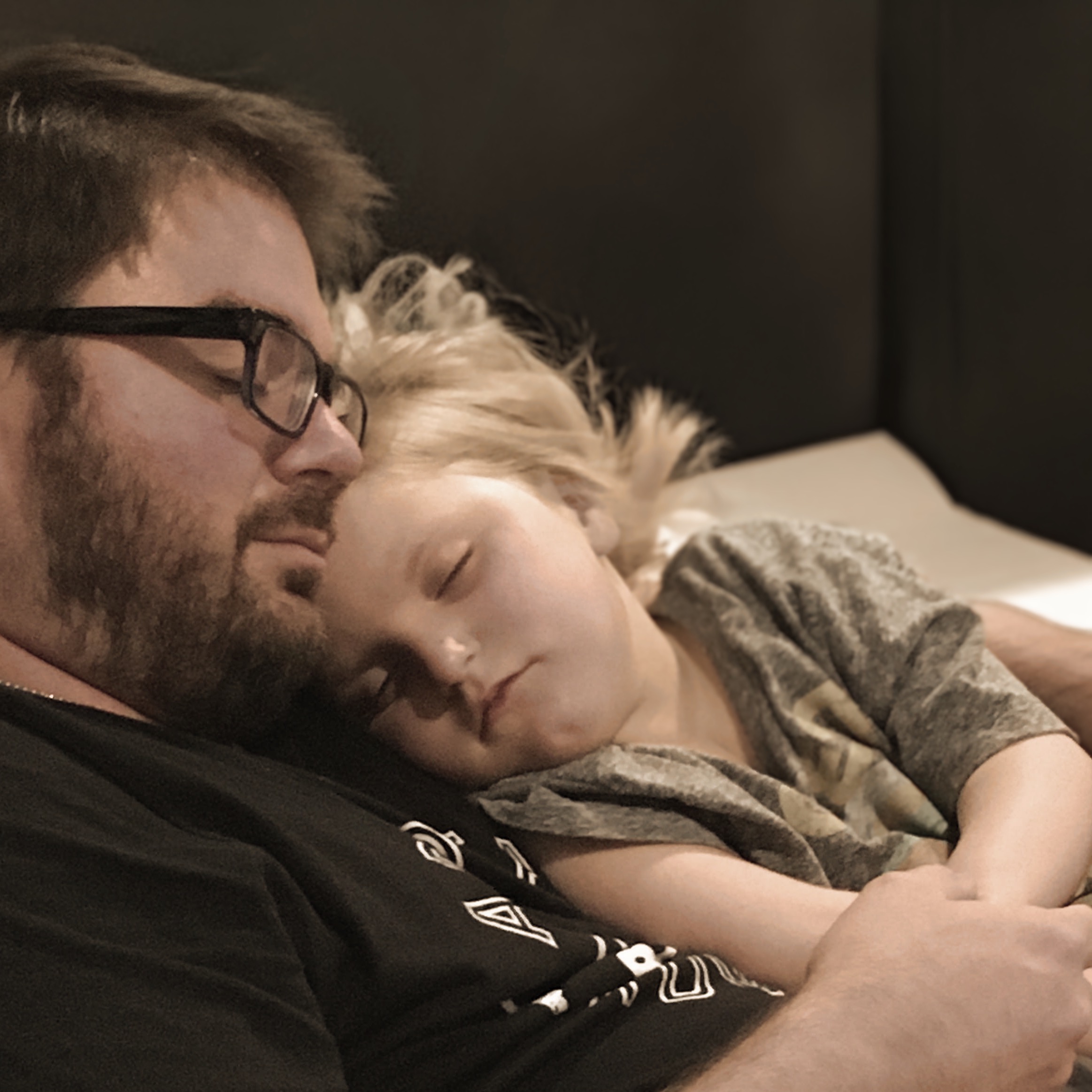
Someone’s grandma cornered us by the drink table at a party years ago.
She was as generous with her cooking as she was with her opinions. She approached us with the easy authority of someone who raised three kids and lived to tell every story twice. My wife and I were trading a fussing Emma between us like a hot potato, astounded that she had so much energy for someone who, inexplicably up to that point, didn’t sleep at all. None of us had slept. The old woman noted that we looked tired, then leaned in with conspiratorial softness. “Sleep when she sleeps,” she said, patting my arm like she was handing me a key. “That’s the only trick you need.”
I wanted to argue with her but it was easier to mentally file the phrase under cliché and let it curdle. After all, it was the kind of thing people say because they’ve run out of things to say. But she wasn’t being malicious and she wasn’t exactly wrong. She was offering the only currency she had, and it was good currency. It’s just that it was minted in a country where we did not live. We had already noticed something more than the ordinary anxieties of new parenthood. But a feeling isn’t a diagnosis, and hope is a stubborn sonovagun. So I nodded, thanked her, and tucked the advice away like a gift card to a store that isn’t open anymore.
But sleep when she sleeps isn’t really about sleep. It’s a sentence built on an invisible foundation. Years later, I’m lying on the floor of the room that taught me what that foundation is.
I am dozing, remembering that soft summer scene with the kindly lady offering her wisdom up like a platter of hotdogs when a sound wakes me. Or well, the absence of it. A half-second where the rhythm of the night breaks and my body sits up before my mind can veto it. The room is dark except for the pulse oximeter, its numbers hanging white and merciless in the air. 98. 97. The fan hums its one flat note in the corner, indifferent. I hold still. I listen for the thing under the thing—the wet, rattling catch in her breath that means the suction machine needs to come out. I am primed for the particular ordeal that is clearing an airway that cannot clear itself.
I move by feel. My hands find the tubing, check the length of it, the give of it, making sure nothing has kinked itself into a small emergency while I dozed. After clearing her airway, I turn her carefully and readjust the blanket over her arms. She has never liked having her arms covered. The oximeter’s glow lights her as I watch the ventilator inhale for her, then exhale for her. Like some kind of medical concertina, it keeps its music going all night.
It is one of the loudest rooms I have ever slept in, overcrowded with hums and beeps and the small percussive facts of a body doing its difficult work. I stopped trying to block it out sometime in the first month after we added the oxygen concentrator. Instead I tuck myself into the noise, let it become the lullaby, and attempt to rest inside it all.
At some point in those first months of medical machinery, my ears became something else. They became instruments, calibrated to an absurdly specific frequency. I can hear the difference between Emma’s tired breathing and her working breathing from two rooms away, through a closed door, over the gentle melodies of João Donato. I couldn’t explain the distinction to you if you asked. It isn’t a fact I know; it’s a fact I am. Like how João’s hands move through chords before his brain names them.
Silence itself stopped being neutral. For most people it is simply the absence of sound. But for me certain silences have a gravitational pull that yanks me upright out of the deepest sleep. The wrong kind of quiet in her room is the sound of something sinister.
For most families, the surrender of sleep is an unremarkable leap into faith taken nightly, without ceremony. You close your eyes and trust that in the next room for the next eight hours, your child will be fine. Most families don’t even realize that this is an act of faith; but I’ve watched the whole world change in the space of a missed breath. Once you’ve seen how thin the line is between fine and not fine, surrender stops being simple. You can’t unknow that thinness. What happens to sleep once the baseline trust it requires has been permanently revised?
I don’t have answers yet, only circling questions. What is sleep if some part of me must stay awake inside it, listening? Can a person truly rest while they’re keeping watch? Is vigilance the opposite of rest, or two things overlapping, coexisting within the same body? But if part of me sleeps and part of me listens, who exactly is doing the sleeping? Have I become two people in this dark room? One who rests. One who stands sentry.
Perhaps that’s what medical parenting changes: sleep stops being the opposite of wakefulness. I don’t know if love can cleave the self like that, half given to unconsciousness and half left on duty. I only know that some nights it feels exactly that way, and other nights it doesn’t feel like anything at all.
In the beginning, every night felt like an exam I hadn’t studied for. If staying awake meant keeping her safe, then by definition sleep was a nightly failure. I carried an unspoken thought that if I was watchful enough, careful enough, awake enough, I could somehow hold the world together.
It took longer than I’d like to admit to see that forced wakefulness was really control dressed up as care. No amount of watching eliminates uncertainty. I have never once, in all those hours of listening, been able to guarantee her a single tomorrow. Nobody can. The watchfulness mattered, but it was never the thing holding the world up.
Every night I hand off what I cannot hold to the habits of attunement that years of being present with Emma have slowly and patiently built. Sleep, it turns out, isn’t the moment vigilance of love surrenders. It’s the moment I admit that love is not omnipotent.
Over the years, the attention moved into my body, no longer needing my conscious mind. My ears wake up before the rest of me does, followed by that strange half-second where my body is already moving, already reaching, while my mind is still walking into the room. The nightwatch doesn’t end when I close my eyes; it has simply moved from the part of me that thinks to the part of me that knows.
I can trust myself to sleep because of the attention I poured into her while awake. It is trust built and rebuilt over countless days and nights of caring for her. The trust is earned through the knowledge that I have met her needs during our daytime hours and the knowledge that comes from having been wrong about a silence once, and never forgetting what that felt like.
That trust lives between my wife and me. There’s a particular choreography two people develop after enough nights on the same watch. Sometimes she wakes before I do; sometimes I am already standing before she opens her eyes. After enough years, it is impossible to say who heard the room first, and neither of us keeps track. We trade shifts without issuing an order. It’s a sleepy, wordless conversation our bodies have been having for years. I trust Emma, my wife, myself, and whatever this thing is the three of us have built in the dark. It feels less like a routine and more like a relationship. It is exquisite, responsive, imperfect, alive. This is where our flourishing starts—the moment we stop mistaking control for love.
I think of that old family friend sometimes, like I did tonight, patting my arm by the drink table. She was offering care then, and I understand that now. She just didn’t know the shape care would eventually take in our house. Sleep when she sleeps isn’t about sleep; it is about trust. It is about placing your faith in a love that has already taught your body how to answer, if it comes to that.
Every parent learns that trust in one form or another. Our nights ask different things of us, and the language in this room has become different, but the work begins in the same place: loving a child well enough to be changed by them.
Yet I am still far from perfect at it. There are still countless nights where the trust buckles, where anxiety overrides instinct, and I lie awake staring at the merciless white numbers. But I’ve learned that where the fear is, the work is. If a tomorrow comes, it is another opportunity to breathe, step into the dark room, and try again.
 Stephen Hager goes by his second middle name (he has three), Bud, because it’s easier to remember and baristas never misspell it. Along with his wife he is a caregiver for their 8-year-old daughter, Emma, who has pachygyria, a rare neurological disorder. He believes in taking an active approach to advocating for his child and others like her. To this end, he sits on various advisory councils at Children Hospital of Orange County (CHOC), volunteers on consulting and directing boards for various non-profit centers and lends his writing skills where he can. Experiencing a lack of support for parents of medically complex children, Bud founded a support group through CHOC focusing on parent-to-parent interaction. He is also a professor of psychology and has a small private psychotherapy practice.