

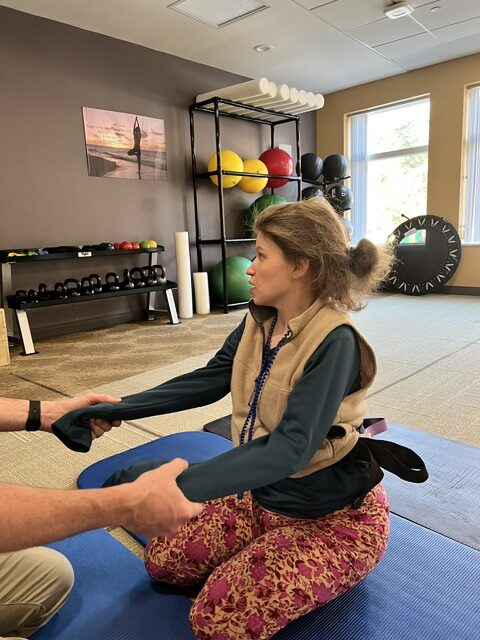
“I sense that it’s been a tough year,” the palliative care clinician stated at the start of our visit. He had clearly reviewed Sasha’s medical chart; or he could tell by just looking at her positioning and demeanor. It had been a tough year.
Sasha usually meets with palliative medicine once or twice a year, per their recommendation. In 2025 we cut back to an annual cycle because Sasha was doing so well. But just over a month ago I looked at Sasha, struggling to hold her head upright and sleeping more often, and I realized we needed to schedule a visit.
Palliative care supports the management of chronic or life-limiting conditions with significant disease burden. The specialty specializes in symptom management and the social-emotional impact of the condition on both the patient and the family.
I was grateful that Sasha was relatively robust and engaged on the day of our palliative care appointment. Just the day before she slept until nearly 1:00PM, but this day she was awake for most of the car ride and leaned forward from her wheelchair in the exam room to look directly at Dr. Wilson, listening to our conversation. I updated him on the past year and told him why I suddenly picked up the phone to schedule a visit. I shared that Sasha was now fully g-tube dependent, that she required three bowel medications daily, and that she was not experiencing her usual springtime rebound. This sunny time of year is normally a celebratory season for us all. Sasha is typically gaining energy and stamina with each lengthening day. But this year, she was still sleeping often. It felt worrisome. Things were progressing.
At my initiation, Dr. Wilson and I discussed what body systems I should expect to be managing later in Sasha’s disease progression. What additional medical equipment may enter our lives? Suction to mitigate secretions was something I anticipated, as well as possible oxygen machines like CPAP or BiPAP should apnea present. What else may be coming our way? Pain management tends to be the harrowing chapter, Dr. Wilson shared; and his team would support us if and when physical discomfort starts to arise. Then we turned our conversation to the social-emotional effects of Sasha’s disease progression.
I worry about my younger daughter. I worry about the impact that losing a child places on a family unit. I’ve started pondering Sasha’s legacy. I shared stories that day about how some of my fellow rare disease mom friends navigated their child’s later years. Each approached this stage very differently, in accordance with their individual personalities. Our provider shared names of colleagues who might be able to engage Child Life Specialist resources for Nika. He said he would get me a list of books that I might find helpful. And then he shared his insights into how to navigate legacy and memory making. Some families create bucket lists. We often talk about doing the big things you always wanted to do together with your loved one, like going to Disney. Other times, and more realistically, it may be simple time spent reminiscing and sharing joy, sitting on the couch together and going through photographs.
I thought about what he was saying. Quality and quantity of time are both unknown, for all of us really. I felt divided by the number of ways our family could and should spend time with Sasha. Do we want to keep chipping away at all of the big Bucket List items, or should we pivot? I looked over at Sasha, her leftward leaning posture fixed and pronounced. Does she just want to enjoy the flowers in our yard and sit in the sunshine together? Or should we be jetsetting? Perhaps I need to shift my thinking to include listening to the birds as time brilliantly spent.
We then turned the conversation to end-of-life planning, and this is when Dr. Wilson’s wisdom really shone. He suggested I start thinking about the involvement I wanted Nika to have when her sister’s end of life nears. Is Nika comfortable talking about death? Does she know what death means? Does she use that word? What were our personal philosophies? I told him I wasn’t sure. I didn’t know what type of funeral I want for Sasha. I didn’t really know my husband’s preferences either.
The only concrete idea I had was about a burial place. I shared with Dr. Wilson my recent discovery of a newly developed green burial space in our state, the first of its kind, and how that resonated with me the most. It is near the mountains that Sasha and I frequented years ago and very close to our former home in the north. I knew certain, upon reflection, that location for her final resting place felt like home. But then I found I was struggling with what our family might think. This would be a non-traditional choice, and it was over an hour’s drive away. Dr. Wilson then revealed an idea that I know will support me through many of my decisions and days ahead. “Whenever I find myself thinking I should do something,” he said, “I ask myself if I want to do that something. Who am I making this decision for? Is it authentic for me or is it because I should do it to conform to societal expectations?”
Together we reflected on some of the decisions some of my friends have made as rare disease moms, and how much I respected them because they were authentic choices. Some parents chose not to have a funeral and kept things very private. Some parents employed a prolonged pause, waiting before letting the world know of their child’s passing altogether. Some held services where loved ones flew in from all over the world to enormous places of worship. To me all of it felt so very right—specifically because the actions were so authentic and deeply personal. It seems these moms did not let concerns about outward appearances or pleasing others impact these important choices. As long as the decisions I make moving forward are the ones I want to make, not ones I’m making because I should make, then that internal guiding wisdom will not fail me.
I do not know how Sasha felt sitting in that conversation beside me, though I wish I did. At one point I noticed Dr. Wilson paused as a look of both concern and curiosity washed over him. He gazed at Sasha and appeared to want to say something. It is both beautiful and challenging that palliative appointments are not scripted. While a loose checklist of topics to cover is helpful, letting the conversation evolve organically can be even more beneficial. But I don’t think we missed our opportunity to ask Sasha how she felt hearing us discuss end-of-life topics. I know in my heart that we opened the door for future discussions for me to have with her privately while sitting beside her at home.
After visits like the one we just experienced this spring, I have a deeper appreciation that palliative care is as much a resource for the caregiver as it is for the patient. We have met with multiple palliative care providers over the years, knowing intuitively that a good match in communication style is paramount in this specialty. To feel fully seen and aligned as a team member with palliative medicine are of the greatest gifts in helping navigate what can feel like an infinite abyss of uncertainty and unknowns. The world of medically complex parenting is never straightforward, but a provider who takes the time to impart wisdom and guide choices is a form of solace I wish for everyone. It is a gift that stays with a family long after the appointment ends.
 Joanne Huff comes to Courageous Parents Network as a long time follower and parent enthusiast of the organization. As the Mother of two girls, the oldest of whom has the rare disease MPS IIIA/Sanfilippo Syndrome, Joanne has benefited tremendously from the intimate parent interviews and candid, vulnerable story sharing throughout numerous thought provoking blog posts. As her daughter’s activities and lifestyle started to slow down with disease progression, CPN became a larger anchor in times of uncertainty and unrest. It is through this lens that Joanne hopes to share experiences and insights via the CPN blog.
Joanne completed nursing school after her daughter’s diagnosis, receiving her Bachelors of Science in Nursing from Plymouth State University, Plymouth NH. She enjoyed community liaison work with home care providers of adults with special needs up until her own daughter’s care became increasingly more involved. In addition to serving on the Boards of New England Regional Genetics Group (NERGG) and Adaptive Sports Partners through 2024, she has found great purpose in volunteer work advocating for policy improvements and change in Washington DC with the National MPS Society. In her free time, Joanne seeks balance and refuge with yoga, hiking and performing as an ensemble Soprano vocalist with the Pemigewasset Choral Society. When not blogging for CPN, Joanne enjoys sharing offerings on her personal Blog Folding Origami for God. She resides in Bow New Hampshire with her two daughters, Sasha and Nika, her husband Mike and her yellow lab Suki.