

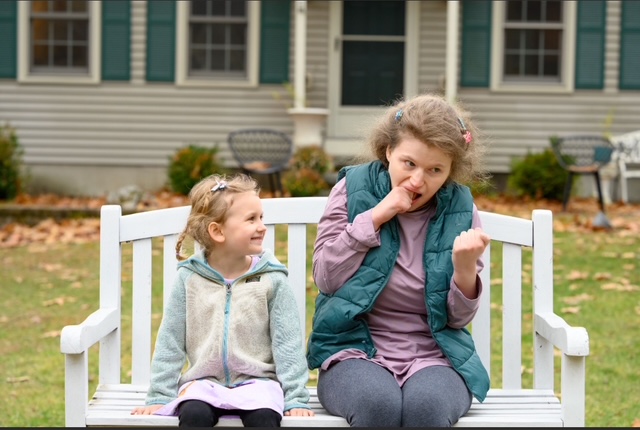
As I write this, Sasha is screaming. Not the kind of vocalizations you might hear at a restaurant or department store and realize someone with a complex disability is in the vicinity. This screaming is a pupils-dilated, faced-flushed, blood-curdling kind of shriek. If you were to zoom in further, you’d see her uvula swinging violently in the back of her throat – something right out of a horror movie. My husband employs noise cancelling headphones during these episodes, while Sasha’s four-year-old sister calmly states, “Sasha, it’s too much.”
These episodes have long been a part of parenting Sasha and living alongside her. In her early years, they tended to be nocturnal. As the sun set, an internal switch would flip on and Sasha would start pacing and screaming. We would hear yells anytime she got cold, whether from a window being down while driving along a highway or from missing a blanket when watching television. Nowadays, a screech may occur when she wakes from a brief catnap and feels disoriented. We always hear one when she is uncomfortable from wetness in her incontinence brief. But mostly – and like clockwork – this behavior occurs during menses. Period Power is the term my husband has dubbed it, referencing the surge of energy, mania, appetite and sleepless nights we often see during “that time of the month”. Each cycle has brought challenges for us as caregivers, and also unexpected, miraculous strength to Sasha’s body.
Sanfilippo Syndrome carries with it a myriad of complexities. Sasha was six when her seizures began. With them came a loss of skills, which was shocking and particularly devastating because we did not yet know her diagnosis. Witnessing such a small, young individual go into convulsions brought a helplessness no parent should ever know. As time moved on, the seizures worsened, and our pediatric neurologist shared that seizures beget more seizures. Eventually, Lennox-Gestaut, a typically intractable seizure disorder, was diagnosed. Ativan was prescribed to halt the cluster events; and a new protocol was in place as we cautiously moved forward.
This intervention mostly worked for a few years to come. Every six weeks, Sasha would have a grand mal seizure for about thirty seconds; we’d administer a tiny tablet of Ativan between her back teeth and cheek, and she would fall into a deep sleep for about sixteen hours. A worrisome occurrence to witness, such deep sleep without stirring, but the potential for a seizure wave and crest was mitigated. Sasha would gradually resume her baseline state of awareness and functioning and life went on. That is, until adolescence.
The teenage years arrived, and with them, hormones. Hormones meant more seizures. Six weeks apart became four, then four weeks apart became two, until they eventually hit a worrisome new frequency where Sasha was having seizures every five days. I’ll never forget the day I told her neurologist that I feared a seizure would be the medical event to take her life. If this shrinking timeline continued, the five day interval would become a two, and then every two days would eventually become one. The daily strain of seizures – those were such harrowing years.
In an urgent conversation, he finally mirrored my worries, and he started combining meds in an attempt to reset Sasha’s neurological hardwiring. We had amazing results with a two medication “cocktail” and suddenly watched our wall calendar transform. Once riddled with red circles marking epileptic events, the calendar began to reveal white spaces. The circles grew further apart. More and more white spaces appeared. Calendar pages turned as days turned into weeks and weeks became months. We had struck gold.
While her menses no longer triggers seizure events, it does still have its challenges. Sanitary care was initially quite difficult, as her fully able body was paired with the developmental understanding of a toddler. But as with any medical decision in this rare disease world, deciding whether or not to medically intervene with her hormone cycle was not simple. If I could count the number of times someone said to me, “Life will get so much easier when….,” I would be a very wealthy individual.
For the past fourteen post-puberty years, I have chosen to not (yet) intervene with Sasha’s menses. Behaviors of sleepless nights, screeching vocalizations, frantic pacing and voracious eating are par for the course each and every month. We opt not to travel via airplane, or stay in hotels or rentals with shared walls due to the potential for unexpected screeching episodes. They are incredibly alarming to hear, and I often find myself waiting for police to be called by well intended strangers. While Sasha’s monthly cycles are fairly predictable, they do have a tendency to slightly shift, making travel planning challenging. Sasha experiences urinary retention every month as her cycle approaches, as well withholding the ability to void for upwards 16 hours. Are there medications that can address all of this? Absolutely. Injectable, oral, non surgical and minimally surgical offerings are all at the ready should we wish to pursue them. How effective they will be for a rare disease individual can vary greatly. If they will be a game changer for the better, or conversely, the card that makes the house of cards tumble – we do not know. I live every day, Sasha lives every day, in a house of cards. Her foundation is not built on sand, but her roof can be made wide open to the elements ever so easily.
There’s a host of reasons why I wait – that for all of these years of screeching, I keep pausing. For one, Sasha cannot tell me if she is experiencing a side effect, and more importantly what that side effect is. Women typically follow their mother’s gynecological history; and for me, I had severe mood swings any time I took hormones, and as a monthly migraine sufferer myself, this would also be a concern for Sasha. Second, there is the chance for weight gain. With Sasha being nearly immobile now, it is important for her health (and for our backs!) that she remains at a relatively consistent weight. Neurologically speaking, estrogen tends to increase neuronal excitability, lowering Sasha’s seizure threshold. We are therefore limited in medication options and would need to use progesterone-only compounds so as not to risk the return of seizures. And there is one oddly unique reason holding me back: Sasha’s stamina.
Every month as Sasha’s period approaches, along with the negative behaviors come unexpected positives – increased strength and a return of mobility. During the week leading up to Sasha’s period, she stands on her own volition, with me only holding her hands for balance, and takes self-initiated steps. For one week, every month, I can get Sasha to walk through multiple rooms in our home. In warmer months, my husband follows behind us with her wheelchair as we walk portions of our neighborhood. It is fleeting but amazing. As the period comes, stamina wanes, energy levels dip, and we are back to a two-person assist at her best, and the hoyer lift at her worst. I am so fearful to risk the loss of this sacred week of strength should we alter her hormone cycle. I simply cannot consider it.
I relay my reasoning to Sasha’s providers every six months. I do not disavow the negatives. I treat Sasha with over-the-counter medications for suspected cramping and headaches, monitor her hydration closely and gently apply warm compresses to her abdomen. And in our cupboard sits a month-long prescription of norethindrone, waiting for me to give it a try. But nothing is simple in this rare disease world. What might look like an obvious medical solution from the outside is, for us, a calculation of risk, memory, and hope — and for now, I choose to wait. Some decisions are not about making life easier; they are about preserving what is miraculous.
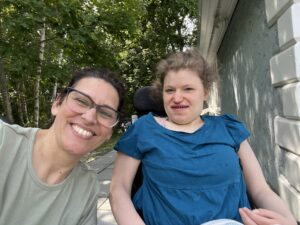 Joanne Huff comes to Courageous Parents Network as a long time follower and parent enthusiast of the organization. As the Mother of two girls, the oldest of whom has the rare disease MPS IIIA/Sanfilippo Syndrome, Joanne has benefited tremendously from the intimate parent interviews and candid, vulnerable story sharing throughout numerous thought provoking blog posts. As her daughter’s activities and lifestyle started to slow down with disease progression, CPN became a larger anchor in times of uncertainty and unrest. It is through this lens that Joanne hopes to share experiences and insights via the CPN blog.
Joanne completed nursing school after her daughter’s diagnosis, receiving her Bachelors of Science in Nursing from Plymouth State University, Plymouth NH. She enjoyed community liaison work with home care providers of adults with special needs up until her own daughter’s care became increasingly more involved. In addition to serving on the Boards of New England Regional Genetics Group (NERGG) and Adaptive Sports Partners through 2024, she has found great purpose in volunteer work advocating for policy improvements and change in Washington DC with the National MPS Society. In her free time, Joanne seeks balance and refuge with yoga, hiking and performing as an ensemble Soprano vocalist with the Pemigewasset Choral Society. When not blogging for CPN, Joanne enjoys sharing offerings on her personal Blog Folding Origami for God. She resides in Bow New Hampshire with her two daughters, Sasha and Nika, her husband Mike and her yellow lab Suki.