

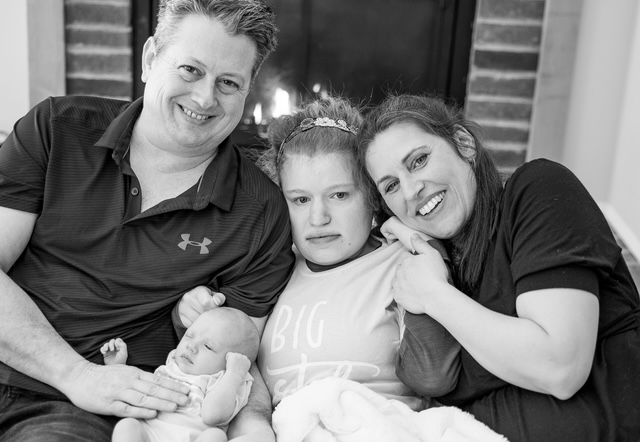
I was certainly late to the party. It wasn’t the first time, but this particular soiree had consequences. Some doors don’t stay open forever. Too late, and you don’t just miss the moment, you lose the chance entirely. And that finality, that reality, could really sting.
For me, the “party” would be having another child. I experienced a decades-long internal debate of whether or not to expand our family after Sasha. During the years that it was more or less expected of me by society to be growing our family, many well intended individuals asked, “Do you plan on having another one?” My answer never needed much prompting. No, I did not intend on having more children.
Sasha has a rare genetic condition known as Sanfilippo Syndrome. From logistical to emotional, there were a wide range of reasons why Sasha should remain an only child. Primarily, as someone who tends to be mentally scattered in many different directions, it felt like an insurmountable task to add an additional individual who would be dependent on me for their survival and wellbeing. I felt capable and competent in caring for Sasha, because it was solely Sasha. There was a balance in the scheduling, transporting, caring for and worrying about one child. Any hiccups or new medical events weren’t as overwhelming because I did not have another individual to schedule, transport, care for or worry about.
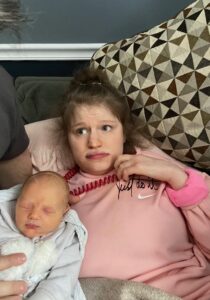 There were other reasons too. Namely the realization that bringing another individual into the world meant that a child, however young and tender, would ultimately endure the death of their sibling. Despite having no idea who this imaginary child might be, it absolutely broke my heart just thinking about that scenario. If I could minimize the rippling effect of that loss – let it end with me and Sasha’s dad – perhaps that would be one small victory in an avalanche of sadness.
When Sasha was three years old, her dad and I split up. Two years later, when I met my now husband, I told him that I did not intend on having more children. That declaration of decisiveness gave me a sense of control. This also meant I could dodge the guilt-ridden feelings I knew awaited me if I was not completely dedicated to solely Sasha. He understood my position, though I’m not sure he held it himself; and so we moved through life for a few years without concerns about family planning.
Sasha’s diagnosis was discovered during this time, which had me doubling down on my position. Sanfilippo Syndrome is autosomal recessive, only resulting from two copies of a faulty gene, each inherited from a parent. The fact that my second husband did not have this faulty gene erased the concern of having another child with the same condition. Any child with my second husband would only have the possibility of being a carrier of the condition, as I am. Regardless, I had chosen to avoid all potential outcomes, and simply care for Sasha.
But something happened when I turned forty. We had just bought a home and were settling into a rhythm, when my husband suggested we start a family. I was stunned. Yet for some unknown reason I thought, “Why not?” I was forty after all, and I knew the chances of getting pregnant were low. When I got pregnant, I was stunned once again, and then even more so by the rollercoaster of an early miscarriage mere weeks later. How sad the whole ordeal actually made me was what shocked me most of all. What if I had been wrong all along? I was being practical all those years, adamantly insisting that one child was manageable. What if, in my pragmatic attempt to control the outcome of loss for another sibling, I had lost sight of the fact that none of us can really control any outcome? I realized I might miss the party, while maintaining my calmer, cleaner, simpler calendar.
In that brief conversation initiated by my husband, we changed course and fully committed ourselves to expanding our family. After struggling to get pregnant a second time naturally, the harrowing and complicated journey known as in vitro fertilization (IVF) began. We had been given low teen percentile success rates with each IVF cycle. By age forty-two I’d had two failed rounds of reproductive endocrinology interventions and was encouraged by my provider to consider other options. We were at the end of the road – a road I wasn’t so sure I should be on in the first place; but one I so desperately wanted to return to only to learn that all the on-ramps had closed. After two years of evaluating the myriad of emotions that come with closing a door to what could have been open if I’d been punctual, I finally shut that door for good. I was back to my original plan. Sasha would not have a sibling to change her life’s balance. We would not feel the burden of juggling too much, and a sibling would never know the pain of losing Sasha. It all finally made sense. A full circle closed, and I felt a sense of restored peace.
I wish I could adequately convey my shock then when I found out I was pregnant the day after my 45th birthday. My birthday itself started out pleasant enough – sunshine blazing, vibrant summer greens around our front porch and clear, electric blue skies. Yet I did not know why I felt so incredibly off. I forced myself to go for my usual run, despite my feet feeling like cinder blocks. I made myself finish my morning coffee, even though it brought little joy. I ate voraciously, yet had no interest in a celebratory birthday margarita that night. It was all so atypical. The next morning, when my morning coffee was still incredibly unappealing, it gave me reason to pause. There was no way… was there? I was far too old at this juncture, but what else could it be? The mere idea of a pregnancy test felt slightly embarrassing, but I still had some (very expired) test sticks from the IVF chapter a few years before. The strip immediately came back positive. What an ugly joke. I recalled the spreadsheet of success rates given to me in an educational IVF brochure a few years back. At forty-five, I now had a paltry 3-5% chance of a “live birth” resulting from a natural conception. There was no way this would be successful.
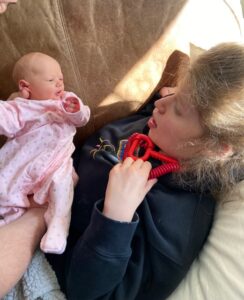 Despite the nine-month saga of a high risk geriatric pregnancy during a pandemic, lo and behold a 6 lb. 14 oz. baby girl was born via cesarean section on February 27th 2021. It is difficult to encapsulate that day, or those weeks or months that followed. The adjustments, the worries, being a novice all over again. Not knowing what milestones to expect with a healthy, typically developing baby. Was she in fact a healthy, typically developing baby? What I did know was that having the choice taken out of my hands was perhaps the only way for this newly expanded family to ever launch.
We are five years in, and I can now say what an extraordinary thing it has been to get to hear one of my children call me “Mommy.” Nika’s health has offered some healing. And yet, I now experience anticipatory grief for Nika. I am fearful about the day when she learns her sister has a terminal diagnosis. I wonder how she will learn that news. I feel in my heart that she should learn that revelation from me. While I am forthcoming answering Nika’s questions, such as why Sasha no longer does something she sees her once doing in an old photograph, I am not sure if Nika senses what that foreshadows. I have not yet broached the issue of Sasha’s impending mortality.
Fellow rare disease moms I have spoken with have, understandably, varying viewpoints on how and when to bring this topic up with a sibling. Some chose to let it develop organically, others opted to be proactive and initiate the discussions. Genetic counselors and palliative care providers are a tremendous resource as we approach these discussions. No choice is wrong. As long as we can be honest with ourselves, then I think we’re doing right by our children.
In this burgeoning era with Nika, I live in an entirely new world, as does Sasha. I see how much of a priority Nika has become, and I witness daily how Sasha is often second in line in my attention. I am hyperaware that these past five years would have looked so different for Sasha had we remained on the original path. But I am also aware of the energy and joy Nika has brought into Sasha’s world – this tiny powerhouse who performs dance routines, gymnastics shows, and belts out “let it GOOOO” for her every single day. I am in awe of how much Nika loves the beauty of trees, just like Sasha always has. I can still envision Sasha, at the onset of each spring, gazing up at the branches high above her. In my memories, she is beaming, smiling so broadly. Today, Nika asked me to pull the car over to the side of a tree-lined road so she could actually hug one. They have shared love, facial expressions and a shared language, even without words. Yes, it is hard, every day – the scheduling, transporting, caring for and worrying about two dependent children instead of just one. One child is medically complex and deserves more from me than I can always give her. The other I so deeply wish could play with her sibling the way the neighborhood kids play with theirs. I hope that none of us will ever have to endure the loss of Sasha. But every day leading up to that inevitable day, and all the days before it and after it, I will feel lucky that there was more love than I knew how to plan for, that our family grew beyond what I thought I could hold.
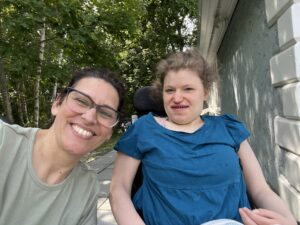 Joanne Huff comes to Courageous Parents Network as a long time follower and parent enthusiast of the organization. As the Mother of two girls, the oldest of whom has the rare disease MPS IIIA/Sanfilippo Syndrome, Joanne has benefited tremendously from the intimate parent interviews and candid, vulnerable story sharing throughout numerous thought provoking blog posts. As her daughter’s activities and lifestyle started to slow down with disease progression, CPN became a larger anchor in times of uncertainty and unrest. It is through this lens that Joanne hopes to share experiences and insights via the CPN blog.
Joanne completed nursing school after her daughter’s diagnosis, receiving her Bachelors of Science in Nursing from Plymouth State University, Plymouth NH. She enjoyed community liaison work with home care providers of adults with special needs up until her own daughter’s care became increasingly more involved. In addition to serving on the Boards of New England Regional Genetics Group (NERGG) and Adaptive Sports Partners through 2024, she has found great purpose in volunteer work advocating for policy improvements and change in Washington DC with the National MPS Society. In her free time, Joanne seeks balance and refuge with yoga, hiking and performing as an ensemble Soprano vocalist with the Pemigewasset Choral Society. When not blogging for CPN, Joanne enjoys sharing offerings on her personal Blog Folding Origami for God. She resides in Bow New Hampshire with her two daughters, Sasha and Nika, her husband Mike and her yellow lab Suki.