

There doesn’t seem to be a word to describe what it feels like for a parent to first hear the name of their child’s diagnosis. I tried to name the feeling – catastrophic, devastating, scary.
None of these terms fully encapsulates the experience; the way the name of the disorder stuns and disorients. What word describes what it feels like to live inside a snow globe that is suddenly and violently lifted and shaken relentlessly?
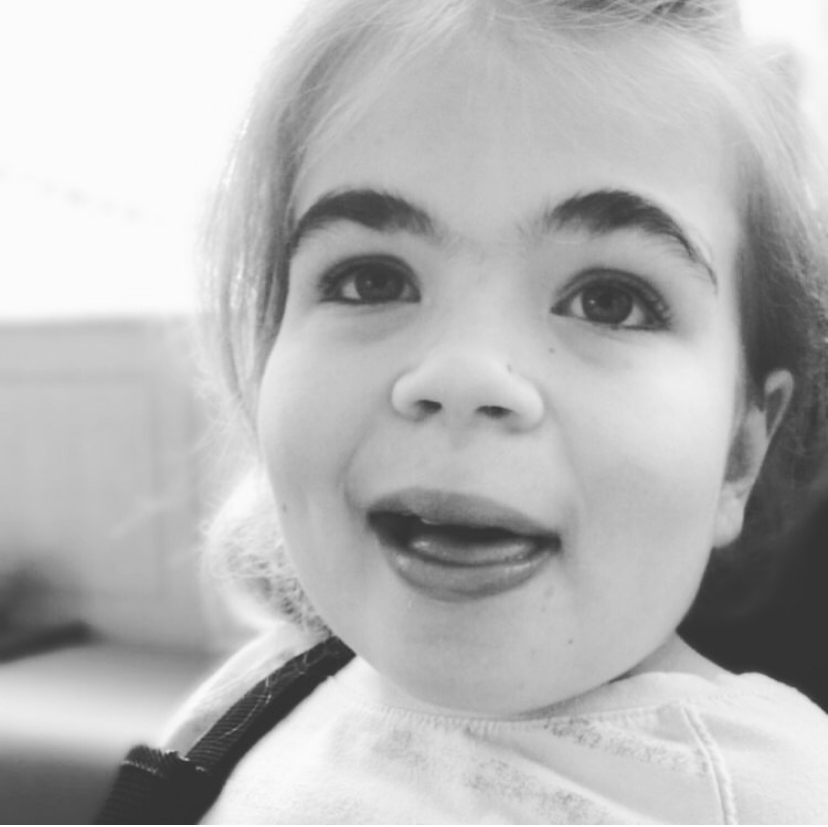
My blonde-haired, round-faced, full-smiled, running-never-walking, 3-year-old Anni couldn’t possibly be the bearer of such a complicated term like “mucopolysaccharidosis.” She could easily navigate a playground, a dinner plate, and a preschool classroom. How was she going to navigate a disease that would relentlessly steal her skills, leaving seizures and a feeding tube as a consolation prize?
I didn’t know on that diagnosis day – the day I sat on my living room floor hearing the words, “Don’t Google it” – how much would be asked of our family. I only knew enough to be terrified and heartbroken, stuck on a repeating loop: How? How? How? How would I ever be okay again? How would I make a life for her that wasn’t a downward spiral of hopelessness? That day, it felt like someone pressed the diagnosis into my hand, and I knew that I would never put it down.
When I learned about my daughter’s diagnosis, I also discovered how much I had quietly and automatically assumed on the day I found out I was pregnant about what her life would be like. I expected sleepovers. I expected school plays. I expected late nights introducing her to movies that I grew up with. I expected teenage years of eye rolling and slammed doors. I expected broken curfews and negotiations about borrowing the car. I expected a normal amount of heartbreak. I expected to live longer than her. I didn’t expect to hear “mom” a limited number of times. I didn’t expect to have to thicken water in her sippy cup, so it wouldn’t leak into her lungs. I didn’t expect to have to carry her when she was a teenager. I didn’t expect I would change her diaper beyond 3 years old.
What do I wish I had known in those early days after her diagnosis? What did I need that I couldn’t find on Google? I already Googled what the disease meant for her. What I didn’t know – what I wanted to look up – was whether I would be able to handle it all. If I were sitting on the other side of that question, answering my 28-year-old self, staring at a brand-new diagnosis, here’s the most honest answer I could give to this question:
Am I going to be okay?
Answer: No. Then yes. Then no, no, no. Then yes again.
A huge part of grieving Anni’s diagnosis and the life I thought we would have together was acknowledging that this type of thing happens, and happens often. Terminal diagnoses are not rare. Even rare diseases are not rare in the grand scheme of human suffering. A mother losing a child is not actually that unusual. I had to grieve that an uninterrupted cosmic “yes” is not something any of us are promised.
I remember sitting with Anni after she had lost most of her speech. We snuggled and stared into each other’s eyes, without words, for what felt like forever. And in that moment, nothing needed to be different – not her diagnosis, not what was coming. The grief was there, and the love was there, and they were the same thing. We were just two people looking at each other.
I didn’t expect this life to be so full of love. I didn’t expect that caring for her body would be more than changing diapers. I didn’t expect the people I would meet who would work very hard to make her life full of good experiences and meaningful inclusion. I didn’t expect to become part of a community that intentionally turns their heartbreak into positive action. I didn’t expect such an expansion of joy.
My perspective on joy isn’t about putting a positive spin on things or hunting down a silver lining. It’s not “just focus on the positive” messaging because doctor appointments, IEPs, and a DNR can be relentless, exhausting, and sorrowful – they are always there. If we focus only on the positive, it would be like looking at our life through a pinhole. I don’t want a pinhole, I want a wide-eyed, courageous panoramic view of it all.
In the 14 years since her diagnosis, I’ve learned that moments of joy are not few and far between. They’re not moments that are meant to sustain you until the next heartbreak. They’re not moments of reprieve in a long line of disappointments and frustrations. What I slowly learned is that living a full life means viewing all moments with equanimity. The dark and luminous alike are necessary for the full human experience. None of us gets through life unscathed, but the gift of living goes to those who learn to invite in both the prickly and effervescent – to sit with them, to listen, to let them stay for a while.
Remember the word I was looking for to describe receiving a diagnosis? Maybe it’s tricky to find that word because the experience itself is so complex. Maybe it’s a word that can only be written with hindsight.
So I invented one:
Excruliance
excruliance (ek-skroo-lee-əns) noun, excruciating + radiance
The simultaneous experience of devastation and illumination; the overwhelming, clarifying, heartbreaking, and ecstatic feeling that arrives when a moment is too vast for any single emotion to contain. Often felt when love and loss become indistinguishable from one another.
“The diagnosis did not destroy her — it arrived with an excruliance she would spend years learning to name.”