

In 1981, when she was five months old, my older sister Heidi was diagnosed with a rare condition called microcephaly. This condition can cause developmental delays, intellectual disabilities, challenges with movement and balance, difficulty eating and swallowing, and vision or hearing loss. Heidi died in 1993 from complications related to microcephaly.
As Heidi’s younger sister, born two years after her, she was simply normal to me. She was my first friend, and we always found ways to play and interact. This was no doubt in large part because I witnessed my parents’ kindness, care and unconditional love for her.
Our parents were young, just out of college, when they had Heidi, their first child. When I asked my parents about the day they received Heidi’s diagnosis, my dad said his overwhelming feeling was that everything would be okay.
 He reflected, “This is our daughter; this is just who she is. I don’t remember being devastated. We didn’t know any different. She was the same person that day as she was the day before when we didn’t know. I don’t feel like it changed how I thought about her or the way I considered her.”
He also shared that many people would pity them and say, “You poor thing, this is awful.” They would imply that she was somehow less than whole.
But my dad did not share those feelings.
He thought, “How is having remorse or pity going to help anything? Heidi needs to be fed, she needs her diaper changed. What are we going to do to help her learn and grow? That’s what I focused on. Action is a form of absorbing the news. It’s empowering. Pity is not empowering.”
Various specialists intimated that our parents could care for Heidi at home while she was young, but they should send her away to live in an institution in the future. The specialists assumed that the amount of care she would require would be too much for them to handle. This was an accepted approach at the time. There were fewer resources available for families to help them keep their loved ones with disabilities at home with them.
With grit and creativity, our parents were able to keep Heidi home, and my mom cared for her day in and day out while my dad attended graduate school and then began a full-time job.
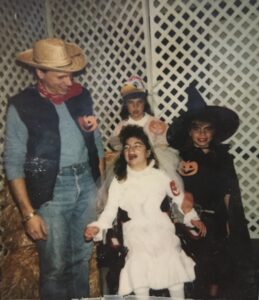
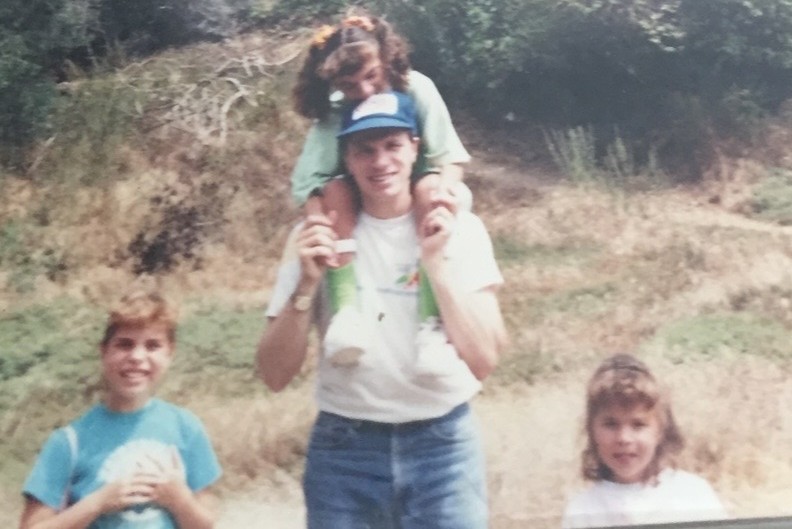
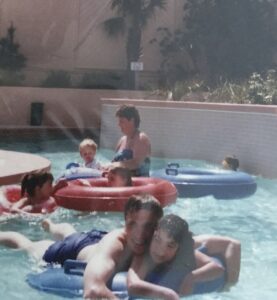
In the evenings, on weekends and on vacations, I remember how Dad was an engaged father, including with Heidi. He took her everywhere. If someplace wasn’t stroller or wheelchair accessible, you could find Heidi on his shoulders, grinning widely, a string of drool falling into his brown hair. He took me, Heidi and our younger sister Mary with him on his weekend errands as well as to places like the pool, the zoo, the library, playgrounds, national parks and historic sites. He took us trick-or-treating, on Easter egg hunts, and to deliver plates of cookies to friends at Christmas. In the years since her passing, these memories of shared tradition and adventure have become a source of joy.
When I was eight and Heidi was 10, Dad had a work trip to New York City, and he brought us with him. His work paid for us to stay in a room on the sixteenth floor of the Plaza Hotel. Dad joked that, “We gave the Plaza Hotel staff a shock when they saw all of Heidi’s equipment.” The hotel staff weren’t used to people with disabilities staying there, but that wasn’t going to deter our dad from including Heidi.
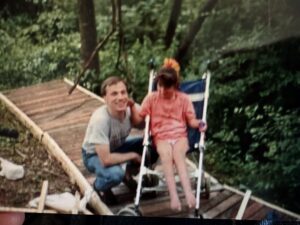
For a few years, we lived in Kentucky with a wooded backyard. Dad helped us build a two-story tree house that would allow Heidi’s wheelchair to go on the first floor. Together with his parents, Grandma Mary and Poppa Cyril, he built a long boardwalk from the grassy part of our backyard to the treehouse, so Heidi’s wheelchair could traverse it. They wanted to be sure Heidi could join me, Mary and our friends at our favorite play spot. We were lucky to have the support of my grandparents; I know not every parent has that kind of help, or understanding, or woodworking skill from extended family as they care for their complex child.
 When I was eight, I became interested in running 5ks with Alan, and Alan included Heidi in these road races by trotting alongside her and helping her drive her electric wheelchair. While the way Heidi was able to participate was often unique to her, my family seemed to always find ways to ensure she could participate, somehow, someway. My mom took on the bulk of Heidi’s intensive day-to-day care and the time- and energy-sucking calls and appointments with physicians, therapists, teachers and insurance companies while my dad was at the office and on work trips. Because of this, I think he had more energy for weekend and summer adventures and projects.
Each summer, we did a road trip to Utah to spend time with each of my grandparents and other relatives in the area. With my mom’s side of the family, we met for a family reunion at a campground. Even though Heidi required a feeding tube and extensive daily care, our parents never hesitated to take her on long car rides, have her sleep in a tent, go horseback riding in the mountains, or swim in a lake. Looking back, I cannot help but think how extraordinarily courageous they were as parents. Caring for a medically complex child at home is challenging enough; this type of adventuring requires an amazing amount of willpower and organization.
At the family reunions, we liked to visit the campground’s ‘sliding rock.’ This was a massive rock that was relatively smooth on one side and people used it as a natural slide. Every year, my cousins and I climbed up some of the small rocks next to the big rock and then slid just part-way down the big rock’s surface. Several times, our dad carried Heidi all the way up to the very top of the big rock and went down it with her on his lap.
The first year he took Heidi down the sliding rock, she was six years old, and one of my aunts captured it on a video tape I found.
“Do you have the guts to go down?” My mom asked Dad as our relatives gathered around the base of the big rock.
“No, I don’t,” Dad chuckled hesitantly, “But Heidi does!”
Mom laughed. Heidi loved to go fast, from being pushed fast in her stroller to going on amusement park rides to traversing down slides at playgrounds.
After a few more seconds of hesitation, Dad pushed off with Heidi on his lap and down they slid. Due to their speed, it took my mom and her dad holding on to each of Dad’s legs at the end to keep him and Heidi from falling onto the ground. Once the movement stopped, we all looked at Heidi whose head was hanging down, her dark brown bangs obscuring her face.
“Was that fun?” Mom signed.
There was a pause as Heidi had her typical delayed reaction, and then she looked up and gave a big grin and bobbed her head joyously up and down.
“Heidi experiences lots of things for a child with handicaps,” our grandpa observed, using the language of the late 1980s.
And she did. She lived a very full life, traveling the country, and participating in many activities. This was possible in large part because my dad believed she could and should experience as much of life as any other child, which was not the typical attitude at the time. It took guts and gumption.
I know many fathers reading this may love their children fiercely while carrying exhaustion, financial strain, grief, health challenges or limitations of their own. Showing up for a medically complex child does not have to look extraordinary to be meaningful. Sometimes it’s attending appointments, learning your child’s cues, making them laugh during a hard day, including them in family traditions, or simply being a calm and dependable presence. What Heidi loved the most was when Dad came home from work and hugged and signed to her and danced around the house with her in his arms. Indeed, paternal love is communicated in ordinary moments over time.
Through thousands of tiny lessons, my dad taught me the importance of inclusion, that every person is valuable, it’s important to have fun, and to love our family members fiercely.
Happy Father’s Day to all the Courageous Dads. Thank you for everything you do!