

Data suggest that 19% of the parenting population is caring for a medically complex child. While small, the number has me considering our common conundrums. For example, we often grapple with finding a comfortable baseline only to chronically wait for it to change. We have an acute awareness of the need to recognize better days for our child and family. And when a downward trend presents, hopes of returning to better days are clung to. A statement shared by triathlete Bruce Campbell, a fellow rare disease advocate diagnosed with Pompe Syndrome summarizes this well, “There’s a constant tension that comes with living with a body that doesn’t always cooperate with your spirit.” As a caregiver, a feeling of helplessness compounds constant tension. It also heightens my grief. I want my daughter to physically be able to do the things she used to. Not only because I miss those experiences with her, but because that loss of ability signifies that we’re getting closer to the finish line.
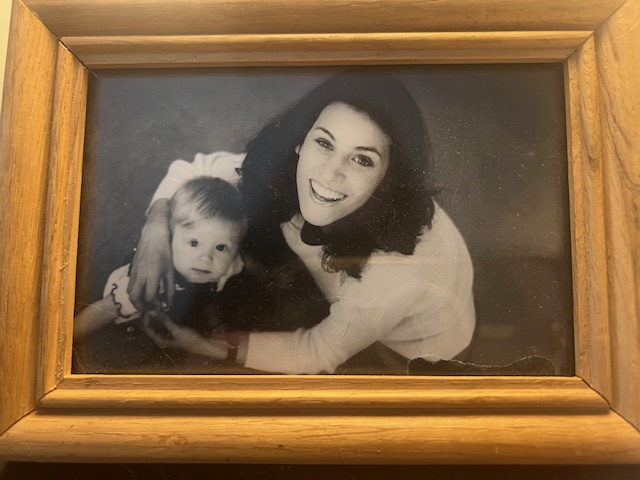
As the regression that is expected from a neurologically degenerative syndrome takes deeper hold in my daughter’s body and in our home, I recognize a phenomenon unfolding like nesting. Often seen in expecting mothers as the weeks of maternity wane, an urge to clean, organize and “nest” settles into the household. Alongside Sasha’s physical body starting to recoil into fetal posturing, her mouth forming sucking gestures when attempting to drink from a straw, and her ability to fall asleep amidst bustling public places, my muscle memory casts me back to her infant years. Pushing a bundled adult Sasha in a wheelchair mirrors infant Sasha going for walks in her stroller decades past. Recently, I am content to find myself painting rooms, rearranging décor, menu planning and keeping up with laundry, reminiscent of preparations for the arrival of a brand-new baby girl. Back when Sasha was born, it was a month before I ventured out into the world. Today, a big outing is a shopping run to gather provisions, then a swift return to the nest where I feel most at ease. A lifestyle such as this is a highly unusual state to find myself content in again. An era of flourishing for me is typically one filled with change, new experiences, new residences, new professional endeavors and frequent travel.
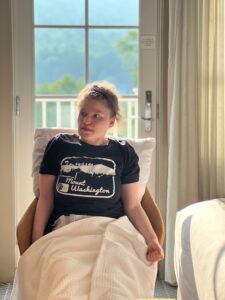 Acceptance of any significant life shift that is not initiated by choice seldom comes easily. Early on clinical trials and research studies into supplements distracted me from acceptance of the realities of Sasha’s diagnosis. Then durable medical equipment to prolong safe eating and standing provided the next ray of hope. Manageable tasks like physical therapy alongside sweeping gestures such as the consideration of relocating to a warmer climate to meet Sasha’s evolving baseline helped me cling to the hope of a return to better days. I didn’t recognize that these actions were, in part, attempts to deny a reality until a dear fellow rare disease mom finally called it out, “Joanne! YOU CAN’T FIX THIS!” I was stunned but not hurt. Those were words I needed to hear. She was so right. I could not fix this. But I wondered, “How could that possibly be?”
Adjustment and adaptation are said to be nuanced responses to any life event that brings forth significant change. Adjustment is a more concrete approach incorporating actions employed to heighten functionality within a new landscape. A new equilibrium is the defined endpoint of adjustment. Adaptation on the other hand, is said to be a more psychological and emotional phenomenon. Here is where capabilities, circumstances and needs are assessed and reframed. Bruce Campbell’s words continue to resurface, “There’s a constant tension that comes with living with a body that doesn’t always cooperate with your spirit.” I live within a state of constant tension. Some of these tensions feel incredibly superficial – like not being able to have a pretty area rug in the living room due to wheelchair maneuverability. Other tensions run deeper and are much darker – like wondering if this could be Sasha’s last Christmas.
When Sasha was approaching sixteen, her neurologist sat me down to delicately segue the discussion to my quality of life alongside Sasha’s. He asked if I considered the longevity of Sasha’s care as she approached chronological adulthood. At the time, there was no apparent decline to Sasha’s physical presentation on the horizon, and he felt we had a long road ahead. He thought that residential care might be something worth considering. I was taken aback. I would never sleep a restful night knowing that Sasha was in a bed outside of our shared home. It is only now that I realize he was hoping to get me to simply make adjustments. Many years later, I now recognize why research is delving into a phenomenon identified so often by study participants: the continual attempts to reconstruct lives to accommodate an illness. The emotional component of a decision like considering residential placement for Sasha is something nearly impossible to convey and I am not sure if any amount of adjustment or adaptation would ease the tension. Because in truth, something even larger looms. Acceptance it turns out, has been my true Achilles.
Acceptance is defined as the action of consenting to receive or undertake something offered. In medically complex parenting scenarios, an additional parenting responsibility has been bequeathed. It’s as though a medical, emotional, physical and spiritual reality has been bestowed upon us and there is no longer, or maybe never was, contact with the originator who passed it down to us. I have long accepted that I will likely never find a satisfactory answer to the “why” question. Why should an innocent child suffer and endure symptoms that combine ALS and Alzheimer’s all in one? How frightening must it be for Sasha to be so impacted by developmental delays that she cannot express her experiences and hardships? Why was I entrusted to walk this path and care for someone that special? Am I honoring Sasha’s spirit as I care for a body that doesn’t always cooperate with it? When I look back on conversations with hundreds of rare disease families over the past 20 years, I often recognize that acceptance is hard to find. I will forever miss walking with Sasha through the halls of her vast medical center to admire the colorful mobiles in the sweeping halls. I will always be aware that my body is pushing her in a wheelchair as opposed to walking shoulder to shoulder, hand in hand. With each delivery of g-tube formula and feeding bags, I will always mourn shopping for her favorite foods – avocados, bananas, sweet potatoes. Just yesterday I put the blender away for good. Stored it in a forgotten cupboard with no plans to ever see it again. How does one accept any of this?
“There’s a constant tension that comes with living with a body that doesn’t always cooperate with your spirit.” We can adjust, adapt, reframe and retool. But to accept should perhaps never be an expectation, only something to strive for. As I continue to nest, I suspect there will be more to explore.
Citation:
https://psychology.town/psychosocial-issues-in-disability/stages-adaptation-adjustment-disability/
https://pmc.ncbi.nlm.nih.gov/articles/PMC11506064/
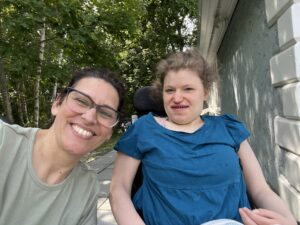 Joanne Huff comes to Courageous Parents Network as a long time follower and parent enthusiast of the organization. As the Mother of two girls, the oldest of whom has the rare disease MPS IIIA/Sanfilippo Syndrome, Joanne has benefited tremendously from the intimate parent interviews and candid, vulnerable story sharing throughout numerous thought provoking blog posts. As her daughter’s activities and lifestyle started to slow down with disease progression, CPN became a larger anchor in times of uncertainty and unrest. It is through this lens that Joanne hopes to share experiences and insights via the CPN blog.
Joanne completed nursing school after her daughter’s diagnosis, receiving her Bachelors of Science in Nursing from Plymouth State University, Plymouth NH. She enjoyed community liaison work with home care providers of adults with special needs up until her own daughter’s care became increasingly more involved. In addition to serving on the Boards of New England Regional Genetics Group (NERGG) and Adaptive Sports Partners through 2024, she has found great purpose in volunteer work advocating for policy improvements and change in Washington DC with the National MPS Society. In her free time, Joanne seeks balance and refuge with yoga, hiking and performing as an ensemble Soprano vocalist with the Pemigewasset Choral Society. When not blogging for CPN, Joanne enjoys sharing offerings on her personal Blog Folding Origami for God. She resides in Bow New Hampshire with her two daughters, Sasha and Nika, her husband Mike and her yellow lab Suki.